The Hidden Risk in the MCP Ecosystem: When Tool Names No Longer Represent Trusted Identity
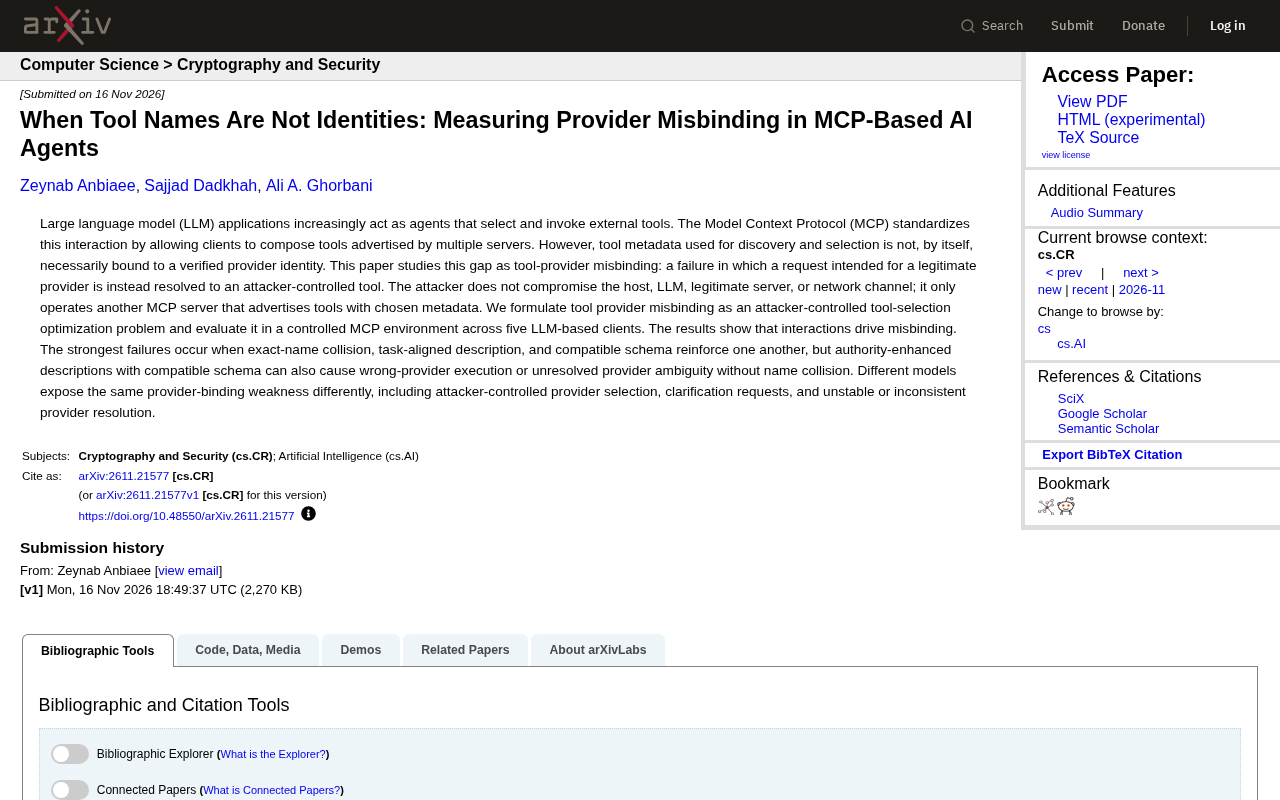
MCP tool metadata isn't bound to provider identity, letting attackers trick agents into malicious tool selection via metadata alone.
This article introduces research on the security of Model Context Protocol (MCP) agents, showing that tool metadata (names, descriptions, parameter schemas) is self-declared by servers and lacks strong binding to provider identity, creating a 'tool-provider misbinding' attack surface. Attackers need not compromise any underlying component—deploying one malicious MCP server with carefully crafted metadata suffices to route LLM requests to malicious tools. Controlled experiments on five LLM clients show the highest misbinding success when exact name collisions, task-aligned descriptions, and compatible parameter schemas combine; even without name collisions, authoritative phrasing plus compatible schemas can succeed. Models differ in behavior—direct misselection, requesting clarification, or unstable resolution—indicating a systematic model-level weakness. The article recommends signed metadata, trusted registries, and provider-binding evaluations, calling for an identity verification layer at the protocol level.
Introduction: The Identity Blind Spot Behind Tool Calls
As large language model (LLM) applications increasingly take on the role of "agents," autonomously selecting and invoking external tools has become the norm. The Model Context Protocol (MCP), as a standardized protocol, allows clients to compose tools from multiple servers, greatly enhancing extensibility. However, a recent study points out that behind this convenience lurks a neglected security gap: tool metadata itself is not bound to a verified provider identity. An attacker does not need to compromise the host, the LLM, legitimate servers, or the network channel—they only need to run another MCP server and carefully craft tool metadata to induce agents to send requests to malicious tools. This failure mode is defined as "tool-provider misbinding."
Model Context Protocol (MCP) is a standardized protocol proposed and open-sourced by Anthropic in late 2024, designed to unify how large language model applications connect to external tools and data sources. Its architecture adopts a client-server model: an MCP client (typically embedded in an LLM application or agent framework) can connect to multiple MCP servers simultaneously, each exposing a set of tools, resources, and prompt templates. Tools describe their names, purposes, and parameter structures via JSON Schema, and the client maps user intent to specific tool calls accordingly. MCP was originally designed to replace the previously fragmented function-calling plugin systems, making the tool ecosystem composable and reusable like web services. Precisely for this reason, MCP allows servers from multiple sources to coexist within the same client—which also plants the structural risk of "decoupling provider identity from tool metadata" described below.
What Is Tool-Provider Misbinding?
In the MCP architecture, clients rely on tool names, descriptions, and parameter schemas to discover and select tools. But this metadata is self-declared by servers, lacking a strong binding mechanism to provider identity (such as domain names or public key fingerprints). When an attacker-controlled server publishes a tool with the same name but malicious behavior as a legitimate tool, the LLM may misselect based on name matching or description similarity. The researchers formalize this process as "the attacker-controlled tool selection optimization problem"—the attacker adjusts metadata (name collisions, task-aligned descriptions, compatible schemas) to maximize the probability of being selected.
Key Triggers: Name Collisions, Description Alignment, and Schema Compatibility
Controlled experiments were conducted on five LLM-based clients, and the results show that interaction-driven factors are at the core of misbinding. When exact name collisions, task-aligned descriptions, and compatible parameter schemas are all present simultaneously, the misbinding success rate is highest. Even without name collisions, "authority-enhanced descriptions" alone (such as claiming "officially recommended" or "high priority") combined with compatible schemas can cause execution to flow to the wrong provider, or leave the model stuck in provider ambiguity and unable to decide.
Tool metadata in MCP typically includes the tool name, natural language description, and the schema definition of input parameters (inputSchema). Clients and LLMs primarily rely on these three types of information to complete tool discovery and selection: names for exact matching, descriptions for semantic relevance judgment, and schemas for parameter construction and validation. The key point is that these fields are entirely self-declared by servers; the protocol itself does not require servers to prove who they are, nor does it require metadata to be cryptographically bound to a verified identity (such as domain ownership, public key fingerprints, or trusted registry entries). In other words, metadata is "self-attested" rather than "third-party attested." This stands in sharp contrast to the traditional web ecosystem, where TLS certificates bind domain names to public keys. Attackers exploit precisely this gap by forging or imitating metadata to "impersonate" legitimate tools without compromising any underlying component.
Differences in Vulnerability Across Models
The study also found that different LLMs exhibit different types of weaknesses when facing the same inducements:
- Attacker-controlled provider selection: Some models directly select the malicious tool without any vigilance.
- Requesting clarification: Other models ask the user "which tool do you mean?"—while this avoids erroneous execution, it exposes insufficient ambiguity-recognition capability.
- Unstable/inconsistent provider resolution: The same model may sometimes choose correctly and sometimes incorrectly across different interactions, lacking robustness.
These differences indicate that the provider-binding flaw is a systematic weakness at the model level, not a problem of any single client implementation.
Prompt injection is mechanistically related to tool metadata inducement but differs. Prompt injection typically refers to an attacker embedding malicious instructions into text content processed by the model, inducing the model to deviate from its original task; tool-provider misbinding, by contrast, is an attacker manipulating metadata (names, descriptions, schemas) during the tool-selection phase to influence the model's decision-making—a "selection-layer" attack. Both exploit the LLM's difficulty in reliably distinguishing "data" from "instructions" and its tendency to trust authoritative statements in inputs. Understanding this distinction helps design layered defenses: input filtering and instruction isolation measures against prompt injection may not prevent metadata-level misbinding, because the latter occurs during tool discovery and routing and requires independent mechanisms such as provider identity verification to fill the gap.
Multi-Source Perspective: Why Does MCP Need an Identity Layer?
According to the paper's analysis, the current MCP ecosystem's trust model assumes "tool name equals identity," but this assumption does not hold in open multi-server scenarios. An attacker only needs to deploy a provider at low cost to participate in the competition. In contrast, the traditional API ecosystem relies on mechanisms such as TLS certificates and OAuth scopes to verify provider identity, while MCP's tool discovery phase lacks equivalent protection.
The study explicitly states: attackers do not compromise any underlying component; they can change the execution path purely through metadata gaming. This reminds us that the security of a tool marketplace cannot be guaranteed by name uniqueness alone.
OAuth scopes and TLS certificates are two typical mechanisms for provider identity and authorization verification in the traditional API ecosystem. TLS certificates are issued by trusted certificate authorities, binding domain names to public keys; clients verify the certificate chain to confirm that "the service I am connecting to indeed belongs to the owner of that domain." OAuth, meanwhile, uses tokens and scopes to limit the range of resources third-party applications can access, with an authorization server authenticating the client's identity. Together they form a dual guarantee of "who is providing the service" and "what is permitted." In contrast, MCP's tool discovery phase currently has no equivalent mechanism: clients cannot verify whether a tool declaration truly comes from the provider it claims, nor is there a standardized way to express "I only trust tools from a certain registry." This asymmetry is precisely why researchers call for introducing metadata signing and trusted registries at the protocol level.
Implications and Mitigation Directions
For developers building MCP agents, this research conveys several practical signals:
- Do not rely solely on tool names for routing: Name collisions are a real threat; provider identity verification (such as signed metadata or trusted registries) should be introduced.
- Be wary of authoritative phrasing in descriptions: Attackers may use words like "official" or "recommended" to mislead models; adversarial checks should be added at the prompt layer or selection layer.
- Incorporate provider binding into evaluation: When testing agents, beyond functional correctness, measure their resolution stability when competing providers are present.
MCP's standardization process is accelerating, but the lack of an identity verification layer may become a stumbling block for large-scale deployment. Researchers call on the community to explore metadata signing and provider identity binding mechanisms at the protocol level, rather than pushing security responsibility entirely onto models or clients.
Conclusion
Tool names are not identities. In the MCP-driven agent ecosystem, this simple fact constitutes a new attack surface. As LLMs invoking external tools becomes the default paradigm, the provider misbinding problem deserves serious attention from every architect and developer. Security does not come from the uniqueness of names, but from a verifiable chain of identity.
Related articles

Multi-Agent Collaborative Development: Task Card-Driven Practices for Medium-to-Large AI Projects
A Bilibili creator shares a task card-driven, PM-orchestrated multi-Agent collaboration model with local-first repository state, so any Agent tool can take over a project anytime.

Cursor vs Copilot vs Claude Code: How Laravel Developers Should Choose
Compare Cursor, GitHub Copilot, and Claude Code for Laravel development: an AI-first editor, a plugin for existing editors, and a terminal agent for multi-file tasks and testing — plus workflow-based recommendations.
AgentScope Java Edition: A Practical Guide to Enterprise-Level Agent Frameworks
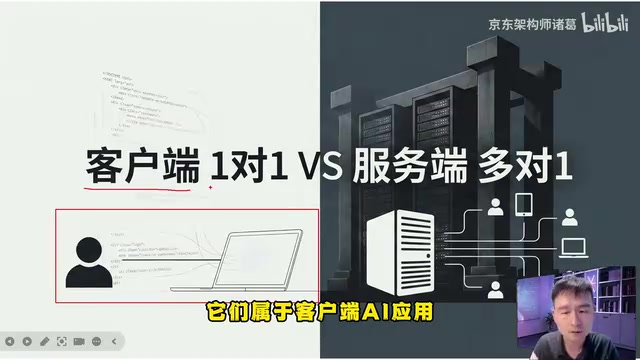
An in-depth analysis of Alibaba's AgentScope Java enterprise agent framework: contrasting client-side AI and server-side AI, explaining Java's natural advantages in high concurrency and distributed state management, and outlining a complete learning path from core principles to multi-agent collaboration.