The Induction Head Mechanism Behind SLAM-ASR Speech Recognition

SLAM-ASR uses induction heads in a frozen language model to perform speech-to-text mapping.
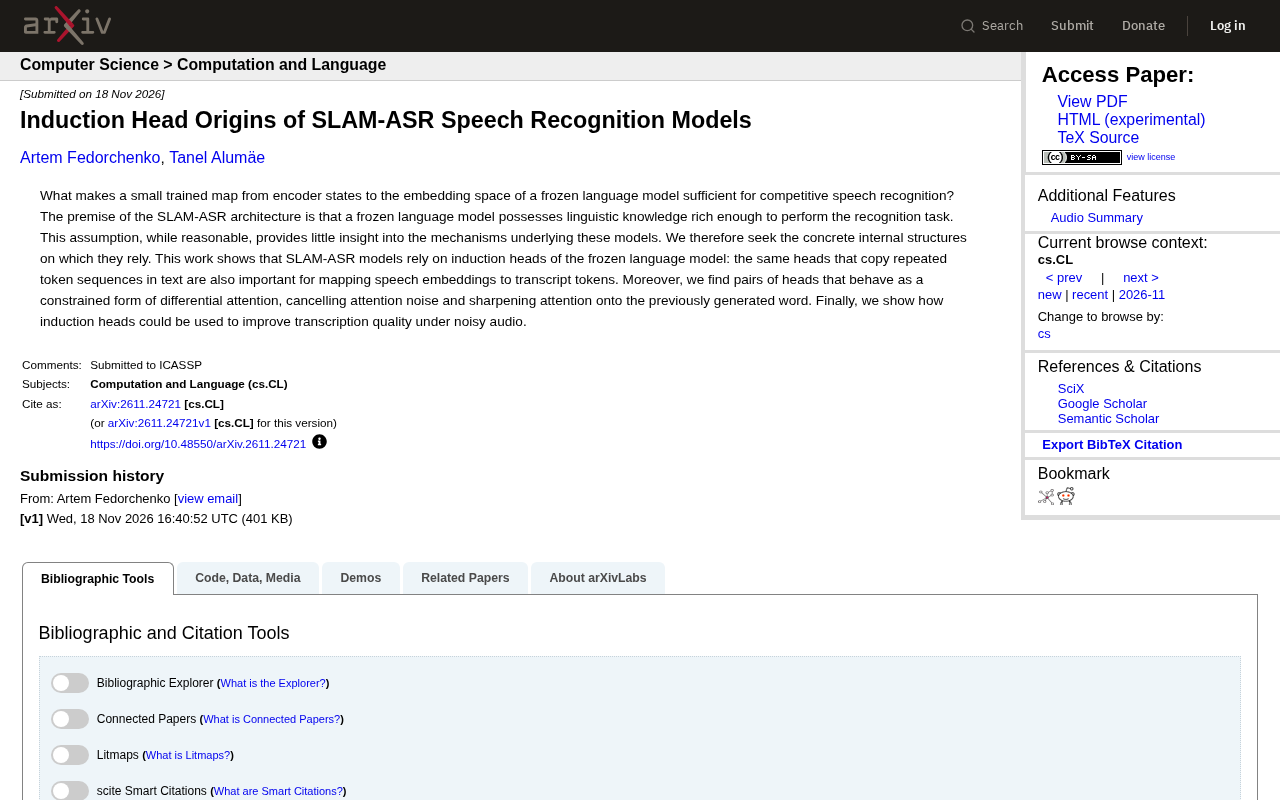
This article interprets a study on SLAM-ASR's internal mechanisms. SLAM-ASR trains only a small mapping layer to align speech encoder outputs to a frozen language model's embedding space. The study finds that its performance critically depends on the language model's existing induction heads—attention heads originally used to copy repeated text sequences, now repurposed to map speech embeddings into transcription tokens, turning speech recognition into a generalized sequence-copying task and explaining why a small mapping layer suffices. A pair of attention heads also exhibits restricted differential attention behavior, suppressing irrelevant attention noise and sharpening focus onto the previously generated word. The study further suggests that guiding induction heads can improve transcription quality in noisy environments and provides a basis for parameter-efficient multimodal architecture design and interpretability debugging.
Introduction: Why Can a Small Mapping Achieve Strong Recognition?
The core premise of the SLAM-ASR architecture is that a frozen language model already possesses sufficiently rich linguistic knowledge to perform speech recognition. Therefore, only a small trainable mapping is needed to align encoder states to the language model's embedding space. Although this assumption is reasonable, it fails to reveal which specific structures the model relies on internally.
A recent study probes the internal mechanisms of SLAM-ASR and finds that its performance critically depends on induction heads in the frozen language model—attention heads originally responsible for copying repeated token sequences in text, now repurposed as the core component that maps speech embeddings to transcription tokens.
SLAM-ASR (Speech Language Model for Automatic Speech Recognition) is a class of parameter-efficient speech recognition architectures that has emerged in recent years. A typical approach connects a pre-trained speech encoder (such as a Whisper encoder or wav2vec 2.0) with a frozen large language model through a lightweight mapping layer, training only the mapping layer to perform recognition. In contrast, traditional end-to-end speech recognition usually requires fine-tuning the entire acoustic model or language model. Representative SLAM-ASR work includes systems built on decoders such as Llama and Qwen, which update very few parameters on large-scale speech-text pairs and still achieve results close to full fine-tuning. Therefore, "why a small mapping suffices" becomes a key question for understanding this class of architectures.
Induction Heads: From Text Copying to Speech Mapping
Induction heads are a special class of attention heads in language models that can detect repeated patterns and copy subsequent tokens. In pure text tasks, this ability manifests as follows: when a sequence contains "A B ... A", the induction head predicts the next token to be B.
This study shows that SLAM-ASR models borrow exactly this mechanism. After the speech encoder outputs an embedding sequence, the induction heads match it against the already generated transcription tokens, thereby guiding the language model to output the correct text. In other words, speech recognition is transformed into a generalized sequence-copying task, and induction heads happen to excel at exactly that.
This finding explains why a small mapping layer is sufficient: the mapping layer does not need to learn complex acoustic-linguistic correspondences; it only needs to "disguise" speech features as token patterns that the language model can recognize, and the induction heads do the rest.
Induction heads were first systematically characterized by the Anthropic team in their 2022 circuit analysis research and are regarded as a core circuit for in-context learning in Transformers. Their typical structure involves two attention heads working together: the former "previous-token head" writes information about tokens that appeared earlier in the context into specific positions, and the latter "induction head" then uses this to match the current token and copy what follows it. Researchers locate such heads through attention pattern scoring, activation patching, and ablation experiments. The existence of induction heads explains why a model can perform new tasks from examples in a prompt without gradient updates—this aligns closely with the assumption that SLAM-ASR borrows a frozen language model to perform speech mapping.
Differential Attention Pair: Suppressing Noise and Sharpening Focus
In addition to induction heads, the study also identifies a pair of attention heads that exhibit a restricted form of differential attention behavior. These two heads work together: one focuses on relevant parts of the context, while the other suppresses irrelevant attention noise.
Specifically, this pair of heads can cancel out interfering components in the attention distribution and sharpen attention onto the previously generated word. This mechanism is crucial for maintaining transcription coherence, especially when the speech signal is ambiguous or contains background noise.
Differential attention is not an entirely new concept, but this is the first time it has been observed in SLAM-ASR models in such a specific form. It reveals how the model achieves more precise attention focus without increasing the parameter count.
Differential attention is a mechanism that eliminates noise by subtracting two sets of attention maps. Its idea can be traced to work such as Differential Transformer: queries and keys are split into two groups, attention distributions are computed separately and then subtracted, so that shared interfering terms cancel each other out and only the truly discriminative signal remains. Unlike standard softmax attention, which tends to spread probability mass across irrelevant tokens, differential attention can achieve sharper focus with lower head dimensionality. The "pair of attention heads exhibiting a restricted form of differential attention" described in the article refers to collaboration and cancellation between two independent heads at the output level, rather than an explicit differential design within a single head—hence the term "restricted form."
Using Induction Heads to Improve Transcription Quality in Noisy Environments
The third contribution of the study is to show how induction heads can be used to improve transcription quality on noisy audio. Since induction heads are responsible for pattern copying, enhancing or guiding the attention patterns of these heads may allow the model to more robustly capture the linguistic structure in speech under noisy conditions.
Although the original text does not provide specific performance improvement numbers, this direction offers a new approach for optimizing the robustness of speech recognition systems: rather than retraining the entire model, one can specifically adjust the attention behavior of induction heads.
Implications for Speech Recognition Architecture
The significance of this study goes beyond SLAM-ASR itself. It shows that the inductive capabilities inherent in a frozen language model can be "borrowed" by downstream tasks without fine-tuning. This provides a theoretical basis for designing parameter-efficient multimodal architectures: selecting an appropriate pre-trained language model and designing a mapping layer to activate its induction heads may be more effective than training from scratch.
At the same time, the study reminds us that understanding a model's internal mechanisms helps reveal potential interpretability clues. The existence of induction heads and differential attention pairs provides concrete intervention points for debugging and optimizing speech recognition systems.
Conclusion
The success of SLAM-ASR does not stem merely from the simple combination of "frozen language model + small mapping"; rather, this combination happens to activate the induction head mechanism already present in the language model. This finding not only explains how the model works but also opens up new possibilities for the design of future speech recognition systems—shifting from black-box optimization to precise utilization of internal mechanisms.
One-line Summary
SLAM-ASR leverages induction heads in a frozen language model to perform speech-to-text mapping.
Paragraph Summary
This article interprets a study on the internal mechanisms of SLAM-ASR. SLAM-ASR trains only a small mapping layer to align speech encoder outputs to the embedding space of a frozen language model. The study finds that its performance critically depends on the language model's existing induction heads—attention heads originally used to copy repeated sequences in text, now repurposed as components that map speech embeddings to transcription tokens, turning speech recognition into a generalized sequence-copying task and explaining why a small mapping layer is sufficient. In addition, a pair of attention heads in the model exhibits restricted differential attention behavior, which can suppress irrelevant attention noise and sharpen focus onto the previously generated word, improving transcription coherence. The study also proposes that transcription quality in noisy environments can be improved by guiding induction heads, and provides a basis for parameter-efficient multimodal architecture design and interpretability debugging.
Related articles

Figma Workplace Scandal: Employee Sues CEO for Forcing Confrontation with Harasser
Figma and its CEO are sued by a current employee alleging sexual harassment and discrimination, and forcing the victim to confront her harasser. This article outlines the background, potential impact, and industry reflection.

Jensen Huang and Nvidia: Elite Privilege Behind the Revolving Door of Business and Politics
An opinion piece uses Jensen Huang's reappointment as Nvidia CEO to examine business-government ties and elite impunity, questioning free-market ideals and AI industry governance.
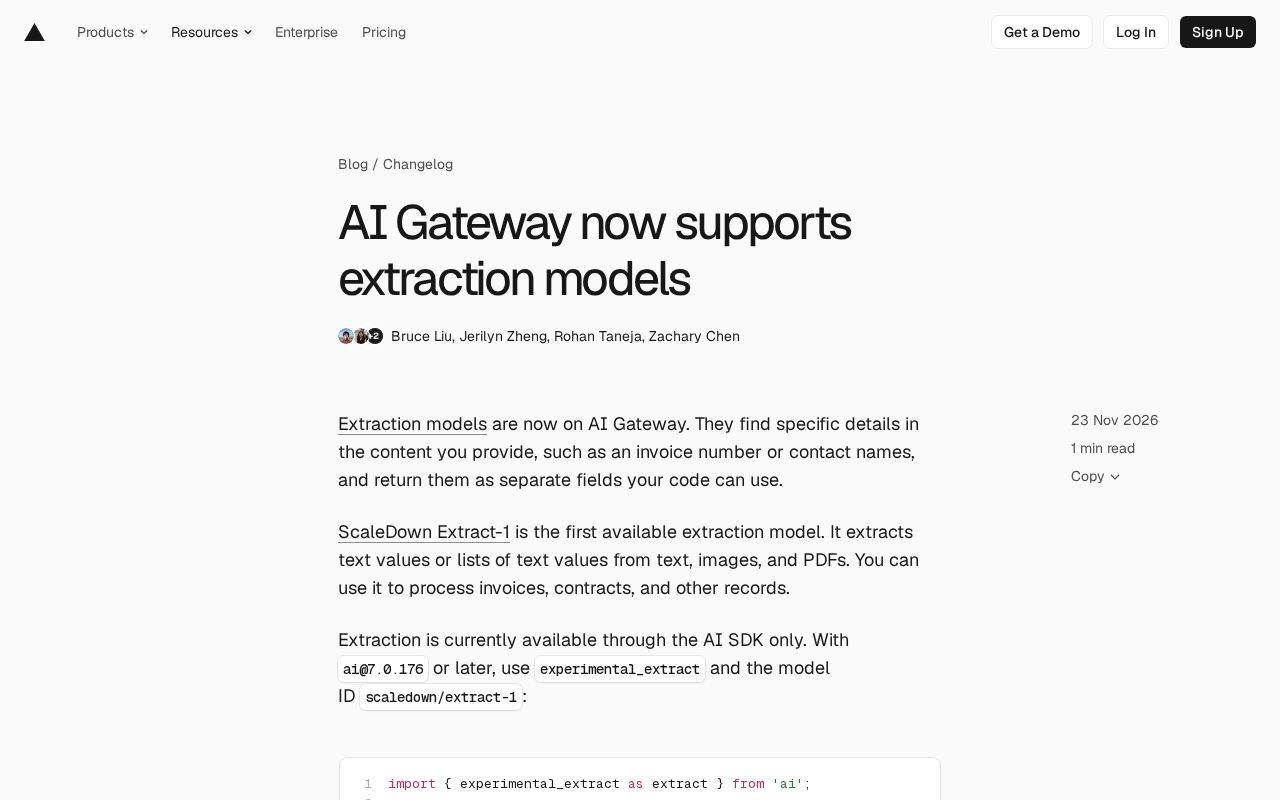
AI Gateway Launches Extraction Models: Precisely Pull Structured Fields from Invoices and Contracts
AI Gateway adds extraction models, debuting with ScaleDown Extract-1, which pulls fields like invoice numbers and contacts from text, images, and PDFs, returning confidence scores and character offsets via AI SDK's experimental_extract.