The Lies of AI Coding Benchmarks: What's Hidden Behind the Scores
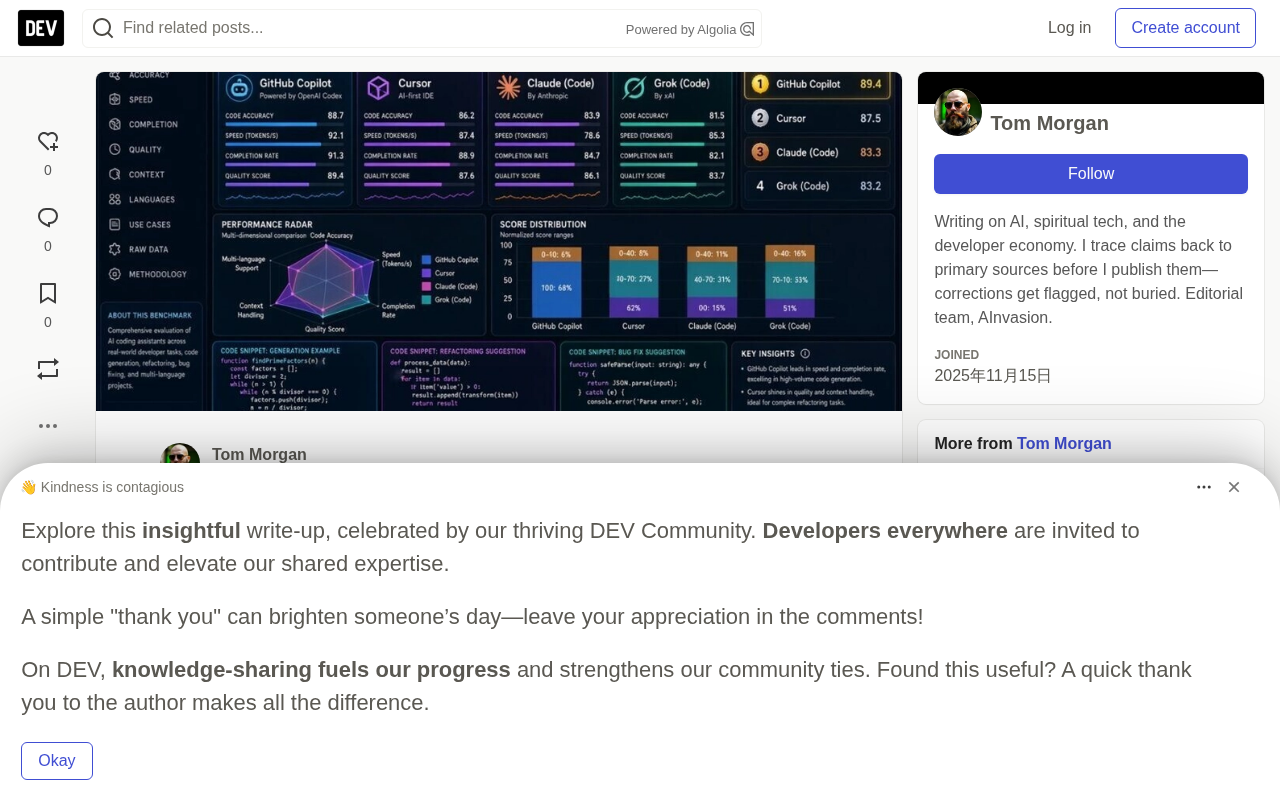
The same model on the same benchmark can differ by 28 points, revealing systemic distortion in AI coding evaluation across speed, accuracy, and cost.
The article argues that current AI coding assistant evaluation has systemic flaws: the same model on the same benchmark can vary by 28 percentage points due to differences in test environment, toolchain, prompts, and retry strategy. Leaderboards show the combined power of "model + toolchain" but wrongly attribute it to the model alone. Cost distortion is even worse — seat price is just the tip of the iceberg, and the real expense comes from billing models and retry rates, which benchmarks usually omit. Fair comparison needs controlled variables — identical tickets, starting commits, and time limits — but almost no public benchmark does this. Developers should treat leaderboards as references rather than conclusions, focus on task fit, and run small-scale controlled tests using real tickets, including retries and manual intervention time in cost accounting, to get a reliable ROI judgment.
The same model, the same benchmark, two results that differ by 28 points. This isn't random noise — it's a systemic flaw in how AI coding assistants are evaluated today. Public leaderboards and vendor-reported numbers are using seemingly precise scores to paper over an uncomfortable fact: no single benchmark can reliably measure speed, accuracy, and cost at the same time.
The Magic of Scores: Who Runs the Test Matters More Than What's Tested
According to Anthropic's system card, Claude Opus 5.5 hit 89.9% accuracy on SWE-bench Pro, and the BenchLM October 2026 leaderboard repeats that same figure. Two sources corroborating each other seems to make the number credible. But the problem is that accuracy scores are never a fixed value — they depend on who ran the test and what tooling wraps around the model.
The same model, the same benchmark, two numbers differing by 28 percentage points. That gap isn't caused by fluctuations in model capability, but by differences in the test environment, prompt design, tool integration, and even retry strategy. A score produced by one team using a carefully tuned agent framework and a result from another team using a plain API call simply aren't comparable.
A subtler issue: leaderboards tend to showcase the best results, while developers in practice deal with default configurations. That 89.9% may correspond to an idealized scenario involving heavy manual intervention and parameter tuning — not the experience you get by opening your IDE.
The Invisible Weight of the Toolchain
The wrapping layer around the model often has a bigger impact on final performance than version differences in the model itself. A powerful agent framework can automatically decompose tasks, generate test cases, and self-correct, lifting a model that would score 60 up to 80 or above. Conversely, a poor integration can make a top-tier model perform like a junior assistant.
This means benchmark scores actually measure the combined capability of "model + toolchain," yet they get attributed to the model alone. When developers pick a model based on a leaderboard, the score they see may not apply at all to the tool environment they use.
Agent framework refers to the software system wrapping around a large language model that automatically decomposes a user's task into multi-step subtasks, schedules the model to execute them in sequence, calls external tools (such as code editors, terminals, test runners), and then decides based on the results whether to re-plan or correct course. Typical implementations have the model first read the repository structure, locate relevant files, generate a patch, run tests, read error messages, and revise. This "plan—execute—verify—correct" loop is exactly why an agent framework can dramatically raise the same model's score: it uses engineering to compensate for the instability of a single model output.
SWE-bench is one of the most mainstream benchmarks for measuring AI coding ability today, short for Software Engineering Benchmark. It draws tasks from GitHub issues in real open-source projects, requiring the system under test to autonomously generate a patch on top of a given codebase snapshot so that previously failing tests pass. SWE-bench Pro is a harder variant with more complex tasks, more dependencies, and stronger requirements for coordinated multi-file edits, so scores are usually lower than the original. Precisely because it closely mirrors real development scenarios, SWE-bench scores also depend heavily on the dependency versions, timeout settings, and evaluation scripts in the runtime environment — which explains why the same model produces wildly different results in different teams' hands.
The Cost Truth: Seat Price Is Just the Tip of the Iceberg
The distortion in the cost dimension is worse than in accuracy. Based on list prices tracked by Developers Digest and verified on September 28, 2026, seat pricing is only the smallest part of the overall cost structure. The real expense comes from the billing model and the retry rate — both of which are completely absent from most benchmarks.
According to data cross-verified across multiple sources, Tool B's actual spend reached $90 in a scenario with 20 merged changes at 4 minutes each. The gap between that figure and the list price reveals the cost black hole of subscription-based AI coding tools. The retry rate is especially critical: when the model's first output fails, developers rephrase, adjust prompts, and try again, each attempt generating additional charges. Benchmarks typically count only the cost of a single successful call, completely ignoring the repeated trial-and-error in real workflows.
Why Cost Is Hard to Standardize
Billing models vary enormously across tools: some charge per token, some per request, some use a hybrid model. The retry rate in turn depends on task complexity, codebase state, and developer patience. These variables make "cost per task" impossible to compare fairly across tools.
A seemingly cheap seat price can, in high-retry scenarios, produce total costs several times that of a competitor. Conversely, a higher-priced tool with a better first-pass rate may actually cost less. If benchmarks don't incorporate these dynamic factors, their cost rankings are misleading.
Billing model refers to the unit of measurement by which AI coding tools charge users. There are three common types: per-token billing (input and output priced separately, with long context and heavy retries significantly driving up cost), per-request billing (a fixed price per call regardless of token length), and hybrid models (a fixed seat fee plus usage-based billing beyond a quota). These three models produce completely different cost curves at different usage intensities: light users may find per-token billing more economical, while high-frequency heavy users often save money under a fixed-seat model.
Retry rate refers to the proportion of cases where the model's first output isn't accepted and the developer needs to rephrase or adjust the prompt to try again. It's pervasive in real workflows because the model's one-shot success rate is far below the idealized value benchmarks assume. Each retry re-consumes tokens, time, and attention, so in token- or request-billed tools, the retry rate directly determines whether actual spend is several times or even ten-plus times the list price. If a benchmark only counts the cost of "one successful call," it effectively assumes a zero retry rate, which is severely disconnected from developers' actual bills.
The Absence of Controlled Experiments
To truly compare AI coding assistants, you need to give each assistant the same ticket text, the same starting commit, and the same time limit. That's the only way to control the variables. But almost none of today's public benchmarks meet these conditions.
Although the SWE-bench family provides standardized tasks, differences in runtime environment, dependency versions, and even timeout settings across teams affect results. Leaderboards like BenchLM try to unify standards but cannot control the differences in the tooling layer around the model.
How Developers Should Read Benchmark Scores
First, treat leaderboards as references, not conclusions. Models within 5 percentage points of each other may not differ noticeably in real use.
Second, pay attention to task-type fit. If your work is primarily refactoring, a high-scoring model optimized for bug fixing may not suit you.
Third, run your own small-scale controlled tests. Use your team's real tickets and codebase, set identical constraints, and observe how each tool performs on first-pass rate, retry count, and total time. That's far more informative than any public benchmark.
Fourth, extend cost calculations to retries and manual intervention time. Seat price multiplied by actual months of use, plus the time cost lost to waiting and error correction, is the true return on investment.
Conclusion: The Real World Beyond the Scores
The trust crisis in AI coding benchmarks is fundamentally a gap between standardized evaluation and real development scenarios. Vendors and leaderboards have incentives to showcase the best numbers, while developers' daily experience is determined by countless details — toolchain maturity, codebase complexity, how ambiguous the task is, even network latency.
The next time you see a model "crushing" its competitors on a benchmark, ask three questions: Who ran the test? What tooling was wrapped around it? Did the cost include retries? If there are no clear answers to these three questions, that score is just a carefully polished report card that may be far removed from your actual experience.
One-line Summary
On the same benchmark, the same model's score can vary by 28 points — revealing systemic distortion in AI coding evaluations across speed, accuracy, and cost.
Paragraph Summary
The article points out that today's evaluation systems for AI coding assistants have systemic flaws: on the same benchmark, the same model's score can vary by 28 percentage points due to differences in test environment, toolchain, prompts, and retry strategy. Leaderboards showcase the combined capability of "model + toolchain" but misattribute it to the model alone. Cost distortion is even worse — seat price is just the tip of the iceberg, and the real expense comes from billing models and retry rates, which are generally absent from benchmarks. Fair comparison requires controlled variables — identical tickets, starting commits, and time limits — but almost no public benchmark meets these conditions. Developers should treat leaderboards as references rather than conclusions, focus on task fit, and run small-scale controlled tests with real tickets, factoring retries and manual intervention time into cost accounting to get a reliable read on ROI.
Related articles

AI Compute Is the New Oil, But the Market Mechanism Has Yet to Take Shape
Hacker News compares AI compute to the new oil, noting the lack of price discovery, concentrated supply, and no hedging tools. The article analyzes structural issues in compute trading and explores a possible three-tier market of spot, contracts, and derivatives, plus the real impact on AI practitioners' cost management.

Running Full iOS 16.5 Firmware on Android Devices: Technical Demo or Marketing Gimmick?
A Hacker News post claims full iOS 16.5 firmware can run on Android, with 315 upvotes. This analysis argues it is more likely a web UI simulation than a true firmware port, and explores the value and risks of such projects.

Etsy Cracks Down on AI Slop: Addressing Buyer and Seller Anxieties
Etsy introduces stricter rules limiting AI-generated content in listings, addressing buyer confusion over AI products and seller fears of original work being diluted by AI slop.