The LLM Capability Perception Gap: The Funnel from 6B to 5K and the Real AI Divide You Can't See

Global LLM capability perception forms a sharply narrowing funnel: 75% have zero exposure, only 0.00006% experience the frontier.
Using a tweet's "napkin math," the article divides the global population into four layers by LLM usage depth: ~6 billion (75%) have almost zero exposure; 1–2 billion (20%) are light users of free products who see AI as a clumsy chatbot; ~20 million (0.2%) use frontier models professionally in math and code, witnessing weeks-long projects completed with one prompt; and only ~5,000 (0.00006%) have internal access to frontier systems, seeing thousands of agents collaborate for weeks on giant projects. The funnel is driven by three factors: problem size and ambition, the jaggedness of system capabilities (prominent in verifiable domains), and stratified access permissions. The article notes this perception gap affects policy, investment, and public discussion, and will be hard to bridge in the short term.
Introduction: Four Worlds at the Same Moment
If you feel that discussions about AI are becoming increasingly fragmented, it's not an illusion. A tweet points out that the gap in people's understanding of large language model (LLM) capabilities is widening—no longer just "two groups talking past each other," but a rapidly narrowing funnel.
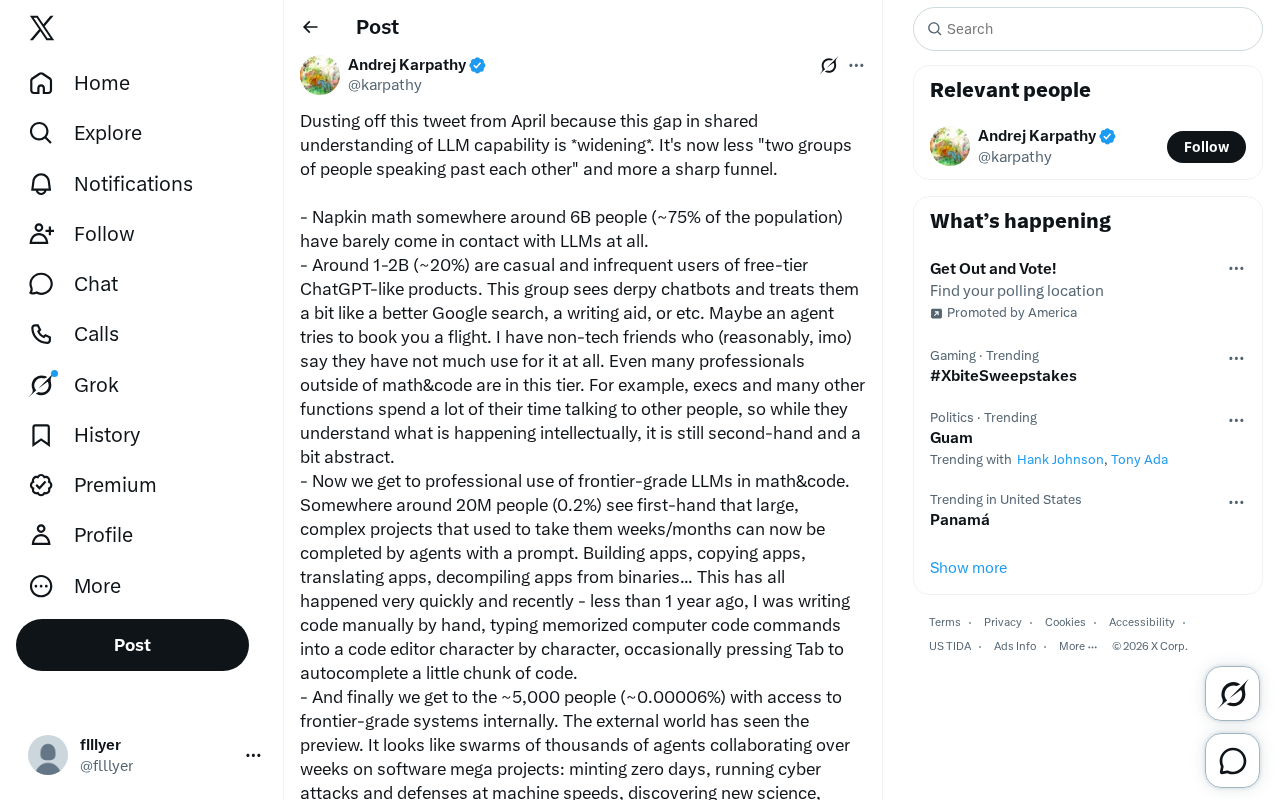
Using "napkin math," the tweet roughly sketches four distinct groups: about 6 billion people (~75% of the population) have had almost no exposure to LLMs; 1–2 billion people (~20%) are occasional users of free products; about 20 million people (0.2%) use frontier models professionally in math and code; and only about 5,000 people (0.00006%) have internal access to frontier systems. This stratification is not just a numerical disparity—it means there is a massive chasm in the perception of AI capabilities.
The Four Layers of the Funnel: From Oblivious to Dizzy
Layer 1: The "Zero Exposure" of 6 Billion
About 75% of the global population is almost completely disconnected from LLMs. They may have heard of ChatGPT but have never actually used it. For them, AI remains a science fiction concept or a news headline, not a daily tool. The existence of this enormous base means that any narrative about "AI普及" (AI adoption) deserves a question mark.
Layer 2: The "Casual Use" of 2 Billion
About 20% are light users of free ChatGPT-like products. What they see is a "clumsy chatbot," which they treat as a better search engine, a writing assistant, or occasionally try to get an agent to book a flight. The tweet author mentions that he has non-technical friends who think AI is "not very useful"—and that's not without reason. Even many non-math/code professionals (such as executives) remain at this layer; although they rationally understand AI's potential, they lack first-hand experience, so their perception remains abstract and second-hand.
Layer 3: The "Professional Shock" of 20 Million
About 0.2% use frontier LLMs professionally in math and code. They witness firsthand: large, complex projects that used to take weeks or months can now be completed by an agent with a single prompt. Building apps, replicating apps, translating apps, even decompiling apps from binaries—all of this happens extremely fast. The tweet author recalls that less than a year ago, he was still manually typing code character by character, occasionally pressing Tab to autocomplete a small snippet. This experience brings a cognitive shock, but only in numeric, verifiable, and economically valuable domains.
Reinforcement Learning with Verifiable Rewards (RLVR) is key to understanding why the "professional shock" is concentrated in math and code. Traditional RLHF relies on human preference scoring and is hard to scale to extremely complex tasks; RLVR, by contrast, uses automatically verifiable signals—such as mathematical proofs and code execution results—as rewards, enabling models to improve themselves through massive trial and error. These tasks have clear correctness criteria, so the model can generate millions of candidate solutions and retain only the paths that pass verification, thereby reaching human-expert level within weeks. This is why the "one prompt completes a project" seen by Layer 3 users is not a general capability, but the result of the system being extremely optimized in verifiable domains.
Layer 4: The "Frontier Vertigo" of 5,000
About 0.00006% have internal access to frontier systems. The outside world has only seen previews: tens of thousands of agents collaborating for weeks, developing giant software projects, mining zero-day vulnerabilities, conducting cyber offense and defense at machine speed, discovering new science, and advancing the mathematical frontier. This work would originally take top experts years. At the same time, human review and understanding are starting to lag—for example, people are still "doing archaeology" on the OpenAI-HF incident from months ago, and mathematicians may need a long time to study 722 frontier mathematics manuscripts. This disconnect between capability and understanding is the strangeness of the current moment.
"Multi-agent orchestration" refers to multiple LLM-driven agents dividing labor, communicating, and collaborating in a shared environment to complete long-horizon tasks. Unlike a single conversation, a multi-agent orchestration system typically includes roles such as planner, executor, and reviewer; it can explore different subproblems in parallel and interact with the environment through tool calls (such as code execution, file reading/writing, and network access). Its core challenge is long-range consistency: agents must maintain goal alignment over weeks and avoid error accumulation. The "thousands of agents collaborating for weeks" witnessed by Layer 4 users is the extreme form of this paradigm, transforming tasks such as software engineering and vulnerability mining from "humans operating line by line" to "humans setting goals and the system advancing autonomously."
Three Drivers of the Funnel
The tweet author points out that the funnel is driven by three factors:
- Impact scales with ambition, problem size, and scope: A question that only needs a paragraph to answer puts almost no pressure on the system. You need a large number of large, difficult problems that you genuinely care about. This drives the consumer/professional dimension.
- The jaggedness of the system: Capabilities peak in digitized, verifiable, and economically valuable domains. This is because LLM capabilities stem from reinforcement learning on verifiable rewards, and the environment mix is driven by revenue potential. This mainly drives the domain dimension (such as math and code).
- Access permissions: Free tier, paid tier, internal tier.
These three factors intertwine, making different groups' perceptions of LLMs vastly different.
The "jagged frontier" is the core metaphor for understanding the shape of the funnel. LLMs do not appear to "uniformly get stronger" to everyone; rather, they perform steeply on digitized, verifiable, high-economic-value tasks, and relatively flatly on tasks requiring physical intuition, ambiguous judgment, or long-tail common sense. This imbalance stems from the distribution of training data and the availability of reinforcement learning signals: code and math have abundant automatic verifiers, while "correctness" in domains such as customer service and creative writing is hard to quantify. Therefore, different groups encounter different types of tasks, and their perception of the same model's capabilities differs sharply—this is exactly the mechanism by which the funnel is widened along the domain dimension.
Multi-Source Perspectives: Consensus and Disagreement
This tweet is not an isolated case. According to analyses by Bilibili UP creators and YouTube channels, similar views are forming consensus across multiple technical communities: there is a significant lag between the practical application of AI capabilities and public perception. For example, discussions about "AI coding agents" are extremely hot in developer communities, while ordinary users remain at the chatbot stage.
However, disagreements also exist. Some experts believe that as free products improve, the lower layers of the funnel will gradually move up; but others point out that the thresholds of access permissions and problem size are hard to overcome, and the gap may further solidify. The tweet author clearly leans toward the latter—he emphasizes that the "dizzying feeling of the curve rising vertically" has been experienced by only a very few, while most people remain under the impression of "clumsy chatbots."
Conclusion: Opportunities and Risks Under the Perception Gap
We are in a split moment happening simultaneously: the general public has almost no exposure to these systems; most professionals see only moderate improvements; a very small number of professionals experience the vertigo of a vertically rising curve. This perception gap not only affects individuals' adoption of AI, but also matters for policymaking, investment decisions, and the quality of public discussion. Understanding the structure of this funnel may help us face the true picture of the AI era more clearly.
One-line Summary
Global perception of LLM capabilities forms a rapidly narrowing funnel: 75% have zero exposure, and only 0.00006% experience the frontier.
Paragraph Summary
Using the "napkin math" from a tweet, the article divides the global population into four layers by depth of LLM use: about 6 billion people (75%) have almost zero exposure; 1–2 billion (20%) are light users of free products and see AI as a clumsy chatbot; about 20 million (0.2%) use frontier models professionally in math and code, witnessing weeks-long projects completed with a single prompt; and only about 5,000 (0.00006%) have internal access to frontier systems, seeing thousands of agents collaborate for weeks to complete giant projects. The funnel is driven by three factors: problem size and ambition, the jaggedness of system capabilities (prominent in verifiable domains), and stratified access permissions. The article notes that this perception gap affects policy, investment, and public discussion, and will be hard to bridge in the short term.
Related articles

Gemini 4 Neon Review: Benchmark Scores Rival Carbon, API Pricing and Quota Breakdown
Google Gemini 4 Neon is now live, benchmark scores closely tracking Carbon, API pricing 3/15 at twice Hydrogen's rate. This article compiles Bilibili creator testing: Neon can replace 90% of Carbon scenarios, AntiGravity quota consumption is only one-third of Carbon, plus subscription channel restrictions and 2API ban risks.

Gemini 4 Helium Coming Soon? Signals of Google Loosening Subscription Restrictions
Google team member hints releases will continue; community speculates Gemini 4 Helium (Flash Lite) may be next. Subscription ban controversy gets a response as product lead says "Soon," suggesting restrictions may be lifted. This article covers Gemini developments, OpenAI Coding Agent and risk management, Doubao real-time audio-video API, and compute business dynamics.

AI-Assisted React Development in Practice: Optimizing a Video App and Handling Errors
A 14-year veteran developer demonstrates AI-assisted React video app optimization: compressing video from 80MB to 5MB (~94%) via ImageKit, plus reliable error handling and retry mechanisms. Includes planning, code understanding, and verification methods for working with AI.