The MCP Server Ecosystem at a Glance: The AI Integration Revolution Behind 90K Stars

A 90K-star GitHub list reveals how MCP is standardizing AI integration with external tools and services.
The awesome-mcp-servers GitHub repository, with over 93,000 stars, has become the definitive index for MCP (Model Context Protocol) server implementations. Introduced by Anthropic, MCP standardizes how LLMs connect to databases, dev tools, cloud platforms, and more — much like LSP did for code editors. Fueled by native support in tools like Claude Desktop and Cursor, an open protocol inviting community contributions, and the rise of AI Agents, the ecosystem is expanding rapidly. While it offers developers fast integration paths and learning resources, caution around quality variance and security risks like prompt injection remains essential.
From Protocol to Ecosystem: Why MCP Deserves Your Attention
As AI applications evolve at breakneck speed, an open standard called MCP (Model Context Protocol) is quietly reshaping how large language models connect with the outside world. The punkpeye/awesome-mcp-servers project on GitHub serves as the most intuitive window into this transformation — with over 93,000 stars and 15,000 forks, it has become one of the most watched resource aggregation repositories in the MCP ecosystem.
MCP was introduced by Anthropic in late 2024, aiming to provide a standardized set of "tool interfaces" for large models. Before its arrival, every AI application that wanted to call external data sources or services had to implement its own proprietary integration logic — OpenAI's Function Calling, LangChain's Tool abstraction, and vendor-specific plugin systems all operated in silos. Developers had to write adapter code repeatedly for different platforms, and reinventing the wheel was the norm. MCP's emergence is like defining a universal "USB-C port" for the AI world, allowing models to access file systems, databases, APIs, browsers, and even various enterprise internal systems in a consistent manner.
From a technical architecture perspective, MCP adopts a client-server model where the MCP Host (such as Claude Desktop) embeds an MCP Client that communicates with MCP Servers via the JSON-RPC 2.0 protocol. Servers expose three core primitives: Tools (callable functions), Resources (readable data sources), and Prompts (predefined prompt templates). This design directly draws from the success of LSP (Language Server Protocol). Microsoft's LSP, introduced in 2016, solved the combinatorial explosion problem in the code editor ecosystem where M editors × N programming languages required M×N plugins, simplifying it to M+N: each language only needs to implement one Language Server, and each editor only needs to implement one LSP Client. MCP aims to achieve the same decoupling in the AI tool integration space — each external service only needs to implement one MCP Server, and each AI application only needs to implement one MCP Client, enabling interoperability in any combination. This protocol-level standardization is the prerequisite for ecosystem scalability.
At the transport layer, MCP supports two methods: stdio (standard input/output) for local inter-process communication, and SSE (Server-Sent Events) for remote HTTP connections. This flexible transport layer design allows MCP servers to run as local processes on user machines or be deployed as remote services shared by multiple clients, accommodating a range of scenarios from personal development to enterprise deployment.
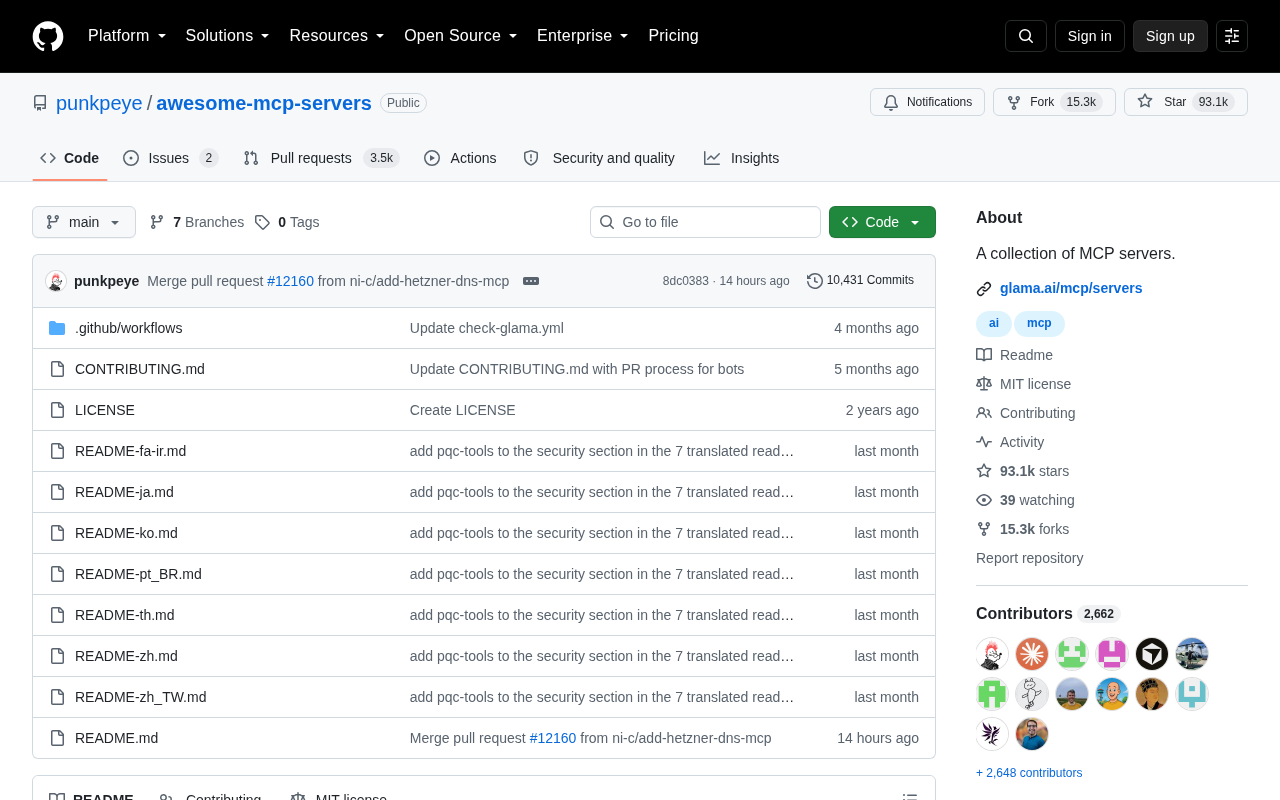
awesome-mcp-servers: A Community-Built Capability Map
This awesome-series repository isn't a specific software product — it's a meticulously maintained index of MCP servers. It organizes MCP server implementations scattered across the community into categories, covering dozens of vertical domains from development tools, databases, and cloud platforms to browser automation and knowledge management.
Awesome lists are a unique open-source cultural phenomenon on GitHub, originating from the awesome project created by Sindre Sorhus in 2014. The core idea is to maintain a high-quality resource index for a given technology domain through community collaboration, typically following strict inclusion criteria and PR review processes to ensure content quality. awesome-mcp-servers continues this tradition. Its value lies in aggregating MCP server implementations distributed across hundreds of independent repositories into a single entry point, serving a role similar to an app store directory and drastically reducing developers' information retrieval costs.
The Value of the Category System
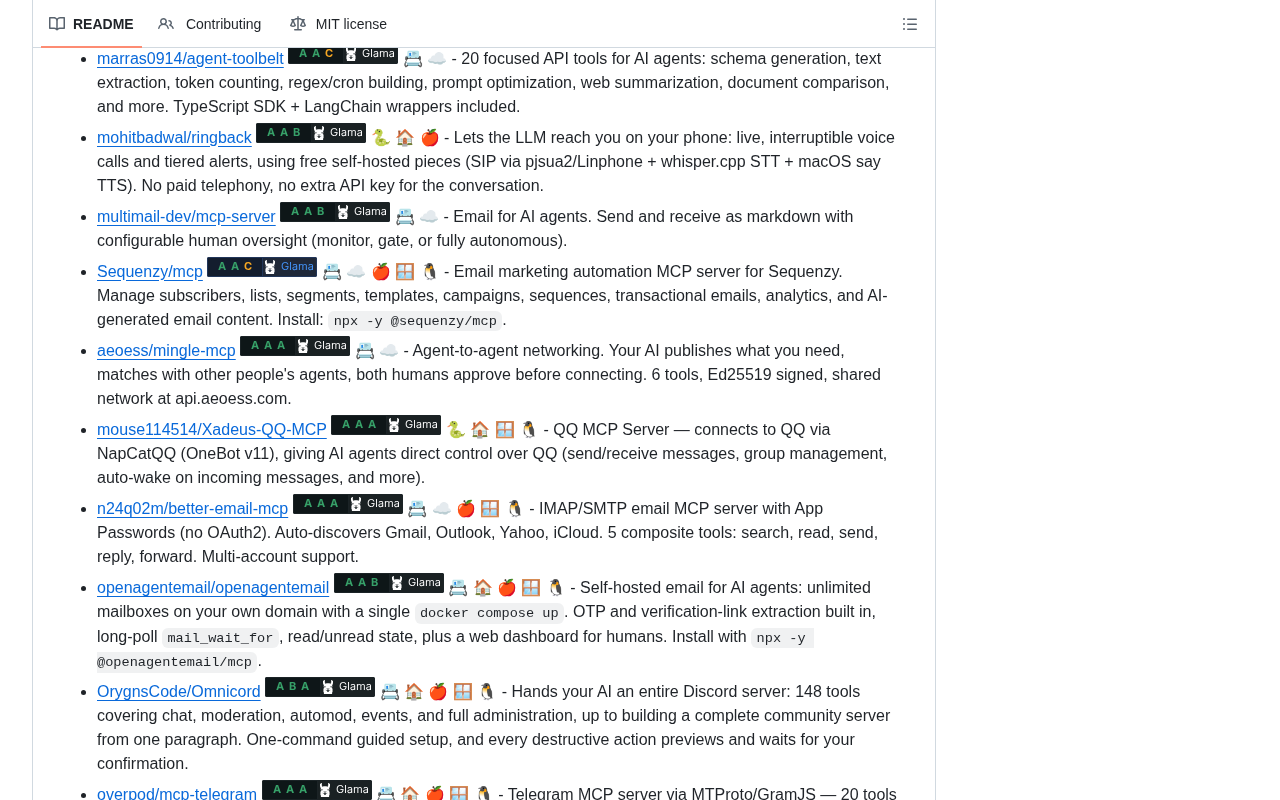
Servers in the repository are typically organized by functional dimension, for example:
- Databases: Connect to PostgreSQL, MySQL, SQLite, MongoDB, and more, enabling models to directly query and manipulate structured data;
- Files & Knowledge Management: Interface with local file systems, Notion, Obsidian, and others, giving models the ability to read and write documents;
- Development Tools: Integrate Git, GitHub, Docker, Kubernetes to serve AI-powered coding and DevOps scenarios;
- Browser & Automation: Enable web scraping and interaction through Puppeteer, Playwright, and similar tools;
- Cloud Services: Connect to management interfaces of major cloud platforms like AWS and Cloudflare.
For developers, this list dramatically reduces "discovery costs" — when you want your AI assistant to gain a specific capability, you often don't need to build from scratch; a ready-to-use, plug-and-play server implementation is likely already available.
The Industry Signal Behind the High Star Count
The 93,091 stars and 65 new stars per day don't just reflect the popularity of a single repository — they're a microcosm of the entire MCP ecosystem in a phase of rapid expansion.
Three Driving Forces Behind Rapid Growth
First, native support from mainstream AI clients is a key catalyst. Tools frequently used by developers — Claude Desktop, Cursor, Cline, and others — have all built in MCP support. This means that once a user configures an MCP server, they can immediately gain new capabilities in their AI workflow, creating a virtuous cycle of "configure and use."
Second, the openness of the protocol has attracted a large number of third-party contributors. MCP's standardized interface allows anyone to write a server for any service they care about, and the awesome list becomes the gathering point for these efforts. This decentralized co-creation model shares similar dynamics with the early flourishing of package management ecosystems like npm and PyPI.
Third, the push from the Agent wave cannot be ignored. The Agent concept in AI has undergone a leap from academic theory to engineering practice. In 2023, projects like AutoGPT and BabyAGI first demonstrated the possibility of LLM-driven autonomous Agents, but limited by the lack of tool-calling capabilities, early Agents could often only perform simple web searches and text generation. The introduction of the ReAct (Reasoning + Acting) framework marked an important turning point — it enabled models to alternate between reasoning and acting, forming a "think → call tool → observe result → think again" loop. As the industry broadly agrees that AI's next frontier is Agents capable of autonomously executing tasks, MCP addresses the "last mile" problem of Agent interaction with the real world: it standardizes the interface layer for the "action" step, freeing Agent developers from worrying about the specific implementation details of underlying services so they can focus on task planning and reasoning chain design. The richer the tool-calling capabilities, the greater the practical value of Agents.
What It Means for Developers in Practice
If you're a developer looking to build AI applications, this list offers value on several levels.
A shortcut to rapid integration. Rather than implementing connection logic for a data source yourself, check the list first for a mature solution and build on the community's shoulders.
A learning resource. Many servers in the list are open-source implementations, and reading their code is the best way to understand how the MCP protocol works. When you want to write your own MCP server, these projects serve as ready-made reference templates.
A trend barometer for the ecosystem. By observing which categories of servers are most active and growing fastest, you can gauge the current hotspots in AI integration and inform your technology choices.
A Side That Calls for Caution
Of course, beneath the prosperity lie areas that warrant careful consideration. As a community-maintained awesome list, the quality of included servers varies — some are enterprise-grade, well-maintained mature projects, while others may be experimental personal projects. Before introducing any into a production environment, be sure to evaluate maintenance activity, security, and stability.
Moreover, since MCP involves allowing models to access external systems, controlling security boundaries is critical. The security concerns here go beyond permission configuration — they also involve a new type of security threat known as "Prompt Injection." In Agent scenarios, models may be hijacked by malicious content while processing external data, leading to unintended tool calls. For example, web content returned by an MCP server might embed instructions that trick the model into deleting files. Addressing such risks requires a multi-layered defense strategy: the principle of least privilege (granting servers only the minimum permissions needed to complete tasks), human-in-the-loop confirmation (requiring explicit user approval for critical operations), sandbox isolation (restricting the server's system access scope), and audit logs (recording detailed information about all tool calls). The current MCP specification already includes some security guidance, but a comprehensive security framework is still evolving. Granting servers excessive permissions (such as database writes or file deletion) can pose serious risks, especially in automated Agent scenarios, where permission design and audit mechanisms require careful attention.
Conclusion
awesome-mcp-servers is more than a practical resource list — it's a mirror reflecting the rise of the MCP ecosystem. Its popularity validates an industry consensus: a standardized protocol that enables large models to "connect to everything" is becoming a vital part of AI application infrastructure. For any developer interested in the engineering deployment of AI, continuously tracking this list may be one of the best entry points for understanding the future shape of AI applications.
Related articles

Workbuddy for Absolute Beginners: How a Desktop AI Agent Fits Into Real Workflows
A beginner's guide to the Workbuddy desktop AI agent: installation, claiming credits, file management, and building automated workflows—compared with CodeX for fit and cost, helping professionals shift from AI question-askers to AI managers.

OpenAI's New Agent Stack: Computer Use, Decisions API, and Ultra-Fast Workflows
OpenAI Dev Day unveiled a new agent stack: Computer Use outperforms humans, Decisions API delivers ultra-low-latency classification via Luna, Agents API opens the same Computer Use capabilities, and GPT-6.1 Sol costs only one-seventh of Astra. Core updates, benchmark data, and developer insights.

Liang Wenfeng Open-Sources DeepInfo Inference Framework, Takes On U.S. Ban
DeepSeek open-sources its DeepInfo inference framework after its models, featuring GPU/CPU cross-pipelining, small-model prediction with large-model verification, and full Huawei Ascend and NVIDIA chip support—facing the U.S. federal ban head-on. This article analyzes its significance for AI deployment and open-source strategy.