The Memory Paradox in AI Decision Systems: Teaching Agents Not to Blindly Trust Past Experience

ED Resolve teaches AI agents to question their own memories by treating past experience as evidence rather than instruction.
ED Resolve is an experimental AI agent architecture that challenges the assumption that more memory equals better decisions. Using a component called Hindsight for storage, it adds a critical "applicability assessment" step after retrieval — if the current context diverges too much from a stored memory, the system actively discards it rather than forcing a fit. The full decision pipeline runs through memory retrieval, applicability evaluation, constraint checking, and simulation, integrating past experience with current limits and forward projection. This repositions memory from instruction to evidence, giving agents a meta-cognitive check on their own experience — improving robustness in out-of-distribution scenarios. The approach remains at the architectural stage, with quantitative validation still pending.
Memory Is Not an Instruction: A Counter-Intuitive AI Architecture Experiment
A developer shared their project ED Resolve on Reddit, raising a sharp question: what happens when an AI system can remember past situations and draw on that experience during decision-making? And more importantly — how do you make it actively discard those memories when appropriate?
This question cuts to a weak point in current AI Agent design. Most memory-enabled systems tend to follow linear logic: retrieve a similar historical case, then directly reuse the solution from that time. But real-world decision-making is rarely simple pattern matching — a correct answer from the past can become the wrong choice under new constraints.
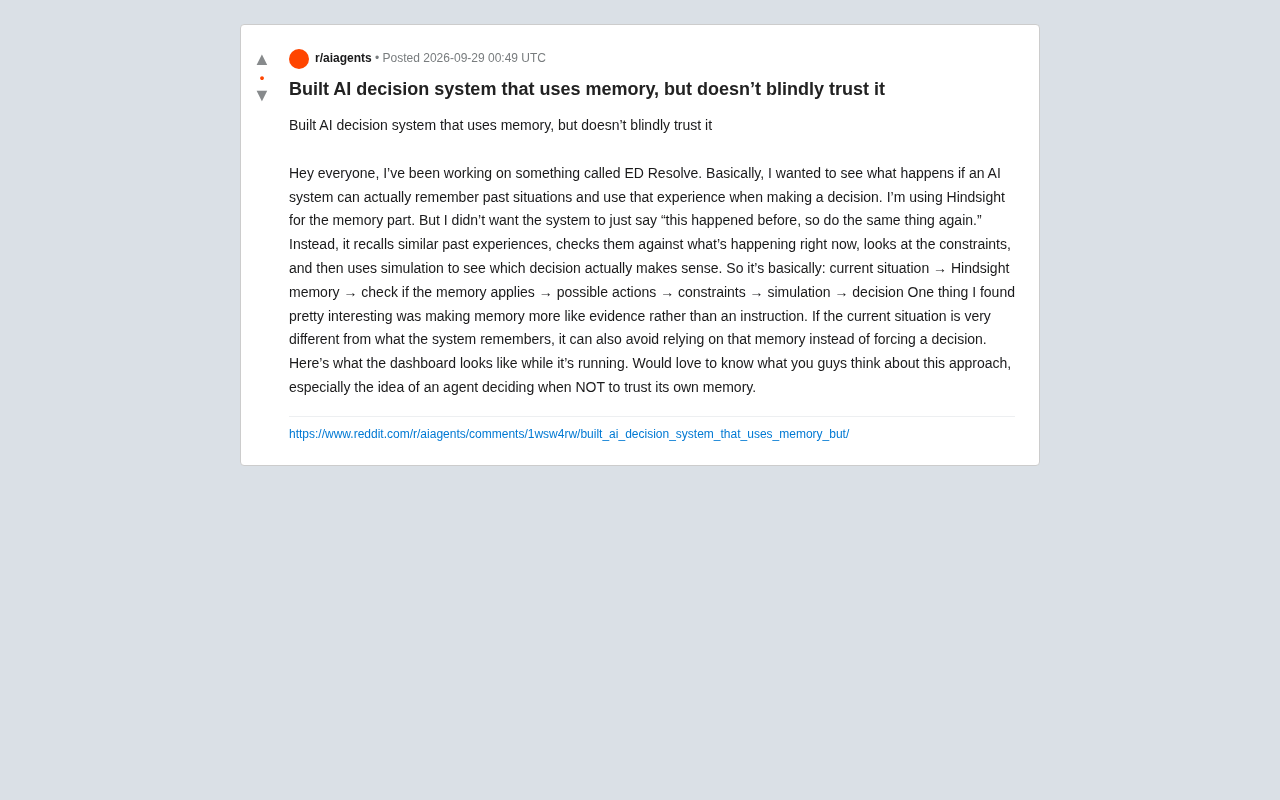
ED Resolve's Decision Pipeline Design
The author uses a component called Hindsight to handle memory storage, but the key innovation lies in how the entire decision flow is orchestrated. The system's processing logic is broken down into a clear pipeline:
Current context → Hindsight memory retrieval → Assess memory applicability → Generate possible actions → Check constraints → Run simulation → Final decision
The most noteworthy step in this pipeline is the third one — assessing memory applicability. The traditional retrieval-augmented approach is "find similar cases, apply similar solutions." ED Resolve, however, performs a relevance evaluation after retrieving historical experience: how closely does the current context actually match the remembered one? If the difference is too large, the system chooses not to rely on that memory rather than forcing it to fit.
This design repositions memory from an "instruction" to "evidence." The distinction lies in weight and authority: instructions demand execution, while evidence is merely one input to inform a decision — still subject to constraint checks and simulation.
Treating Memory as Evidence, Not Instruction
The author considers this the most interesting aspect of the entire project. When an AI treats past experience as evidence, it gains a capacity for "doubt" — it can evaluate the credibility and applicability of that experience rather than passively complying with it.
This reflects a broader proposition about AI safety and reliability. An agent that blindly trusts its own memory is prone to making confident mistakes in out-of-distribution scenarios: it applies a historically relevant but now-invalid solution to an entirely new problem. Teaching an agent to say "this situation is different from what I remember — I shouldn't copy that approach" is actually the key to improving robustness.
"Out-of-distribution (OOD) scenarios" is a core concept in machine learning, referring to input data encountered during inference that differs significantly from the distribution of training or historical experience data. A concrete example: an autonomous driving system trained on clear-weather road data is in an out-of-distribution state during a blizzard — its historical experience loses much of its descriptive power over the current environment. For memory-based agents, the OOD threat is especially insidious: the system cannot automatically sense that "the current situation has exceeded my experience," and will mechanically retrieve the most superficially similar historical case and execute the corresponding solution. This kind of confident analogy is often precisely where errors originate. ED Resolve attempts to address this through the applicability assessment step, having the system perform a "validity self-check on its experience" before acting — essentially compensating for the distribution-awareness capability that memory retrieval systems inherently lack.
Hindsight, as a memory storage component, is technically positioned similarly to the "External Memory" or "Episodic Memory" modules common in the AI Agent space. The core function of these components is to persist past interaction snippets, decision contexts, and outcomes in vector or structured form, then return the most relevant historical fragments via semantic similarity search (typically backed by a vector database) when a new query arrives. Unlike a large language model's parametric memory (i.e., knowledge encoded in training weights), external memory stores can be dynamically updated, precisely targeted, and explicitly deleted or corrected. RAG (Retrieval-Augmented Generation) is currently the most mainstream technical paradigm, and ED Resolve's design adds a layer of "meta-evaluation" on top of RAG's retrieved results — rather than directly injecting retrieved content into a prompt for the model to act on.
Simulation as the Final Decision Checkpoint
After memory passes the applicability check and candidate actions are generated incorporating current constraints, ED Resolve introduces a simulation step. The system runs through possible decisions to see which one actually holds up under current conditions before making a final choice.
This step effectively fills the gap left by pure memory retrieval. Memory tells you "what was done before," constraints tell you "what can't be done now," and simulation answers "what would happen if this were done." Combined, the basis for a decision shifts from a single historical similarity score to a composite judgment spanning historical experience, current limitations, and forward-looking projection.
The Value of This Approach — and What Still Needs Validation
From a design philosophy standpoint, ED Resolve's proposition — that an agent should decide when not to trust its own memory — is a meaningful direction. A common failure mode in many memory-enabled agents today is over-trusting retrieval results and lacking meta-cognitive awareness of whether those memories are actually valid.
That said, the author's writeup currently remains at the level of architectural description and dashboard demonstration. Several key questions remain to be validated:
- What are the criteria for applicability assessment? How does the system quantify the "difference between current context and remembered context"? How are thresholds set, and can it produce false positives or negatives?
- What are the cost and accuracy tradeoffs of simulation? Simulation itself depends on environment modeling — if the model is inaccurate, simulation conclusions are equally unreliable.
- Where are the comparative performance numbers? Versus a baseline that directly reuses memories, how much does this "skeptical" architecture actually improve decision quality? Quantitative evidence is still lacking.
"Meta-cognition" originates from cognitive psychology, referring to an individual's ability to monitor and regulate their own cognitive processes — "thinking about thinking." In AI systems, meta-cognitive ability typically refers to a system's capacity to evaluate the confidence of its own outputs, identify the boundaries of its knowledge, and adjust its behavioral strategy accordingly. Most current LLMs show clear deficiencies in meta-cognition: they express established facts and hallucinated errors with similar fluency, lacking any internal sense of "I don't know" or "my basis for this is unreliable." ED Resolve attempts to introduce an external meta-cognitive mechanism at the memory retrieval stage — replacing the model's implicit confidence judgments with explicit applicability scoring. This represents a "structured meta-cognition" approach, directly related to the "knowing what you don't know" problem discussed in recent research.
Closing Thoughts
The most thought-provoking aspect of this project isn't which specific memory component it uses — it's that it challenges the default assumption that "more memory is better and more trust is better." Giving an AI system the ability to judge when its own experience has become invalid is, at its core, injecting a degree of prudence into the agent.
For developers building agents with long-term memory, ED Resolve offers a useful reference point: decouple memory retrieval, applicability assessment, constraint checking, and simulation into independent, auditable, and intervenable stages. This approach may be closer to the essence of reliable decision-making than simply pursuing a larger memory store or stronger retrieval capability.
Related articles

GPT-Next Leak, Gemini 4 Argon Imminent: AI News Roundup
GPT-Next leak suggests extreme efficiency; OpenAI's 28-day shipping pledge boosts speed 50%; Gemini 4 Argon nears release; Anthropic subscription value report sparks debate.

GPT-Next Leaked, Gemini 4 Argon Speeds Up, Fable 5.5 May Launch Today
OpenAI's GPT-Next model leaks, expected to be extremely low-cost and possibly part of the 28-day release plan; Gemini 4 Argon internal testing accelerates, NanoBanana 2.1 is live; Semi Analysis tests show Claude Max's equivalent API value is about 5 times that of ChatGPT Pro; Fable 5.5 may launch today.

Gemini 4 Argon Launches Globally: Key Highlights from the AI Daily Brief
Google opens Gemini 4 Argon globally across Pro and Ultra subscriptions and the API, and demonstrates robot control. This article rounds up open-source models, Agent infrastructure, cost transparency, and safety governance updates.