The Microduck Robot That Jensen Huang Made Famous: 20,000 Units Sold Out
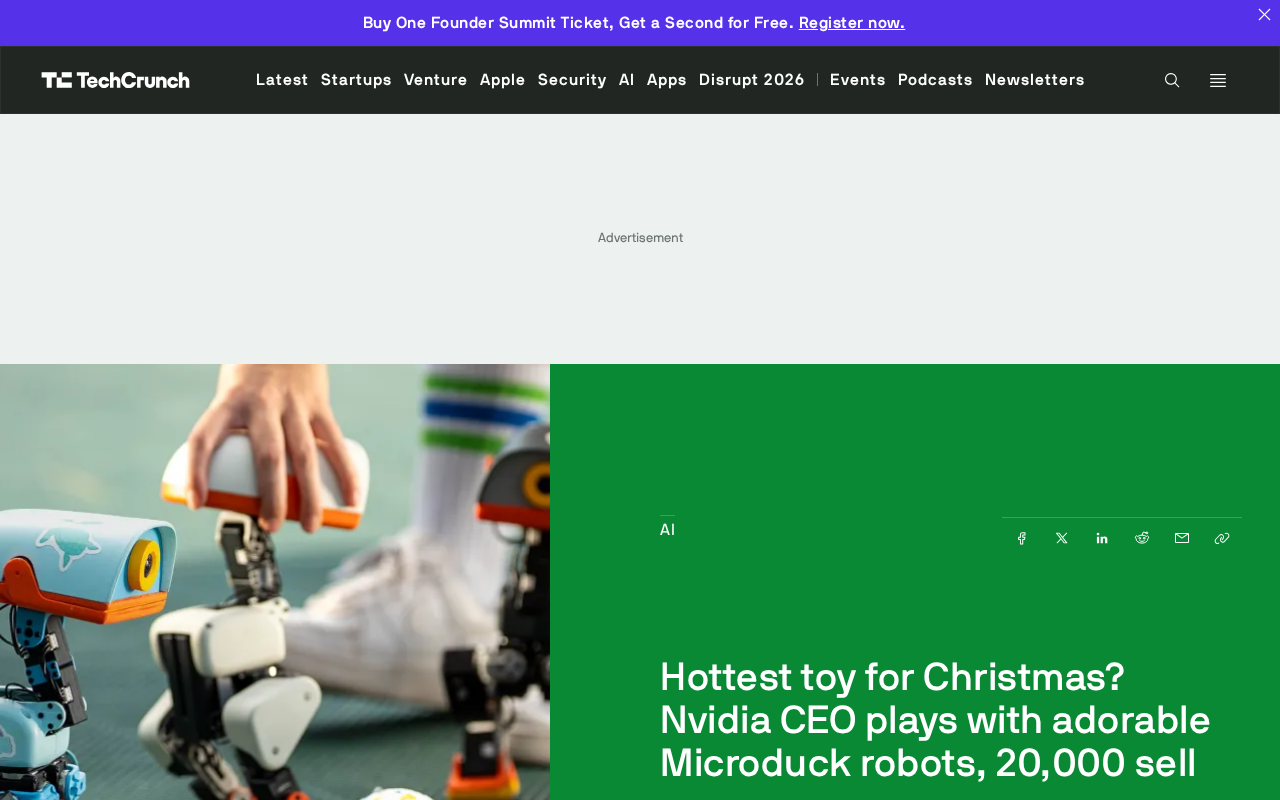
Jensen Huang's impromptu interaction with Microduck ignited sales, revealing the power and limits of emotional design in consumer robotics.
The article uses the viral video of NVIDIA CEO Jensen Huang interacting with Microduck toy robots as an entry point to analyze why the product sold 20,000 units in a short time. On the product side, Microduck triggers anthropomorphic motions and R2D2-style sounds via voice commands, creating instant feedback and emotional expression with simple interaction, positioned for the mass toy market rather than geek products. On the communication side, Huang's approachable image and the contrast of "chip giant CEO squatting to talk to ducks" create strong social propagation. The article also notes that toy-grade robots face the risk of being shelved after novelty fades, and whether they can sustain popularity depends on continuous content ecosystem updates, arguing that this case shows emotional design may determine consumer robotics market performance more than technical specs.
When Jensen Huang Squatted Down to Talk to a Little Duck
At a public NVIDIA event, CEO Jensen Huang wasn't talking about GPUs or AI compute—he was squatting on the floor interacting with a group of palm-sized robots. These little guys, called Microduck, shuffled around on tiny feet, emitted R2D2-style electronic sounds, and upon hearing voice commands could sit down, play dead for a "nap," and even do somersaults. According to the original report, these robots sold 20,000 units in a short period and earned the title of "hottest toy of Christmas."
Why did an impromptu interaction from a chip giant's CEO instantly sell out a toy-grade robot? Behind this lies both the偶然 of celebrity effect and the inevitability of long-building momentum in the consumer robotics market.
The Product Itself: Big Ingenuity in a Small Body
The Balance Between Voice Interaction and Motion Design
Microduck's core selling point isn't compute power—it's charm. From the report's description, its motion library is designed around children and family scenarios: walking, sitting, playing dead, somersaulting, paired with R2D2-style sound effects to form a complete emotional expression system. The interaction method of triggering actions via voice commands is simple, but its strength lies in immediate feedback—a child says something, and the duck responds instantly. That feeling of "being heard" is key to a toy's appeal.
A detail worth noting: designs like "playing dead for a nap" carry an obvious anthropomorphic tendency. They make the robot no longer a cold mechanical device but more like a little companion with a personality. This product approach isn't new in consumer robotics, but Microduck compressed it into an extremely low price band and an extremely small form factor.
R2D2 is a classic robot character from the Star Wars series, expressing emotions and intentions through a series of electronic sounds, beeps, and whistles. Though lacking human language, it conveys a rich "personality" through sound rhythm and pitch changes. This non-semantic sound design has been widely borrowed in robotics: it avoids the complexity of natural language synthesis while leveraging humans' natural sensitivity to vocal emotion to build affinity. Microduck's similar style is effectively using a low-cost sound solution to achieve highly recognizable emotional expression, letting users perceive its "attitude" even without understanding "duck language."
Misaligned Competition in Pricing and Positioning
The report didn't disclose the specific price, but the "hottest toy of Christmas" label suggests it targets the mass consumer market rather than geek enthusiasts. This means Microduck's competitors aren't high-end humanoid robots but traditional electric toys. Using voice interaction and motion choreography to create differentiation is why it stands out on the shelf.
The Jensen Huang Effect: An Accidental Marketing Victory
Why Celebrity Endorsement Worked at This Moment
Jensen Huang's personal image has a rare approachability in the tech world—leather jacket, humor, willingness to do "unprofessional" things on camera. When he squatted down to interact with Microduck, the signal he sent wasn't "NVIDIA is making toys" but "even I find this thing interesting." This non-commercial stance is actually more persuasive than any advertisement.
From a communication perspective, the visual of this interaction is extremely strong: the CEO of the world's most valuable chip company and a group of little ducks making R2D2 noises. The contrast itself is fuel for social media. The 20,000-unit sales figure is largely the result of this contrast being repeatedly shared.
Celebrity endorsement in marketing usually refers to leveraging a public figure's fame and credibility to boost a product's trustworthiness. But Jensen Huang's interaction here is closer to "non-commercial incidental endorsement": he didn't appear as a spokesperson, nor was there clear commercial promotional intent, so viewers perceived lower persuasive motive, making trust transfer smoother. The "contrast effect" in communication studies also applies here—the identity mismatch between a high-tech CEO and a low-tech toy creates a strong memory hook, giving the content self-propagation momentum on social media that's more efficient than traditional advertising reach.
Implications for the Consumer Robotics Sector
The takeaway for consumer robotics companies is direct: technical specs rarely move ordinary consumers, but a scene that makes people smile can. Microduck's motion library isn't complex, and its voice interaction isn't cutting-edge, but it achieves "fun" in a specific use scenario. As AI capabilities become increasingly commoditized, a product's emotional design ability may determine market performance more than model scale.
Cold Thinking Behind the Hot Sales
The Ceiling of Toy-Grade Robots
What needs calm consideration is that toy robot popularity often comes and goes quickly. The combination of voice commands and preset motions easily falls into disuse once novelty fades. Whether Microduck can retain users depends on whether it has a continuously updated content ecosystem—new motions, new interaction modes, even integration with other devices. The original report didn't mention this information, which is also the key variable for whether it can sustain as a "hit."
The consumer robotics field often uses the "novelty decay curve" to describe changes in user enthusiasm for interactive products: high-frequency usage driven by novelty in the early launch period, but as preset motions and interaction modes are exhausted, usage frequency drops rapidly. Due to limited hardware compute and sensor configuration, toy-grade robots' content expansion relies heavily on manufacturer updates or user community derivative creation. Products lacking continuous content supply often degrade from "daily playmate" to "shelf ornament" within weeks to months—a structural reason for the category's generally low repurchase and long-term retention rates.
What 20,000 Units Means
In the toy industry, 20,000 units isn't an astonishing number, but as a new product with a tech label, it's enough to prove demand exists. More importantly, this sales volume validates a hypothesis: consumers are willing to pay for "little robots with personality," provided the price and experience match. For AI robotics companies seeking landing scenarios, this is a sample worth studying.
Final Thoughts
Microduck's story has no disruptive technology; its success comes from the overlay of product design, celebrity timing, and communication momentum. Jensen Huang's involvement was accidental, but a toy selling out during the Christmas season shows it did at least one thing right: making robots appear cute rather than scary in front of humans. In an era where consumer robotics repeatedly start strong and fade, this simple ability is actually scarce.
Related articles

LLaMA-Factory in Practice: A Complete No-Code Guide to Fine-Tuning Large Models
An introduction to LLaMA-Factory, the open-source fine-tuning tool: its 60.1K-star background, supported models and algorithms, local vs. cloud deployment, and CUDA setup steps.

Zeng Ming's Deep Retrospective: Why OpenAI May Not Be the Ultimate Winner — and Why the Corporate System Will Disappear
Zeng Ming's deep retrospective on the AI endgame: model companies are just infrastructure, OpenAI and Anthropic won't be the final winners; the next battle is the Agent entry point standard; the corporate system will disappear as AI restructures collaboration, and only mission-driven companies can survive the cycle.

OpenHands v1.28.0: OpenCode and PI Added as Built-in Agents, API Keys Requestable In-Conversation
OpenHands ships 5 releases in 21 days: v1.27.0 adds OpenCode and PI as built-in agents, v1.28.0 enables in-chat key requests. ACP integration, credential reuse, model list changes, and upgrade advice.