The Most Complete Hermes Agent Practical Tutorial on Bilibili: From Beginner to Project Integration

Break down the three-layer knowledge framework and four practical scenarios of the Bilibili Hermes Agent course.
Based on the public syllabus of the Bilibili course "Hermes Agent in Practice: From Beginner to Mastery," this article outlines its knowledge framework. The course progresses in three layers: first building awareness of Hermes architecture and basic AI Agent concepts, then moving into hands-on installation, configuration, and MCP service access, and finally landing on four real projects—a Feishu news push bot, Python library integration, automated tech blog setup, and scheduled project code review. The article points out that using Feishu as the landing entry reflects a design approach of embedding into existing workflows, the standalone coverage of MCP indicates its role as infrastructure for connecting external tools, and scheduled tasks run through multiple projects. The course suits developers with Python basics and technical leads, but be mindful of platform phrasing and configuration changes due to framework version iterations.
AI Agents are moving from concept to everyday tool, but most people are still stuck at the stage of chatting with AI via text. A course on Bilibili titled "Hermes Agent in Practice: From Beginner to Mastery" attempts to pull Agents into real workflows through a complete path—from installation and configuration to Feishu integration, MCP access, and on to a news push bot and automated code review. This article is based on the publicly available syllabus information of the course, outlines its knowledge framework, and adds interpretation of key stages to help you build a clear map before getting hands-on.
What is Hermes Agent, and what problem does this course aim to solve
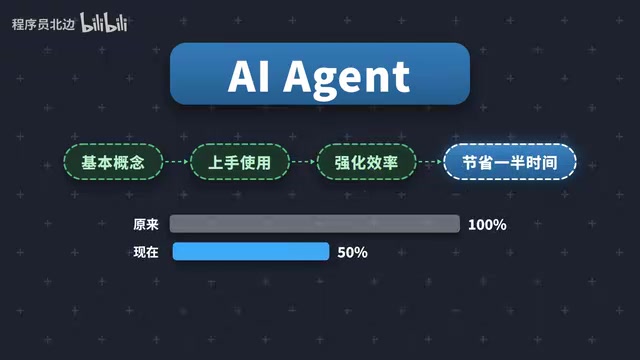
The course doesn't dive straight into code; instead, it first explains the basic concepts of AI Agents: telling AI to complete a task in one sentence requires the combined effort of models, tool calling, memory, and orchestration logic. In this course, Hermes is positioned as a practical Agent framework with the goal of embedding into real scenarios—Feishu groups, project codebases, personal blogs, and news feeds—rather than just demonstrating a demo.
The course claims a benefit of "saving up to half the time," which comes from the instructor's efficiency assertion and lacks a quantitative baseline, but the direction is clear: delegate repetitive information processing and code maintenance to Agents that run on schedule.
Course structure breakdown: from architectural understanding to scenario practice
The course content is organized in a clear progressive relationship, roughly divisible into three layers.
Layer 1: Basic introduction and architectural understanding
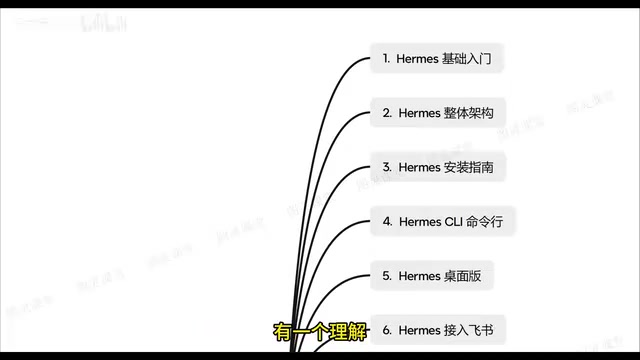
The course first helps learners build an understanding of Hermes's overall architecture and its component modules. This step may seem theoretical, but it is crucial for subsequent configuration—without a clear understanding of how the orchestration layer and execution layer of an Agent divide responsibilities, you'll easily get stuck on "why configure it this way" when connecting MCP or writing integration code later.
The orchestration layer and execution layer of an Agent framework: The orchestration layer is responsible for deciding "what to do and in what order," typically driven by a large model that decomposes user goals into multi-step plans; the execution layer is responsible for "actually doing it," interacting with external systems through tool calling—such as executing commands, reading/writing files, and calling APIs. Between them, a memory module is needed to preserve context so the Agent can maintain coherence across multi-turn tasks. Understanding this layering is essential to knowing which layer each configuration item affects: MCP services mainly extend the tool boundaries of the execution layer, while scheduled tasks and trigger conditions belong to the scheduling logic of the orchestration layer.
Layer 2: Installation and configuration hands-on
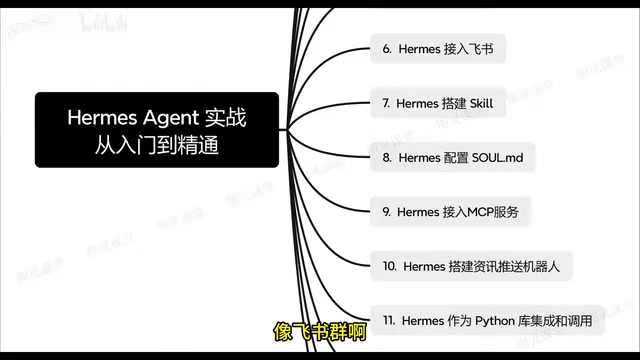
Moving into hands-on practice, the course covers Hermes installation, common commands, desktop installation methods, and several key configurations: the syntax of the configuration item "受点 MD" (as expressed in the course), and how to connect MCP services. MCP is a widely discussed protocol direction in the current Agent ecosystem, and the course treats it as a standalone section, indicating its position is not just "optional" but infrastructure for connecting external tools.
MCP (Model Context Protocol): An open protocol that enables large model applications to connect to external tools and data sources in a standardized way. It decouples "tool providers" and "model callers": external services only need to expose capabilities according to the protocol, and the Agent side can uniformly discover and call them without writing separate integration code for each service. In the Agent ecosystem, MCP is often analogized to the "USB-C interface for AI applications." The course covers it separately precisely because it is key to Hermes evolving from a closed framework to extensible infrastructure—after connecting MCP, the range of tools the Agent can call is no longer limited by the framework's built-in capabilities.
Layer 3: Real-world scenario projects
This is the most substantial part of the course, with four practical projects each having a different focus:
- News push bot: Periodically fetch real-time AI trending news and push to Feishu groups. Involves scheduled tasks, information source processing, and message push pipelines.
- Python library integration: Embed Hermes as a Python library into your own projects for invocation, aimed at developers doing secondary development.
- Fully automated personal tech blog setup: Use the Agent to complete the blog website generation process, a content production automation scenario.
- Scheduled project code review: Have the Agent review the codebase on a schedule and provide correction suggestions, corresponding to the quality stage in the R&D process.
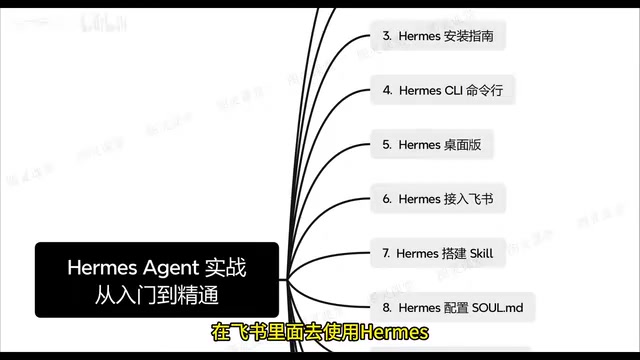
These four projects cover four directions: information aggregation, library-level integration, content generation, and code quality, basically corresponding to the most common automation needs of individual developers and small teams.
Several technical details worth noting
Feishu as the landing entry point. The course repeatedly mentions Feishu group push, indicating its design approach is to integrate the Agent's output into the team's existing communication tools rather than building a separate interface. This has reference value for enterprise implementation—lowering the usage barrier is often more important than adding features.
Standalone coverage of MCP access. Listing MCP service configuration as a separate chapter means the course believes learners need to understand the protocol layer between the Agent and external tools. There are currently few publicly available systematic Chinese tutorials on this topic, making it differentiated content of the course.
Scheduled tasks run through multiple projects. Both news push and code review rely on scheduled triggers, and the course is effectively repeatedly training the same type of orchestration capability: defining trigger conditions, organizing execution flows, and handling output results.
Combining scheduled tasks with Agent orchestration: Traditional scheduled tasks (Cron) only handle "triggering on time," while Agent-based scheduled tasks also need to complete multi-step processes such as information acquisition, judgment and filtering, content generation, and result delivery after triggering. The news push bot needs to handle information source deduplication and summarization, while code review needs to read changes, analyze issues, and generate suggestions. The difficulty in such scenarios is not the trigger itself, but enabling the Agent to execute stably unattended and handle exceptions—this is also why the course repeatedly trains the same type of orchestration capability.
Who it's for, and things to note
The course is suitable for developers with basic Python skills who want to apply Agents to real work, as well as technical leads who need to build internal automation tools for their teams. Complete beginners may struggle with the architecture and MCP configuration sections.
It's worth noting that the course title carries obvious platform traffic phrasing ("most complete and detailed," "hard to find in full"), and the actual depth of content should still be judged by the preview chapters. Additionally, Agent frameworks iterate quickly, and the installation commands and configuration items in the course may change with versions; it's advisable to cross-check with official documentation when getting hands-on.
From the syllabus structure, the value of this course lies not in any single technique but in providing a complete path from concept to project integration. For developers still at the "just chatting with AI" stage, walking through this path at least builds a basic feel for Agent engineering.
One-line Summary
Break down the three-layer knowledge framework and four practical scenarios of the Bilibili Hermes Agent course.
Paragraph Summary
Based on the public syllabus of the Bilibili course "Hermes Agent in Practice: From Beginner to Mastery," this article outlines its knowledge framework. The course progresses in three layers: first building awareness of Hermes architecture and basic AI Agent concepts, then moving into hands-on installation, configuration, and MCP service access, and finally landing on four real projects—a Feishu news push bot, Python library integration, automated tech blog setup, and scheduled project code review. The article points out that using Feishu as the landing entry reflects a design approach of embedding into existing workflows, the standalone coverage of MCP indicates its role as infrastructure for connecting external tools, and scheduled tasks run through multiple projects. The course suits developers with Python basics and technical leads, but be mindful of platform phrasing and configuration changes due to framework version iterations.
Related articles

Remote Compose: A New Document-Driven Paradigm for Cross-Platform UI on Android
Remote Compose transmits compact binary documents instead of screen pixels, enabling efficient UI rendering on remote surfaces like Wear OS and widgets. This article covers its document creation API, expression animations, size optimization techniques, and Wear OS progress.

How Crashlytics Eliminates Android Memory and Responsiveness Issues
Through the Chroma Clip case study, this article explains how Firebase Crashlytics uses Application Exit Info, Profiling Manager, GWP ASAN, and ARM MTE to pinpoint ANRs, OOMs, memory limit terminations, and native memory corruption—solving the challenge of stack traces that don't point to the real culprit.

Googlebook's First Developer Case Studies: How Notability and Logitech Built Desktop-Class Android Experiences
Notability and Logitech share first-hand experience building for Googlebook: using Jetpack Compose, Navigation 3, and Jetpack Ink for desktop-class Android, plus how the peripheral customization API bridges hardware and OS.