The Most Comprehensive Agent Tutorial on Bilibili: 3 Chapters from Zero to Commercial Monetization

Bilibili creator launches a three-chapter zero-foundation AI Agent tutorial covering cognition, advanced practice, and enterprise-level implementation and monetization.
This article introduces the most comprehensive zero-foundation AI Agent tutorial on Bilibili. Targeting the polarized pain points of market tutorials that either only talk concepts or throw code directly, the course takes a middle path of building intuition first before hands-on practice. The course is divided into three chapters: the Cognition chapter explains the difference between Agents and large model conversations, the planning/reasoning and memory mechanisms of the ReAct framework, and runs through the first Demo; the Advanced chapter covers LangChain, AutoGen framework practice, multi-agent collaboration, Function Calling, and evaluation/debugging and security boundaries; the Practice chapter includes three enterprise-level projects: intelligent customer service system, automated data analysis, and multi-agent collaborative production line. The course comes with source code, courseware, Prompt templates, and a learning roadmap, obtainable for free by commenting in the comments section. It is suitable for developers with zero foundation who want to quickly reach a commercially usable level.
In an era of rapidly iterating AI technology, Agent has become one of the most closely watched directions for developers. But most tutorials on the market either pile up jargon or throw code at you directly, making it hard for beginners to truly understand how agents work. This zero-foundation AI Agent tutorial released by a Bilibili creator breaks down the complete path from cognition to commercial monetization in three chapters, and currently appears to be the most comprehensive Agent introductory content on Bilibili.
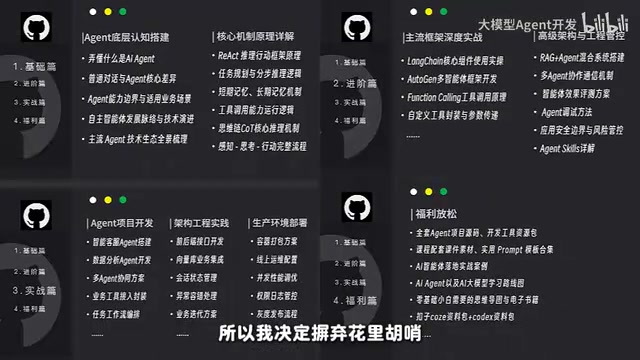
Why Can't Most Agent Tutorials Be Learned?
The creator mentions a key observation at the start: after scouring Agent-related content on Bilibili and YouTube, they found that over 90% of tutorials fall into two extremes. One is talking only about concepts—piling up big words like autonomous planning and tool calling, but never getting hands-on. The other is jumping straight into coding, where learners are already calling APIs before they even understand what problem the Agent is solving.
This disconnect leaves many people unable to independently build a usable agent even after finishing the course. Targeting this pain point, this course takes a middle path: first understand how an Agent thinks, then build one from scratch.
Cognition Chapter: Building the Foundational Cognitive Framework of Agents
The first chapter focuses on helping learners build a foundational understanding of Agents. The course answers several core questions: What's the difference between an Agent and a regular large model conversation? How exactly do the planning, reasoning, and memory mechanisms of the ReAct framework work?
To lower the barrier to understanding, the creator uses everyday analogies to explain these concepts.
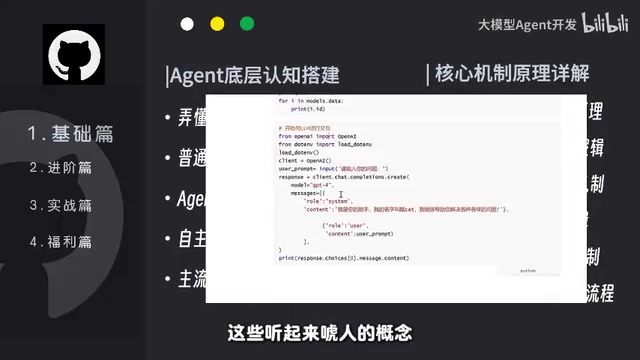
The Cognition chapter is not purely theoretical indoctrination—learners will run through their first Agent Demo and personally experience how an agent actually works. This design of building intuition first before diving into details fits the learning curve better than directly grinding through papers or API documentation.
The ReAct framework is one of the most classic reasoning paradigms in the Agent field, short for Reasoning + Acting. Its core idea is to have the large model output a piece of reasoning (Thought) before each action, then decide which tool to call (Action), then observe the result returned by the tool (Observation), looping until the task is complete. Compared to directly having the model generate a final answer, ReAct significantly improves accuracy and interpretability in complex tasks through the explicit "think-act-observe" chain. Understanding ReAct is the starting point for understanding most Agent frameworks, because the internal loops of mainstream tools like LangChain and AutoGen all draw on this pattern to varying degrees. The course explains it with everyday analogies in the Cognition chapter precisely so that learners can build intuition about the Agent decision-making process without the burden of coding.
Advanced Chapter: Framework Practice and Multi-Agent Collaboration
The second chapter enters deep technical waters, covering LangChain and AutoGen framework practice, multi-agent collaboration, Function Calling tool invocation, and hybrid architectures of ReAct and Agents.
Particularly noteworthy is the section on evaluation, debugging, and security boundaries. Currently, many Agent developers, after completing a prototype, often don't know how to systematically evaluate Agent performance, nor how to set security boundaries to prevent tool abuse. The course including this as advanced content shows the creator has a clear understanding of real-world development pain points.
Each section comes with code courseware, packaged and provided to learners, lowering the barrier to following along.
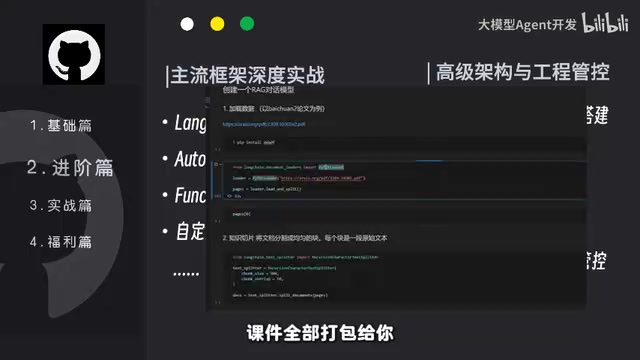
Function Calling is the standardized mechanism for large models to interact with external tools. Developers pre-describe a set of available functions using JSON Schema (such as checking weather, sending emails, querying databases), and the model decides during conversation whether to call, which function to call, and what parameters to pass based on user intent. It is the technical foundation of an Agent's "tool calling" capability, and also the most common implementation of the Action step in ReAct. LangChain provides abstraction layers such as chain orchestration, memory management, and tool integration, suitable for quickly building single-agent applications; AutoGen focuses on multi-agent dialogue and collaboration, letting multiple roles message each other to complete tasks by defining them. The two have different positioning, and the course covers both, intending to let learners master both the engineering encapsulation of single agents and the organizational approach of multi-agent systems.
Practice Chapter: Enterprise-Level Project Implementation
The third chapter directly targets commercial scenarios, including three enterprise-level projects: intelligent customer service Agent system (from intent recognition to automatic ticket routing), automated data analysis Agent (upload Excel to automatically generate reports and charts), multi-agent collaborative production line (multiple agents dividing work like a team).
What these projects have in common is that they solve real business problems rather than toy demos. After completing them, learners will be capable of independently designing and developing agent applications that solve practical problems. This is also the basis for the course's claim of enabling commercial monetization—using Agents to help enterprises replace repetitive workflow processes is itself the most direct monetization path currently.
Intelligent customer service Agent's "intent recognition to automatic ticket routing" is a typical enterprise-level chain: first use a classification model or large model to determine the intent type of the user's issue (inquiry, complaint, after-sales, etc.), then route to the corresponding processing flow based on intent, and if necessary create a ticket and dispatch it to a human agent. Automated data analysis Agent demonstrates an Agent's ability to handle unstructured input—after uploading Excel, the Agent needs to understand the table structure, choose analysis dimensions, call a code interpreter to generate charts, and finally output a report. Multi-agent collaborative production line simulates real team division of labor, for example one Agent handles requirement decomposition, one handles execution, and one handles quality inspection, collaborating through message passing. These three types of projects correspond to the three high-frequency commercial scenarios of customer service, data analysis, and process automation, which are also the directions enterprises are currently most willing to pay for Agents.
Learning Resources and Supporting Materials
The course comes with complete source code, courseware, Prompt templates, and an AI Agent developer learning roadmap compiled by the creator.
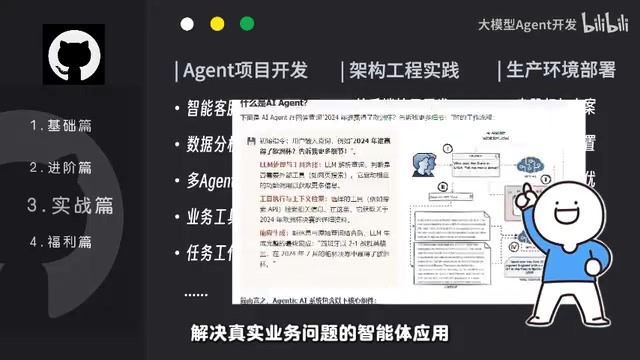
These resources can be obtained for free by commenting "Agent" in the comments section. For learners who want to systematically get started with agent development, this saves a lot of time collecting materials on their own.
The creator spent four months polishing this course, splitting the core knowledge points into three progressive chapters: Cognition, Advanced, and Practice. Even with zero foundation, following along in order will gradually build complete Agent development capabilities.
Summary
The core value of this tutorial lies in bridging the gap between "conceptual understanding" and "hands-on implementation." The three-chapter structure corresponds respectively to knowing what it is, knowing how to do it, and knowing how to use it. For developers with zero foundation who want to quickly reach a commercially usable level, this is a rare systematic introductory resource on Bilibili.
One-line Summary
A Bilibili creator launches a three-chapter zero-foundation AI Agent tutorial covering cognition, advanced practice, and enterprise-level implementation and monetization.
Paragraph Summary
This article introduces the most comprehensive zero-foundation AI Agent tutorial on Bilibili. Targeting the polarized pain points of market tutorials that either only talk concepts or throw code directly, the course takes a middle path of building intuition first before hands-on practice. The course is divided into three chapters: the Cognition chapter explains the difference between Agents and large model conversations, the planning/reasoning and memory mechanisms of the ReAct framework, and runs through the first Demo; the Advanced chapter covers LangChain, AutoGen framework practice, multi-agent collaboration, Function Calling, and evaluation/debugging and security boundaries; the Practice chapter includes three enterprise-level projects: intelligent customer service system, automated data analysis, and multi-agent collaborative production line. The course comes with source code, courseware, Prompt templates, and a learning roadmap, obtainable for free by commenting in the comments section. It is suitable for developers with zero foundation who want to quickly reach a commercially usable level.
Related articles

How Big Can Stars Really Get? The Physical Limits of the Largest Stars
Red supergiants are the largest stars by volume, with radii up to 2,000 times the Sun, engulfing the inner solar system. But there is no precise upper limit on stellar size—models predict up to 15,000 solar radii. The most massive blue stars are far smaller than red supergiants—biggest and heaviest are two different things.

Apple HomeView Smart Display Full Feature Breakdown: Wall-Mount or Desktop, $299
Apple launches HomeView, a $299 smart display with wall-mount and desktop options, 12MP camera for facial recognition, smart home control, music playback, and recipe step-by-step cooking. Full breakdown of watch faces, apps, privacy, and cooking integration.

Where Did the Promised New Studio Go? Craft Computing Answers After Five Years
Craft Computing's host responds to viewer questions: the new studio promised five years ago was shelved as construction costs soared from $30,000 to $75,000, and was replaced by a 168-square-foot garage conversion.