The Mystery of Composer 3's Disappearance: Replaced by Grok 4.5 or Still in Development?

Cursor's promised Composer 3 model has mysteriously disappeared from docs, replaced by Grok 4.5.
Cursor once previewed Composer 3, a proprietary 1.5T+ parameter model trained on 100K+ GPUs, but it has since vanished from official documentation with Grok 4.5 taking its place. The community speculates it was either repackaged as Grok 4.5, delayed in development, or strategically abandoned. This reflects a broader industry tension between building proprietary models and integrating third-party ones, with Cursor seemingly pivoting toward Agent architecture over raw model development.
Composer 3 Has Completely Vanished from Official Documentation
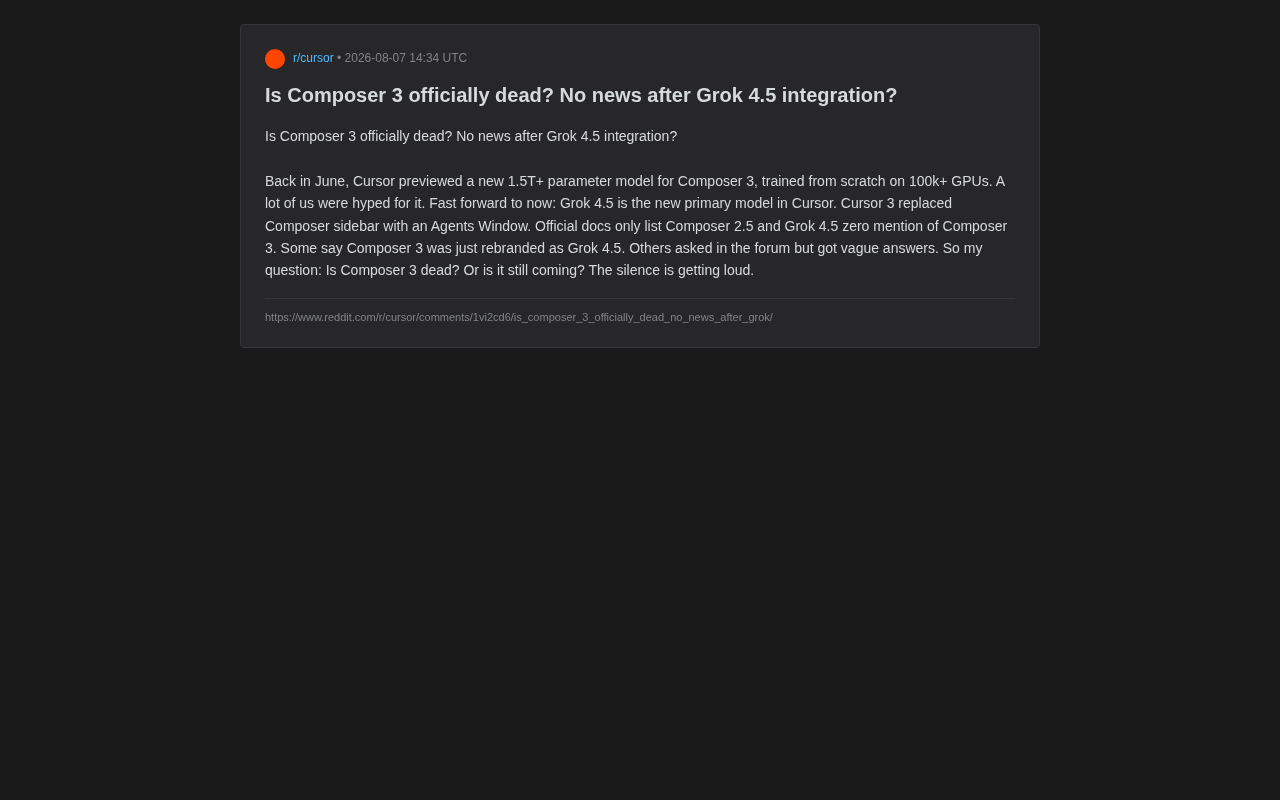
Back in June, Cursor previewed a brand-new proprietary model—Composer 3. Based on information that surfaced at the time, this was a heavyweight model with over 1.5 trillion parameters, trained from scratch on 100,000+ GPUs.
These specs are top-tier by industry standards. For reference, GPT-4 is widely speculated to have around 1.8 trillion parameters (using a Mixture of Experts architecture), Meta's LLaMA 3 maxes out at 405B parameters, and Google's Gemini Ultra is reportedly in the trillion-parameter range as well. A training cluster of 100,000+ GPUs means coordinating multiple large-scale data centers. At current H100 GPU market prices, hardware procurement costs alone could exceed $3 billion, and with power, cooling, and personnel costs factored in, the total investment could reach the $5-10 billion range. This level of spending is typically only feasible for giants like OpenAI, Google, and Meta—so Cursor claiming such capabilities as a developer tools company naturally drew enormous attention.
For developers who have long relied on Cursor for AI-assisted programming, this was undoubtedly a shot in the arm, and the community was buzzing with anticipation.
However, the situation has shifted subtly since then. Grok 4.5 has become Cursor's new flagship model, and Cursor 3's interface has replaced the original Composer sidebar with an entirely new Agents Window. Even more puzzling, the official documentation only lists Composer 2.5 and Grok 4.5, with absolutely no mention of Composer 3.
Some background on Grok 4.5 is worth explaining here: Grok is a large language model series developed by xAI, Elon Musk's AI company. Grok 4.5 is the latest iteration in the series, excelling in code generation, reasoning, and multimodal understanding. xAI massively expanded its compute infrastructure between 2024-2025, with its Memphis-based supercomputing cluster "Colossus" housing over 100,000 H100 GPUs—one of the world's largest AI training clusters. The Grok series has been particularly impressive on programming tasks, which explains why Cursor chose it as their flagship model.
This prompted a Reddit user to pose a pointed question: Is Composer 3 dead? The silence is growing increasingly "loud."
Three Prevailing Community Theories About Composer 3's Fate
Several different interpretations are circulating in the community around Composer 3's "disappearance," each worth analyzing individually.
Theory 1: Composer 3 Was Repackaged as Grok 4.5
The most popular view holds that Composer 3 didn't disappear—it was "reborn" under the Grok 4.5 name. This isn't entirely baseless—Grok 4.5 assumed the flagship position that Composer once held in Cursor, and the timelines align closely.
If this theory holds, it might reflect some kind of deep collaboration or technology licensing arrangement between Cursor and xAI. Integrating proprietary model branding with external partner models isn't uncommon in business. However, this remains speculation without official confirmation.
Theory 2: Composer 3 Is Still in Development, Just Delayed
A more optimistic view suggests that Composer 3 development hasn't been terminated—it simply hasn't met release standards yet. Training a 1.5T-parameter model is an extremely complex and costly engineering endeavor, and delays, adjustments, or even architectural overhauls are par for the course.
Common challenges in large model training include: loss spikes caused by training instability, communication bottlenecks in distributed training, performance ceilings due to data quality issues, and iterative fine-tuning during the alignment phase. OpenAI's GPT-4 went through over six months of safety testing and capability evaluation from training to release, and Google's Gemini similarly experienced multiple delays. For Cursor, with relatively limited resources, these challenges would only be more severe.
From this perspective, the absence of Composer 3 from official documentation might simply mean it's not ready for its debut—not that it's been axed. Keeping a low profile during the polishing phase is standard practice for many companies.
Theory 3: Composer 3 Has Been Strategically Abandoned
The most pessimistic interpretation is that Cursor may have paused or abandoned the Composer 3 self-development track due to cost, performance, or strategic considerations, pivoting instead to embrace mature external models like Grok 4.5.
For a company focused on developer tools, rather than pouring massive resources into training a trillion-parameter model from scratch, it may be more efficient to simply integrate industry-leading third-party models. This is a commercially sound choice. In the AI industry, the decision between "building your own model" and "integrating third-party models" is essentially a classic "build vs. buy" decision. Many successful AI application companies (like Perplexity and Jasper) have taken the integration route, building competitive advantages through application-layer innovation—validating the business logic that "you don't need to own the best model, you need to use models in the best way."
The Build vs. Integrate Debate for AI Models
Regardless of which theory proves correct, this situation reflects a key trend in the AI coding tools space: the strategic tension between building proprietary large models vs. integrating third-party models.
Training a trillion-parameter model from scratch requires astronomical compute investment—at the scale of 100,000+ GPUs, hardware and power costs alone are enough to make most companies balk. By contrast, directly integrating mature models like Grok, GPT, and Claude allows for rapid product iteration at much lower cost.
The AI coding tools market is currently in a white-hot competitive phase. Beyond Cursor, major players include GitHub Copilot (backed by Microsoft and OpenAI), Windsurf (formerly Codeium, with substantial funding), Augment Code, and various open-source model-based solutions. Competition dimensions have expanded from simple code completion to full-stack Agent capabilities: including codebase-level context understanding, multi-file editing, automated test generation, and terminal command execution. Against the backdrop of increasingly homogeneous underlying models, product-level differentiation—such as context window management strategies, Retrieval-Augmented Generation (RAG) implementation, and UX fluidity—is becoming the decisive factor.
For a tools company like Cursor, its core competitive advantages lie more in product interaction, context management, and Agent workflows—application-layer innovations rather than the underlying model itself. The upgrade from a Composer sidebar to Agents Window demonstrates that Cursor is shifting its focus toward building Agent capabilities, rather than simply stacking model parameters.
Agents Window represents the core architectural trend in current AI applications. Unlike traditional single-turn Q&A interactions, Agents can autonomously plan tasks, invoke tools, read and write files, execute commands, and iteratively self-correct based on feedback. This shift reflects the industry's paradigm leap from "AI-assisted" to "AI-autonomous execution"—developers no longer need to guide AI line by line, but can describe high-level intent and let the Agent independently complete complex multi-step programming tasks. From this perspective, Cursor redirecting resources from model training to Agent architecture may be a more forward-looking strategic choice.
What Cursor's Vague Response Signals
According to the original poster, users have already inquired about Composer 3's whereabouts on the official forum, only to receive ambiguous replies. This "neither confirm nor deny" attitude often generates more community anxiety than clear bad news.
From a product communications standpoint, vague responses could stem from several reasons: the product direction hasn't been finalized, making external commitments inappropriate; commercial agreements with partners (like xAI) prevent public disclosure of details; or they want to avoid impacting existing users' usage expectations and subscription decisions.
But regardless of the rationale, prolonged silence around a product that was once loudly previewed and highly anticipated by the community does erode trust. This is particularly sensitive in open-source and developer tool communities—developers inherently value transparency and honest communication. They'd rather hear a candid "we changed direction" than face endless silence. Transparent communication often sustains community relationships better than a delayed model ever could.
What Developers Should Focus On
As of now, Composer 3's fate remains an unsolved mystery. It may have transformed into Grok 4.5, it may still be being refined behind the scenes, or it may have been quietly shelved.
For developers, rather than fixating on the survival of any particular model, it's better to focus on whether the tool itself continues to deliver an excellent programming experience. After all, in this era of rapid model iteration, today's "star model" might be surpassed by something stronger in just a few months. A more pragmatic approach is to evaluate the tool's overall ecosystem: Are its Agent capabilities powerful enough? Is context understanding accurate? Is multi-file editing smooth? Is integration with development workflows seamless? These application-layer capabilities affect daily development efficiency far more than which underlying model is being used.
What's truly worth anticipating is whether Cursor can provide a clear, honest answer—whether that's Composer 3's return or a candid acknowledgment of a new direction. This increasingly "loud silence" will eventually need to be broken.
Related articles

Fei-Fei Li on AI: Visual Intelligence, the Boundaries of Creativity, and Human Agency
Stanford professor Fei-Fei Li discusses AI and visual science on Huberman Lab, explaining how ImageNet ignited modern AI, AI's capability boundaries, healthcare applications, and why human agency is the central question in AI development.

DeepSeek Harness Hands-On Review: Core Advantages of a Plugin-Based Agent Framework
Hands-on review of DeepSeek Harness open-source Agent framework, analyzing its plugin architecture, coding capabilities, deployment, and comparison with Claude Code.

Building a 500K Domain Search Engine for $10: Lessons from an Indie Developer's Weekend Project
An indie developer built a 500K domain vertical search engine in one weekend for $10. We analyze the tech stack, vertical search opportunities, and rapid validation methodology.