The n8n AI Bookkeeping Trap: When "Success" Extracts Nothing

An unanchored regex mistook "subtotal" for "total," revealing why silent failures are more dangerous than errors in AI invoice parsing.
This article examines a real bug in an AI bookkeeping system where the pipeline succeeded but produced wrong results. An unanchored regex matched "subtotal" before "total," causing two invoices to be under-read by roughly the tax amount ($284–$285) with no errors thrown. The fix draws from a Google project's design philosophy: every extracted number carries its source line for full auditability. A click-to-highlight review UI shows human-readable original sentences — not raw parsed strings — dramatically cutting per-document review time. Four core lessons: watch for false successes, test with real data, preserve provenance, and design for human reviewers.
When the Tool Reports "Success" but Extracts Nothing
An AI-powered automated bookkeeping workflow returned a success status — but extracted zero meaningful data. This is the most insidious failure mode when building invoice parsing systems: the pipeline runs to completion, no errors are thrown, but the output is wrong. On automation platforms like n8n, this kind of "false success" is more dangerous than an outright error, because it silently corrupts your books.
The root cause is a seemingly harmless string match: the word "subtotal" contains the word "total". When a parser uses an unanchored regex to find "total," it hits the "subtotal" line first.
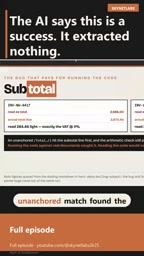
One String Match, One Accounting Error
The result is a real dollar discrepancy. Two invoices were each under-read by $284 and $285 respectively — amounts that happen to equal the tax on each invoice. In other words, the parser grabbed the pre-tax subtotal instead of the post-tax total that should have been recorded. For a bookkeeping system, this kind of error is enough to invalidate the entire ledger.
The key insight: you cannot find this bug by reading the code. The logic looks perfectly correct. Only by running real code against real documents — letting it collide with the actual layout of real invoices — does the "subtotal trap" surface.
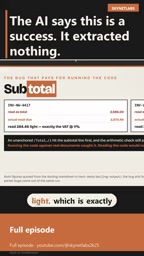
This is a reminder for everyone building AI document extraction: when dealing with real-world invoices in all their formatting variety, testing must be data-driven with real documents — not validated on clean samples that "look right."
An unanchored regex is a pattern that lacks boundary assertions (such as \b for word boundaries, ^ for line start, or exact field terminators) to constrain the match. When searching for total, an unanchored engine scans the full text and treats any position containing that character sequence as a match — subtotal, grand total, and total_amount all trigger it. Anchored patterns like \btotal\b or (?<![a-z])total(?![a-z]) enforce that "total" cannot be immediately preceded or followed by other letters, ruling out false matches like "subtotal." Since invoice documents have a fixed field order (subtotal before total), an unanchored match will naturally be "stolen" by the subtotal line that appears first — and once the parser takes the first match, it typically stops searching, booking the subtotal as the final total.
Making Every Number Carry Its Source
The solution draws inspiration from a Google project — the pattern of thinking was reconstructed; no code was copied. The core idea is simple yet powerful: every number this tool extracts carries with it the original line of text it came from.

This "data provenance" design transforms AI extraction from a black box into an auditable pipeline. Every field the model pulls out can be traced back to a specific location in the source document, rather than being an isolated number stripped of context.
This approach is known in data engineering as data lineage or extraction provenance. Traditional document parsing pipelines output only structured field values (e.g., total: 1284.00). When a value is wrong, debugging requires re-running the entire pipeline to locate the source. A provenance-aware design records, alongside each value, which line of the document it came from and what the original text said — creating a bound "value–source" pair. This not only makes post-hoc auditing straightforward, it also provides a basis for downstream confidence scoring: if the source line contains both "subtotal" and a number, the system can proactively flag it as a low-confidence candidate for human review, rather than silently writing it to the ledger.
Human-Machine Collaboration: Click a Field, Highlight the Source
The true value of provenance shows up during manual review. When a reviewer opens a pending record and clicks on any field, the corresponding original sentence lights up.
Better yet, what's shown is the line of text as a human would read it — not the stripped, cleaned version the parser actually used for matching. The machine matches against a de-formatted string, but the human sees the full, natural sentence. Keeping these two representations separate naturally improves review efficiency.
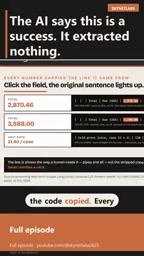
The impact is immediate: review time per document drops dramatically from the original two minutes. For bookkeeping workflows that process large volumes of invoices, this kind of human-machine efficiency gain compounds significantly.
Lessons for AI Document Extraction
This small case study distills several core lessons for building reliable AI document processing systems:
- Watch out for false successes: A success status does not mean a correct result. You need independent validation mechanisms (like cross-checking tax amounts) to catch silent errors.
- Test with real data: Problems invisible to code review will be exposed by the format diversity of real documents.
- Preserve provenance: Binding each extracted value to its source text is the foundation of auditability and trustworthiness.
- Design review interfaces for humans: Showing human-readable original sentences rather than raw machine-matched strings significantly reduces review overhead.
As AI takes on more responsibility in high-precision domains like finance and legal work, this engineering philosophy — explainable, traceable, with a human safety net — often matters more than model parameter counts in determining whether a system is truly production-ready.
The silent error mentioned in this article is the most troublesome failure category in automated systems. Unlike explicit errors that throw exceptions, silent errors let the pipeline complete normally with a success status code, while the output data has quietly drifted from expectations. Common defenses in financial contexts include: cross-validation (verifying mathematical constraints like "subtotal + tax = total"), anomaly detection (triggering alerts when amounts deviate from historical averages beyond a threshold), and sampled manual review. The shared logic behind all these mechanisms is — never trust a "success" signal from a single source; instead, seek verification from the internal consistency of the data itself. On low-code automation platforms like n8n, these validation nodes are often less valued than the core extraction logic, but they are precisely the last line of defense for system trustworthiness.
Related articles

Free Unlimited Claude Code Solution: Agnes AI + CC Switch Setup Guide
No paid subscription needed — pair the free AI platform Agnes AI with the open-source tool CC Switch to provide a backend for Claude Code, enabling unlimited free calls to text, image, and video models. This guide covers the full setup, test results, and usage boundaries.

A Complete Zero-Cost Guide to Getting Started with Claude Code for Beginners in China
A beginner's guide to Claude Code for users in China: two installation methods (command line and IDE plugin), full configuration steps for replacing the official API with the free domestic LongCat model, and a hands-on demo of building a small tool with natural language, plus tips.

When the NSA Gets Involved: The AI Supply Chain Crisis Behind Open-Source CVEs and API Key Hijacking
Multiple open-source projects disclosed severe CVEs in one day, PHP flaws alarmed the FBI, and Railway and OpenCode were breached with API keys stolen. This article breaks down the vulnerability window, AI-accelerated exploitation, and the AI supply chain crisis behind the API key black market, with a developer defense checklist.