The Open-Weight Model Alliance: The Dual Game of AI Safety and American Competitiveness

Exploring how open-weight model alliances balance AI safety through transparency with maintaining U.S. competitive edge.
This article examines the strategic significance of open-weight model alliances, analyzing how AI openness simultaneously serves digital safety and national competitiveness. It explores the technical spectrum from closed-source to fully open models, the security logic of transparency-enabled safety versus risks of guardrail removal, the geopolitical dynamics driving ecosystem competition, and how alliance-building is reshaping AI governance.
The Industry Signal Behind a Brief Statement
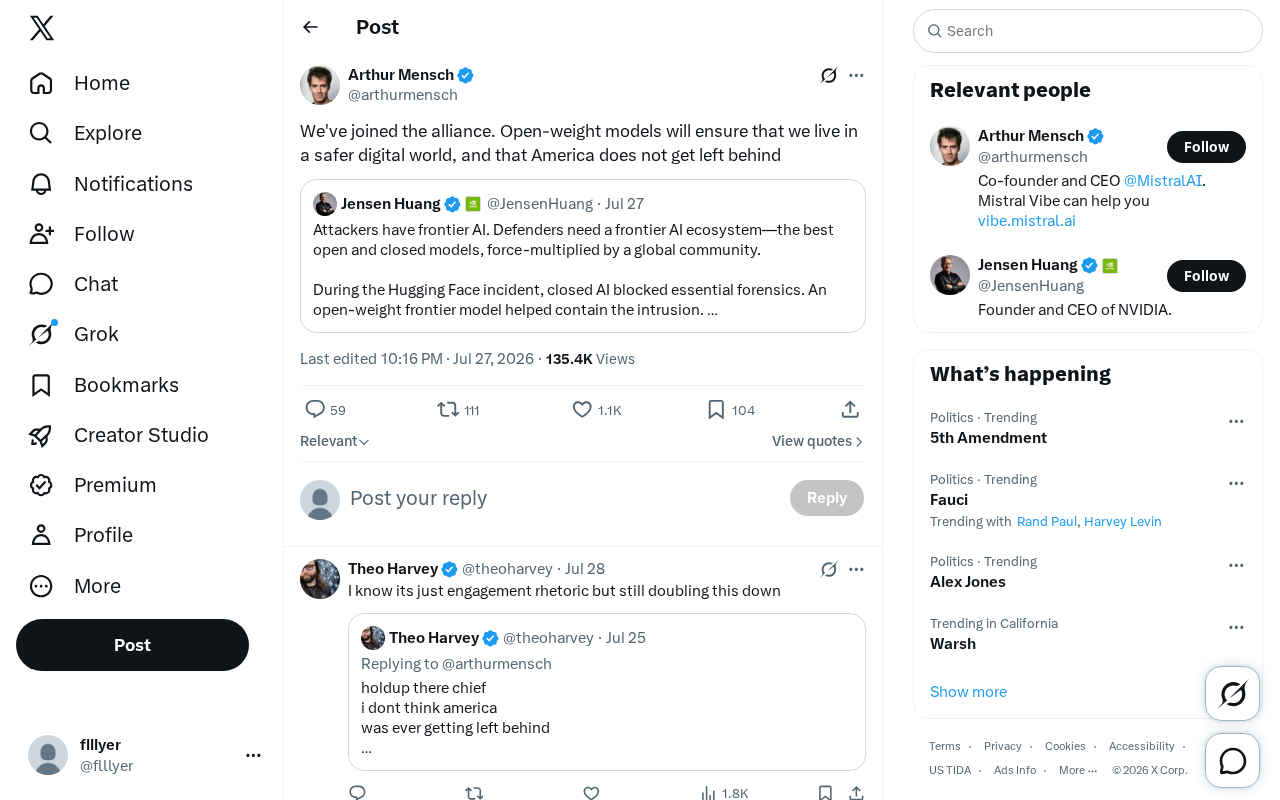
Recently, a brief statement from the tech world caught widespread attention: an AI organization announced its decision to join an open-weight models alliance, citing two core reasons—ensuring we live in a safer digital world, and ensuring America doesn't fall behind in the AI race.
This seemingly simple statement condenses the two most critical threads in global AI development today: the relationship between technological openness and safety, and geopolitical competition in AI. Understanding these two points helps us see why open-weight models have become a focal point of industry debate.
What Are Open-Weight Models
From Closed-Source to Open: A Spectrum
Before diving into this statement, it's essential to clarify the concept of "open-weight models." The openness of AI models isn't a simple binary of "open-source" versus "closed-source"—it's a continuous spectrum:
- Fully closed-source models: Like early GPT-4, where users can only access the model through APIs without access to model weights, training data, or architecture details.
- Open-weight models: The model's weight parameters are publicly released, allowing developers to download, deploy, and fine-tune them. Examples include Meta's Llama series and some of Mistral's models. However, it's important to note that open weights don't equate to fully open source—training data and complete training pipelines are often not disclosed.
- Fully open-source models: Weights, code, training data, and training methods are all publicly available.
Open weights have become the mainstream approach because they strike a balance between "usability" and "commercial/safety considerations": enterprises and researchers can deploy locally and build on top of the models, while model providers don't need to fully expose their training details.
What Are Model Weights, Exactly?
To understand the significance of "open weights," you first need to understand the technical meaning of weights themselves. Model weights are the numerical parameters stored in a neural network after training—essentially a collection of billions or even trillions of floating-point numbers. These numbers encode all the knowledge and patterns the model learned from its training data. A large language model's weight files can occupy tens to hundreds of gigabytes of storage. Having the weights means you can run model inference on local hardware, and you can further train the model on domain-specific data through fine-tuning techniques to adapt it to specialized scenarios. This is why the degree of weight openness directly determines the freedom available to external developers—it essentially puts the model's "brain" in the hands of the community.
Why Open-Weight Models Can Build a Safer Digital World
The Core Logic: Transparency Enables Safety
The statement's claim that open-weight models can "ensure we live in a safer digital world" builds on a core belief long held by the open-source community: transparency enables safety.
This logic has been repeatedly validated in traditional software security. When model weights are made public, researchers worldwide can audit them, conduct red-teaming, and hunt for vulnerabilities, thereby discovering potential risks earlier—such as biases, jailbreak vulnerabilities, or tendencies toward harmful outputs. In contrast, closed-source models rely entirely on internal teams for security, making external oversight difficult.
The concept of red-teaming originates from military exercises, where a group is assigned to simulate enemy attacks against one's own defense systems. In AI safety, red-teaming refers to security researchers systematically attempting to make a model produce harmful, inappropriate, or dangerous outputs. Methods include adversarial prompting, jailbreaking, and probing model behavior in extreme scenarios. When model weights are public, researchers can go beyond black-box testing (interacting only through inputs and outputs) to perform white-box analysis—directly examining the model's internal activation patterns and attention mechanisms. This enables a deeper understanding of why a model produces specific outputs, making vulnerability discovery more efficient and thorough.
Furthermore, open weights reduce the risk of AI capabilities being monopolized by a few giants. When powerful models are controlled by only a handful of companies, society lacks counterbalancing mechanisms if misuse or abuse occurs. Openness allows more organizations, governments, and academia to independently verify model behavior.
The Counter-Argument: Does Openness Introduce New Risks?
Of course, this argument is controversial. Critics argue that publicly releasing the weights of powerful models could equally be exploited by malicious actors—for example, removing safety guardrails, mass-generating disinformation, or producing malicious code. This is one of the biggest points of contention in AI governance today: does openness increase safety, or does it introduce new risks?
Understanding this debate requires knowledge of how safety guardrails are technically implemented. AI model safety guardrails are typically achieved through multiple layers of technical measures: first, alignment techniques during training, such as Reinforcement Learning from Human Feedback (RLHF) and Direct Preference Optimization (DPO), which make the model inclined to refuse harmful requests; second, filtering systems during inference, including malicious prompt detection on the input side and harmful content filtering on the output side. When model weights are made public, technically capable individuals can weaken or remove the effects of this alignment training through fine-tuning—a process with relatively low computational cost that may require only consumer-grade GPUs and minimal data. This is the technical root of the safety controversy around open weights—the "removability" of guardrails makes risk assessment for open-weight models complex.
The statement takes the "openness equals safety" position, which is itself a declaration of values.
American AI Competitiveness and the Geopolitical Game of Open Weights
AI as a National Strategic Resource
The statement's second rationale is more politically charged—"ensuring America doesn't fall behind." This reflects that AI has elevated from a purely technical topic to a matter of national competitiveness.
In recent years, the global AI landscape has become increasingly multipolar. Beyond the United States, China has invested heavily in large models, producing competitive open-weight models including DeepSeek and Qwen. Europe is pursuing a differentiated path through companies like Mistral and the regulatory framework of the AI Act. The Middle East, backed by sovereign wealth funds, is also actively building AI infrastructure. This multipolarization means that any single nation's strategy of maintaining its lead through technology lockdown faces challenges—when competitors already possess open models of comparable capability, staying closed-source may actually limit the development speed and breadth of one's own ecosystem.
The rise of open-weight models means that any nation or organization with compute and talent can rapidly build applications on top of powerful foundation models. If America's top institutions cling to closed-source approaches while other regions iterate quickly through open ecosystems, the U.S. could actually fall behind in ecosystem vibrancy and developer scale.
The Strategic Value of Open Ecosystems
Historical experience shows that open standards tend to build broader ecosystem moats. Android in mobile operating systems and Linux in server infrastructure are classic examples. Opening model weights means attracting global developers to build tools, applications, and knowledge systems around this technology stack, thereby establishing de facto standards.
The core mechanism by which open standards build ecosystem advantages lies in network effects and the accumulation of switching costs. Take Linux as an example: it grew from a personal project in 1991 to the underlying system powering over 90% of global cloud servers and all Android devices, thanks to the vast toolchain, driver ecosystem, and talent pool formed around its kernel. Once developers accumulate knowledge and code assets on a particular technology stack, the cost of migrating to alternatives continues to increase. In AI, if a particular open-weight model becomes the de facto standard, the fine-tuning datasets, deployment tools, inference optimization frameworks, and application-layer code built around it will create a powerful lock-in effect—while the model itself is open, the ecosystem's inertia will continue to bring influence to the original contributor.
From this perspective, "joining an open-weight alliance" is not just a technical choice but a form of ecosystem positioning. Whoever commands the most active developer community holds the initiative in long-term competition.
Alliance-Building: A New Paradigm in AI Governance
From Going It Alone to Collective Action
You might not have noticed, but the keyword in this statement is "joining an alliance." This means the advancement of open weights is evolving from individual corporate behavior into multi-party collaborative collective action.
The significance of alliance-building lies in its ability to establish common technical standards, safety norms, and governance frameworks. A single organization opening a model might be a business strategy, but multiple organizations forming an alliance is closer to establishing industry consensus and public infrastructure. This helps distribute risk, pool resources, and more easily form unified positions in dialogue with regulators.
Alliance-building in AI is not a new phenomenon. Several similar organizations already exist, such as the Frontier Model Forum (established by Google, Microsoft, OpenAI, Anthropic, and others) focused on frontier model safety research, and the Open Source Initiative (OSI) promoting standardization of open-source definitions for AI. These alliances typically function by establishing common model release protocols (such as risk assessment processes and capability evaluation benchmarks), sharing safety research findings, and coordinating responses to regulatory proposals. An alliance's authority derives from the representativeness of its members—when major model providers jointly sign a set of guidelines, those guidelines can evolve into de facto industry standards that then influence regulatory direction. This makes the act of "joining an alliance" itself an important vote in the contest for AI governance discourse power.
Conclusion: A Choice About AI's Future Direction
This brief statement is, in reality, a clear declaration on the direction of AI development. It bets on "open over closed," believing that transparency brings safety and that open ecosystems sustain competitiveness.
However, the tensions between openness and safety, competition and governance, are far from resolved. Whether open weights will build a safer, more prosperous digital world or introduce new risks of losing control still requires time and practice to determine. What is certain is that as more and more organizations choose to join the open camp, this industry game surrounding AI openness has only just entered deep waters.
Related articles

EmbeddedSass for .NET: A Sass Compilation Solution Without Node.js Dependencies
EmbeddedSass for .NET uses the official Embedded Sass Protocol, enabling .NET developers to compile Sass/SCSS natively without Node.js. Learn how it works and integrates with ASP.NET.

San Francisco to Singapore Time Difference: The Trans-Pacific Routine of Silicon Valley Tech Workers
SF and Singapore are 15-16 hours apart, and frequent travel between them is now routine for tech workers. Explore the time difference challenges, AI industry globalization, and talent flows.

Anthropic Launches Official Claude Code Plugin Directory: A Curated High-Quality Extension Ecosystem
Anthropic launches claude-plugins-official, a curated directory of high-quality Claude Code plugins. Learn about its positioning, core value, and impact on the AI coding ecosystem.