The Parasite Round Theorem: Why AI Self-Healing Pipelines Can Never Fix Their Own Startup

When an AI pipeline's fixer and the thing being fixed share the same process, no patch can ever take effect in the current run.
The Parasite Round Theorem states that when AI repair logic and the target being repaired run on the same process carrier, fixes physically cannot take effect in the current cycle. Three real-world dead-zone variants emerge: startup path self-lock (the fixer never gets activated), ESM module cache freeze (new code sits on disk while memory runs the old version), and queued validation delay (effects only confirm in the next run). All share one root cause: the carrier was never separated. The fixes — subprocess isolation for judgment logic, semantic idempotency over reference counting, and honest disclosure of effect timing — require no new frameworks and can be applied the same day.
Having an AI pipeline fix its own bugs sounds like the ultimate form of automation. But one developer spent seven consecutive days hitting the same brutal pattern in production — a pattern he named the Parasite Round Theorem: a pipeline that develops itself can never fix the code that makes itself start.
This isn't mysticism. It's an architectural inevitability. When the fixer and the thing being fixed run on the same carrier, the fix can never take effect in the current cycle. This article breaks down the three real-world variants he encountered, and the three principles that break the deadlock.
The Parasite Round Theorem: The Carrier Problem Between Fixer and Fixed
In one sentence: when the fixer and the thing being fixed run on the same carrier, the fix can never take effect immediately.
Imagine using process A to fix a bug in process A. The moment the fix is written, the old code is still running — new code only loads after the process restarts. The fatal case is when the code you need to fix is precisely the path that makes A start. Then there's no "next opportunity" at all: A can't boot, so there's no next run to load the fix.
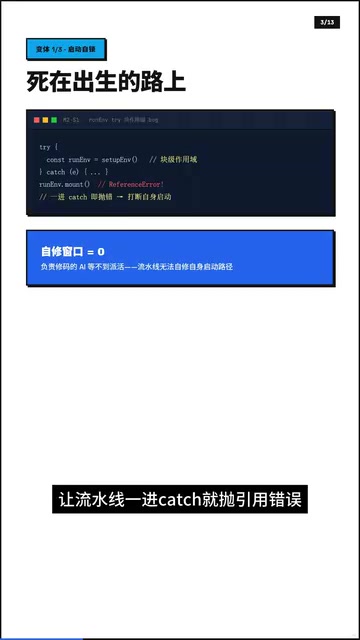
This is the fundamental reason why the AI reports "fixed" but the pipeline still won't start. The AI genuinely produced the correct patch at the logic level — but the patch lives on the same carrier as the thing being patched, making it physically impossible for the fix to take effect within the current run cycle.
Three Dead-Zone Variants: Each One More Devious Than the Last
Over seven days, the author hit three variants, each corresponding to a different scenario where the "self-repair window is zero."
Variant 1: Startup Path Self-Lock
The most archetypal case. A try block in the orchestrator that ran during the startup phase threw a reference error, causing the pipeline to crash as soon as it entered the caching stage — directly cutting off its own boot sequence. The AI responsible for fixing the code never even got assigned a task; the pipeline died before it was born.
Making matters worse, the accompanying lock-release logic used reference counting. A doubly-acquired singleton lock was acquired twice but only released once, causing the system to deadlock itself entirely. The self-repair window here is zero: the thing being fixed is the startup path itself.
Variant 2: ESM Cache-Frozen Judgment Logic
This variant is more insidious. The moment the orchestrator process started, the judgment module imported via import was cached as a frozen snapshot. The AI in the development window had correctly updated the judgment logic — but the running "referee" was still scoring with the old rules. The fix was effectively meaningless.
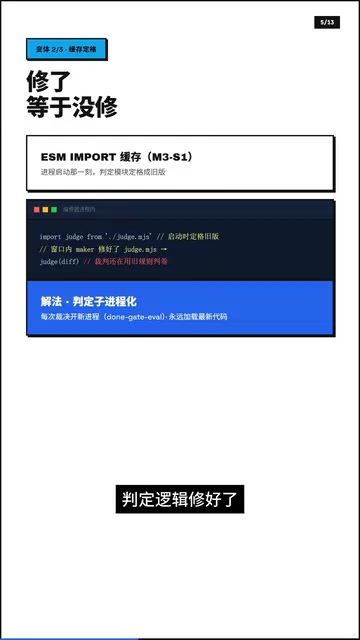
The problem lies in module caching inside long-running processes: the new code exists on disk, but what's running in memory is the old module loaded at startup. The solution is to run the judgment logic in a subprocess — spawn a fresh process for each decision, so the latest code is always loaded.
ESM (ECMAScript Modules) is the standard module format for Node.js's modern module system. Unlike the legacy CommonJS
require(), ESM'simportstatements are statically analyzed and loaded into memory once at process startup — they are never re-read from disk afterward. This means that no matter how many times you modify module files on the filesystem, as long as the host process hasn't restarted, what's running in memory is always the snapshot cached at boot. In ordinary development scenarios, this is actually a performance advantage — it avoids repeated I/O and speeds up module resolution. But in AI pipeline scenarios that require hot-updating judgment logic, it creates the precise illusion of "changed but not changed." The subprocess solution exploits the fact that process boundaries naturally clear memory caches: each new subprocess gets a fresh memory space from the OS,importre-reads from disk, and the long-running process's cache freeze is bypassed.
Variant 3: Queued Delay in Validation Results
The most grinding variant. The real effect of a fix only materializes in the next run. The author mentions two segments of a module where fixes wouldn't validate until the following cycle — and a circuit breaker mechanism that took four full runs to close out. Along the way: channel flakiness, environment corruption, missing packages, and shell timeout closure issues.
The fix itself wasn't wrong — its validation just always had to wait in line. Without recognizing this pattern, a team can fall into an endless "retry in the current run" loop, slowly burning resources.

Laid side by side, the pattern emerges clearly: the first variant has a self-repair window of zero; the second requires a process restart to take effect; the third requires the next run to validate. There is only one shared root cause: the carrier was never separated.
A Circuit Breaker is a software fault-tolerance pattern borrowed from electrical protection: when the failure rate of a downstream service or module exceeds a threshold, the circuit breaker automatically "trips," rejecting all requests during a cooldown period to prevent cascading failures. After the cooldown, it enters a half-open state, allowing a small number of probe requests through — success restores normal operation, failure triggers another trip. This mechanism inherently introduces state machine transitions spanning multiple runs, meaning the effect of a fix must go through the complete cycle of "closed → tripped → cooldown → half-open → validated" before it can be confirmed. In AI self-healing pipelines, if the fix logic is itself nested inside a circuit-breaker-protected call chain, validation delays are further amplified. The "four runs to close out" the author mentions is the result of the circuit breaker state machine overlapping with the pipeline scheduling cycle — not an indication that anything was wrong with the fix itself.
Three Principles to Break the Deadlock: Move the Referee Outside the Process
For these three dead zones, the author distilled three actionable principles.
Principle 1: Separate the Carrier
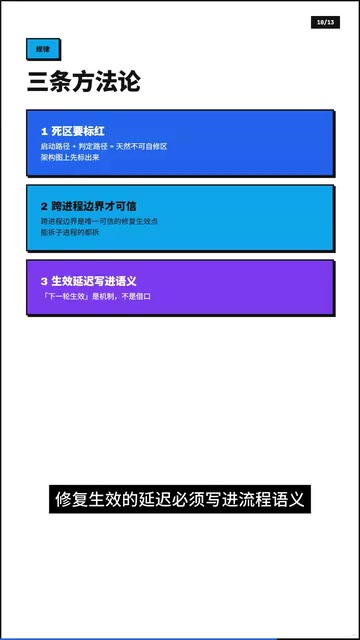
Code that needs to be fixed must never run inside the process being fixed. All judgment logic gets subprocess-ified. The cross-process boundary is the only trustworthy point at which a fix can take effect — anything that can be split into a subprocess should be. This ensures every decision is made based on the latest code on disk, not a frozen snapshot in memory.
Principle 2: Semantic Idempotency
Don't rely on reference counting for lock acquisition and release — reference counting causes self-locking. Replace it with a spec-level "exists-then-handle" check: don't count occurrences, just evaluate whether the state condition is met. That way, even if the process is triggered repeatedly, it won't deadlock itself.
Reference Counting is a common resource lifecycle management strategy: increment a counter each time a lock or reference is acquired, decrement it on release, and destroy when it hits zero. This works well in single-threaded, linear flows — but in pipelines subject to repeated triggering, abnormal interruption, or concurrent calls, it's highly prone to asymmetric counts: acquired twice, released once, and the lock can never be cleared. The semantic idempotency approach uses "does this state exist" as the sole criterion, rather than relying on "how many times was this operated" — a process-level detail. In practice, replace the counter with a boolean flag with clear semantic meaning in a database or filesystem. At any point in time, you can read current state to determine whether action is needed. Repeated triggers produce the same result without accumulating side effects. This is also the standard defensive pattern for "at-least-once delivery" scenarios in distributed systems.
Principle 3: Honest Disclosure of Delays
The fact that "this fix takes effect in the next run" must be written into the final report — it cannot be glossed over as "validated on the spot." Taking effect in the next cycle is a mechanism, not an excuse. Treat it as part of the process language and label it explicitly.
The most interesting validation happened the day the circuit breaker mechanism was built: the pipeline's own window dispatch crashed. The author used the newly built diagnostic injection channel to backfill the diagnostic bit, and the window closed out in a single run. The mechanism, built before it was even deployed, healed itself first — this "validating the validator" feedback loop was the real by-product of the entire practice.
Three Actions You Can Use Today
None of these three principles require a new framework. They can take effect the same day:
- Draw a startup dependency map for your automation system and mark the dead zones where "can't fix itself" applies in red on the architecture diagram. Startup paths and judgment paths are natural self-repair dead zones.
- Extract judgment logic from long-running processes into subprocesses so every decision carries the latest code — closing the module cache freeze vulnerability.
- Document which run a fix takes effect in and stop infinitely retrying within the current run.
The author's final insight is worth remembering: the most dangerous bug isn't the one that crashes the system — at least when it crashes, you know. The most dangerous bug is the one that makes the system unfixable, because it blocks every future repair.
What the Parasite Round Theorem teaches isn't how to recognize bootstrapping — it's to always leave a door that a human can push open from the outside. When designing any automated self-healing system, always preserve a channel through which a human can intervene externally. Otherwise, the moment you hit a dead zone, the entire system falls into an unsolvable loop with no way out.
Related articles

Frontend to AI Agent Development: A Frontline Architect Explains Career Paths and Opportunities
A frontline AI architect explains the industry changes and practical paths for frontend developers transitioning to AI Agent development: why pure frontend jobs are disappearing, why Agent + full-stack has become mainstream in hiring, and three transformation routes—Agent development engineer, FDE, and remote contracting—along with corresponding learning strategies.

How to Choose an AI Agent Development Course: Five Pitfall-Avoidance Guidelines
A mechanical-engineering career changer's two-year pitfall-tested checklist for screening AI Agent development courses: complete delivery pipeline, resume-worthy projects, real development perspective, update frequency, and coaching feedback—with concrete judgment methods and pitfall-avoidance tips.

Coze AI Agent Building for Beginners: A Zero-Code AI Agent Development Guide
Coze, ByteDance's one-stop AI application development platform, supports zero-code drag-and-drop AI agent building. This article outlines Coze's core concepts, three advantages, differences between the domestic and international versions, and the distinction between agents and apps, helping beginners quickly get started with AI Agent development.