The Persian 'Book of Snakes': How an Ancient Divination Text Finds New Life in the Digital Age

A 1892 Persian snake divination text illustrates how digital tech and AI are reviving ancient manuscripts.
An 1892 Persian divination text called MâR-Nâmeh (The Book of Snakes) recently surfaced on Hacker News, highlighting how digitization and AI are making obscure historical manuscripts globally accessible. The article explores the cultural context of snake divination in Zoroastrian tradition, the role of 19th-century Orientalist scholarship, and how modern technologies like HTR and large language models are lowering barriers to ancient text research while drawing philosophical parallels between divination and machine learning.
A Forgotten Persian Divination Manuscript
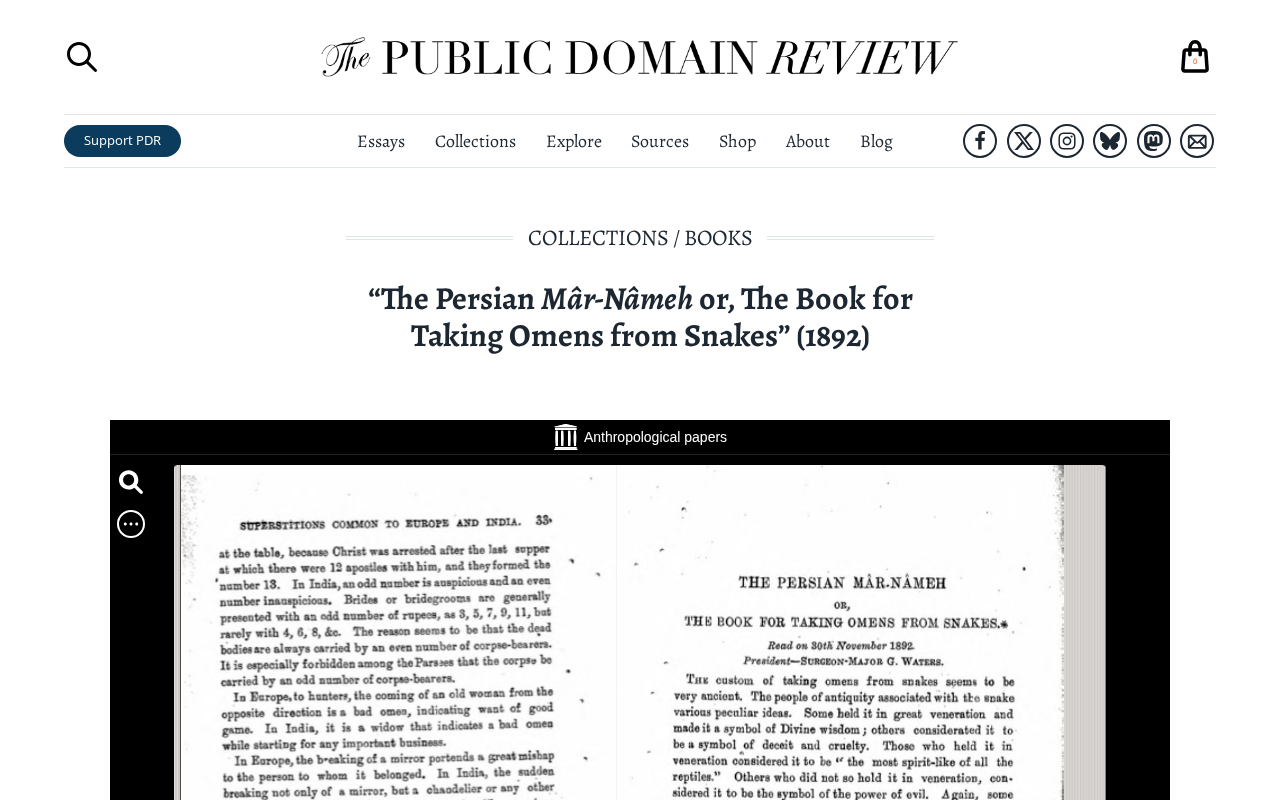
Recently, a Persian text published in 1892 called MâR-Nâmeh (meaning "The Book of Snakes," or The Book for Taking Omens from Snakes) sparked a small but fascinating discussion on Hacker News. The core content of this work is a knowledge system detailing how ancient Persians practiced divination by observing snakes' behavior, the directions from which they appeared, and related omens.
While such a topic might seem more at home in the realms of folklore and religious history today, the fact that it surfaced on the technically-minded Hacker News community reflects a phenomenon worth noting: digitization technology is bringing vast quantities of nearly lost historical documents back into public view. The 1892 edition of this document is one of many products of the late modern wave of Orientalist research—collected, translated, and printed during that era.
The Historical Context of Snake Divination
Divination as an Ancient Knowledge System
In pre-modern societies, divination was not mere superstition—it was a knowledge system that attempted to explain and predict an uncertain world. From Chinese oracle bones and the I Ching, to Roman augury, to Persian snake divination, humans in the age before modern scientific tools constructed causal relationships and decision-making frameworks by observing natural phenomena.
What the Book of Snakes records is a complete symbolic system within Persian culture that uses snakes as objects of observation. Snakes carry powerful symbolic significance across many ancient civilizations—representing both wisdom and healing (as in the medical caduceus) and danger and mystery. This duality made them ideal vehicles for divinatory practice.
In Persian culture, the tradition of snake divination is closely tied to the cosmology of Zoroastrianism. Zoroastrianism understood the world as a battlefield of dualistic opposition between good and evil. Within this system, snakes were typically associated with the evil force Angra Mainyu, yet were simultaneously regarded as sacred messengers bearing omens. This contradiction gave the mere appearance of a snake an intensely rich space for symbolic interpretation—a snake appearing from the left versus the right, during daytime versus nighttime, corresponded to entirely different judgments of fortune or misfortune. Notably, this classification system based on direction and time actually constitutes a remarkably sophisticated symbolic matrix, with combinatorial complexity far exceeding what most people imagine when they think of "divination."
The Scholarly Value of the 1892 Edition
The year 1892 is a crucial marker. The late 19th century was the height of European Orientalism, a period when vast quantities of Persian, Arabic, and Sanskrit texts were systematically translated, annotated, and published. The modern printed edition of this Book of Snakes is a product of that academic movement, preserving for future researchers content that might otherwise have been lost from oral tradition or scattered manuscripts.
During this wave of Orientalist scholarship, several important academic centers and publishing institutions emerged. Oxford University's Sacred Books of the East series (1879–1910), edited by Max Müller, systematically translated 50 volumes of Eastern religious classics spanning Hinduism, Buddhism, Zoroastrianism, and Islamic texts. Similarly, France's Société Asiatique and Germany's Oriental societies were actively organizing Persian-language documents. The 1892 edition of the Book of Snakes was born within this scholarly ecosystem—researchers typically obtained raw materials from manuscript collections in Persia and Central Asia, then collated and annotated them before publishing as academic works in very small print runs, circulating only among specialist scholars. Precisely because of this, such documents became extremely rare in the century after publication, until the digital wave gave them new life.
The Revival of Ancient Texts in the Digital Age
From Dusty Archives to Globally Accessible Knowledge
The fact that this document appeared in a tech community and was widely shared is itself a microcosm of the Digital Humanities wave. Ancient texts that were once locked away in library special collections, accessible only to a handful of experts, are now being opened to ordinary readers worldwide through high-resolution scanning, OCR recognition, and online archiving.
The Internet Archive, Google Books, and various university digital collection projects have already digitized millions of historical documents. The fact that an obscure Persian text on snake divination caught the attention of a technology community demonstrates precisely how this accessibility is breaking down barriers between disciplines and cultures.
The process of digitizing ancient texts is far from a simple matter of photographing and uploading. Take the Internet Archive as an example: their book scanning equipment (such as the Scribe system) features specially designed V-shaped book cradles that can scan page by page without damaging bindings. For documents in Persian and other languages using Arabic script, OCR recognition is far more challenging than for Latin characters—different letters take different forms depending on whether they appear at the beginning, middle, or end of a word, and combined with the cursive connections and decorative calligraphy in manuscripts, recognition accuracy has long remained below 70%. In recent years, deep learning-based HTR (Handwritten Text Recognition) technology has been improving this situation. Tools like Transkribus have achieved significant breakthroughs in Arabic manuscript recognition, enabling large-scale document digitization to move from mere "image archiving" to truly "searchable text resources."
New Possibilities AI Brings to Ancient Text Research
With the development of large language models and multimodal AI, the barriers to studying such ancient texts are being further lowered. AI can assist with the transcription and translation of Old Persian, recognize blurred handwriting in manuscripts, and even conduct cross-textual comparative analyses of divination systems across different cultures.
In the field of AI-assisted ancient text research, several milestone achievements have already been made. In 2019, DeepMind's Ithaca system was able to restore missing characters in ancient Greek inscriptions with 62% accuracy (compared to just 25% for human experts). In 2023, a Hebrew University team successfully used AI to decipher previously unreadable content from carbonized Dead Sea Scrolls. For Persian-language documents, Stanford University's Open Islamicate Texts Initiative (OpenITI) is building a large-scale digital text corpus of Islamic civilization, having already collected over 10,000 Arabic and Persian works, laying the foundation for training language models specifically targeting historical documents.
For historians and folklore researchers, this means they can process massive volumes of documents in shorter timeframes, discovering patterns and connections that were previously imperceptible. A single Book of Snakes may seem insignificant, but the collection of thousands of similar documents will become invaluable corpora for training and validating cultural AI models.
Why a Tech Community Would Care About a Divination Text
Curiosity-Driven Cross-Disciplinary Knowledge Exploration
The Hacker News community has always been known for its intense curiosity about obscure and unusual knowledge. A Persian text about "taking omens from snakes" perfectly satisfies the tech community's desire to explore the boundaries of human knowledge. It reminds us that while pursuing cutting-edge AI technology, looking back at how humans constructed early knowledge systems can be equally profoundly inspiring.
The Philosophical Echo Between Ancient Divination and Modern Machine Learning
From a broader perspective, divination systems attempt to infer future outcomes from limited observations—a logic that has a subtle philosophical resonance with modern machine learning's extraction of patterns from data for prediction. Of course, the two differ enormously in methodological rigor, but this "predictive impulse" spanning millennia is itself a thought-provoking topic.
From a cognitive science perspective, the similarity between divination systems and machine learning is deeper than it appears on the surface. Both rely on "feature selection"—a diviner choosing to observe a snake's color, direction, and timing as input features, much like a machine learning engineer selecting data dimensions. Both also face the risk of "overfitting"—the excessive interpretation assigned to single events in divination systems is analogous to a model's overfitting to training data. The crucial difference, of course, is that modern machine learning has explicit validation mechanisms (such as cross-validation and A/B testing), while ancient divination systems primarily relied on confirmation bias to maintain their credibility—people tend to remember accurate predictions and forget failed ones. This also explains how divination systems could persist in society for millennia despite lacking actual predictive power.
Conclusion: Using New Technology to Awaken Sleeping Cultural Heritage
Though the Persian Book of Snakes was merely a niche share in a tech community, it serves as a small window through which we can glimpse the intersection of ancient knowledge, Orientalist scholarship, and modern digital technology. In an era when AI is advancing at full speed, how to use new technology to preserve, understand, and reactivate these dormant treasures of human cultural heritage may be a question even more worth contemplating than divination itself.
When we survey the long history from ancient snake divination to modern artificial intelligence, we see not only the progress of methodology, but also humanity's eternal impulse to seek knowledge in the face of uncertainty. Technology changes, but the deep human desire to understand the world and predict the future has never wavered. And the true power of digital technology may lie not only in creating new knowledge, but in bringing ancient wisdom—submerged by time—back into the light.
Related articles

EmbeddedSass for .NET: A Sass Compilation Solution Without Node.js Dependencies
EmbeddedSass for .NET uses the official Embedded Sass Protocol, enabling .NET developers to compile Sass/SCSS natively without Node.js. Learn how it works and integrates with ASP.NET.

San Francisco to Singapore Time Difference: The Trans-Pacific Routine of Silicon Valley Tech Workers
SF and Singapore are 15-16 hours apart, and frequent travel between them is now routine for tech workers. Explore the time difference challenges, AI industry globalization, and talent flows.

Anthropic Launches Official Claude Code Plugin Directory: A Curated High-Quality Extension Ecosystem
Anthropic launches claude-plugins-official, a curated directory of high-quality Claude Code plugins. Learn about its positioning, core value, and impact on the AI coding ecosystem.