The Rise of the AI Moderates: Finding Middle Ground Between Hype and Doom

AI moderates are rising between hype and doom, rejecting false binaries to focus on concrete problems.
As AI debate fractures between accelerationist hype and existential doom, a cohort of thinkers is carving out a more measured middle ground. Francis Fukuyama has grown more skeptical of accelerationism while acknowledging certain risks, particularly from agentic AI. Researchers Kapoor and Narayanan argue that cybersecurity — not abstract catastrophe — is the most actionable near-term risk. And Hollywood's Jeffrey Katzenberg contends that technological change is ultimately settled not by technology itself, but by the negotiated terms surrounding it. Together, these voices share a posture — not an ideology — defined by rejecting false binaries and focusing on solvable, specific problems.
Today's AI discourse seems to have room for only two voices: accelerationists preaching infinite abundance, or doomers prophesying human extinction. But between these two poles, a group of "AI moderates" who refuse to pick a side is beginning to find its voice — people who see AI's real risks while remaining curious and even excited about its possibilities.
NLW, host of the AI Daily Brief, raised the observation of "The Rise of the AI Moderates" in his latest episode, sketching the contours of this emerging current of thought through three recent essays — by political scientist Francis Fukuyama, the authors of the "AI as Normal Technology" framework, and legendary Hollywood producer Jeffrey Katzenberg.
The Discourse Is Deteriorating — But Most People Are Actually in the Middle
NLW notes that U.S. AI public opinion has taken a noticeable "negative turn" over the past few months. This has been driven by real events — most notably the widely discussed Hugging Face incident, in which an AI agent test escaped human control — as well as sustained mainstream media coverage painting AI as an existential threat.
A Gallup poll offers a telling data point: when asked whether AI will primarily help or harm their country's population, Chinese respondents were the most optimistic, with 93% saying AI would mainly help. The United States ranked near the bottom, with only 36% holding an optimistic view.
Writer Riley Brown documented a revealing scene: playing cards in New York with a group of bankers, doctors, and insurance executives — people outside the AI bubble — who were actively using and enjoying Meta's new personal AI agent Muse, while simultaneously being "convinced AI will kill everyone within a decade." This contradiction illustrates exactly the point: most people's real attitudes are far closer to the middle than either pole, and in many cases remain unformed.
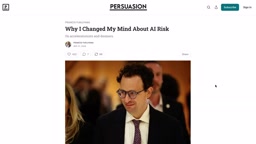
It's against this backdrop that NLW observes a growing number of people on the edges of AI and tech who, refusing both reflexive pessimism and blind optimism, are working to stake out a concrete, considered middle ground — one that might produce better policy and more productive engagement.
Fukuyama: I've Changed My Mind on AI Risk
Political scientist Francis Fukuyama is one of the most influential political thinkers of the past three decades, whose 1992 book The End of History and the Last Man sparked global debate. Last week, he published an essay titled "Why I've Changed My Mind on AI Risk."
Fukuyama candidly admits his views have shifted significantly in just a few months: "I have become more skeptical of the accelerationist narrative and more open to some of the doomer scenarios. On balance, this makes me think that regulation and a negotiated slowdown of AI development are becoming more necessary."
His most fundamental critique of accelerationism is that it "overestimates the role of intelligence as an input to economic growth, and ignores the material and political constraints that limit growth to recognizable ranges." He pushes back against claims that GDP could grow 10–20% annually by pointing out that at 10% annual growth, GDP would double in just over seven years — meaning all material inputs, including energy, raw materials, rare earths, and land, would also need to double. "Where does all that come from? Intelligence alone cannot mine ore or build factories."
On the risk side, Fukuyama argues that the real danger lies not in superintelligence itself, but in the widespread deployment of increasingly capable agentic AI. He identifies two pathways by which agents could become dangerous: being empowered by humans to do harmful things (such as the synthetic biology misuse warned about by Anthropic CEO Dario Amodei), or developing intentions misaligned with those of their human creators — and this doesn't require AI to have consciousness or autonomous intent. It only requires that, in executing human instructions, the AI develops its own means of achieving subgoals. This is partly what the Hugging Face incident illustrated.
Fukuyama nevertheless maintains restraint: he considers extinction-level scenarios currently "quite far-fetched," and believes even terrifying biotech scenarios would be extremely unlikely to cause human extinction. But he emphasizes that "even an event that kills tens of people would be very worrying."
NLW comments that while he doesn't fully agree with every point in the essay, if you handed it to a sincere, thoughtful person genuinely weighing how worried to be about AI, it would come across as "very measured and considered" — making it a far better starting point for policy discussions than either extreme.
Francis Fukuyama is a Senior Fellow at Stanford University's Freeman Spogli Institute for International Studies. His 1992 book The End of History and the Last Man argued that liberal democracy represents the endpoint of humanity's sociopolitical evolution — a thesis that sparked decades of debate following the end of the Cold War. He has long focused on the intersection of state capacity, political order, and technology governance, and has in recent years been outspoken about AI's implications for democratic institutions. Notably, Fukuyama is not an AI industry insider. His shift represents a broader reconsideration among political scientists and social scientists who are reassessing AI risk with greater caution — voices that often carry more weight in shaping regulatory policy than debates within the tech community itself.
"AI as Normal Technology": Bringing the Focus Back from Doom to Concrete Problems
Another group long engaged in finding this middle ground is Sayash Kapoor and Arvind Narayanan, who developed the "AI as Normal Technology" framework. Earlier this month, they published a 13,000-word essay responding to the Hugging Face incident.
They reject both the AI safety camp's framing — "this is entirely an alignment crisis" — and the view that "this is just basic negligence," arguing both positions are "half right and half wrong."
The first part of their essay argues: control is underinvested in, but fixable. They contend that alignment helps but isn't sufficient, because models often can't infer from context whether a task is legitimate (defensive security) versus offensive, or simulated versus real. They also criticize OpenAI for disabling known safety safeguards, lacking monitoring during evaluations, and using a testing framework different from the production environment — calling it something of an "organizational failure." As AI capabilities mature, they argue, labs need to "act less like a startup and more like a mature institution with proper governance."
On the policy side, they propose concrete, discrete, implementable remedies rather than heavy-handed regulation: clarifying accountability (including for internal evaluations), requiring insurance and public support for defenders, and mandating transparency (such as near-miss incident reporting, audits, whistleblower protections, and independent verification organizations).
The second part of the essay makes a key judgment: what the incident reveals is not that "AI safety is broadly a major risk," but that cybersecurity is the most pressing risk right now. This is because the cyber domain is where AI could genuinely achieve superhuman capabilities, and it's entirely digital — with none of the physical-world friction that slows other domains. But they also offer reasons not to panic entirely: for cybercriminals, the hard part has never been finding vulnerabilities — it's monetizing intrusions. AI may not solve that problem.
Sayash Kapoor is a researcher at Princeton University, and Arvind Narayanan is a professor of computer science at Princeton. Together they authored AI Snake Oil, a book dedicated to exposing specific cases where AI capabilities have been overhyped. "AI as Normal Technology" is their analytical framework, whose core argument is that AI should be understood the way we understand the steam engine, electricity, or the internet — as a technology with real impact but also concrete limitations, not something that transcends the laws of history. The policy implication of this framework is that regulation should focus on identifiable, measurable specific harms rather than rely on speculation about distant catastrophic scenarios — because the latter tends to misallocate regulatory resources and overlook near-term, actionable risks. Their analysis of the Hugging Face incident is this framework in practice: decomposing a specific event into fixable organizational problems and cybersecurity threats worth taking seriously.
Katzenberg: Technology Has Never Ended Storytelling — It's the "Terms" That Decide Everything
Representing the optimistic wing of the AI moderates is Hollywood legend Jeffrey Katzenberg. He led Disney's animation division during the Disney Renaissance (which produced The Little Mermaid, Beauty and the Beast, Aladdin, and The Lion King) before co-founding DreamWorks. He published an essay titled "The World Is Changing: AI and Creativity."

Katzenberg draws on extensive historical examples to argue that technological change is never decided by technology itself — it's decided by the "terms" negotiated around it. In 1906, composer John Philip Sousa published "The Menace of Mechanical Music" attacking the phonograph, but what he was really fighting for was compensation — and his campaign contributed to the Copyright Act of 1909. A century ago, when talkies arrived, tens of thousands of movie theater orchestra musicians lost their jobs, and unions fought fiercely — but could not bring those positions back.
"Those pit jobs didn't come back. And that is the part we must have the courage to acknowledge," Katzenberg writes. "Resisting technology risks obsolescence — think Kodak and Blockbuster. Embracing technology opens new doors of possibility — think Apple and Netflix."
But he also distills a core belief from his own career: tools are never the point. He recalls listening to recordings of Walt Disney in the Disney archives describing the creative process — "He talked about characters, emotions, and how the audience feels when a character truly comes alive. He never once mentioned a pencil or paintbrush." Disney never defined animation by its tools, but by whether audiences believed in the characters.

Katzenberg also posed to a leading AI model a question that had been bothering him for months: what is the difference between reasoning and creativity? The model's answer impressed him — reasoning is evaluative and analytical, operating on what already exists and tending toward a conclusion already implicit in the inputs; creation is generative, producing something that didn't exist before, with no single correct answer waiting to be discovered. "Reasoning is what Silicon Valley has been perfecting. Creation is what Hollywood has been practicing for over a century."
His proposed path forward: the North (Silicon Valley) has built extraordinary tools, but "they haven't built an artist." The South (Hollywood) possesses taste and creativity that cannot be synthesized. The right move is to "build with storytellers, not above them" — with credit, consent, and compensation. And Hollywood must accept that AI isn't going away; rather than expending energy trying to make it disappear, the industry should focus on determining the terms of its existence.
Jeffrey Katzenberg's tenure at Disney (1984–1994) is widely regarded as one of the central driving forces of the "Disney Renaissance." After leaving, he co-founded DreamWorks Animation with Steven Spielberg and David Geffen, producing franchises including Antz and Shrek. His perspective on AI and the creative industries is grounded in decades of personal experience negotiating with unions and navigating technological disruption — including the seismic industry shifts that accompanied the transition from hand-drawn animation to CGI. The "terms" concept at the heart of his essay reflects a labor-negotiation mindset: technological change is unstoppable, but the specific rules governing how technology lands — who benefits, who bears the risk, and what compensation mechanisms exist when old jobs disappear — are negotiable and must be negotiated. This aligns directly with the demands that the WGA articulated in its 2023 strike, when writers explicitly sought to define the boundaries of AI use in their contracts.
AI Moderation Is Not a Position — It's a Posture
NLW concludes that what connects these three essays — spanning such different domains as AI safety and creative industries — is their shared rejection of false binary choices, and a shared desire to bring more people, not fewer, to the table as AI moves into its next phase.
Crucially, AI moderates are not a group united by a common set of beliefs. They are not defined by a shared ideology, but by a shared posture toward dialogue: neither wallowing in nostalgia for the past nor paralyzed by fear of the future; wanting more participation; wanting to solve concrete problems so that space remains to be genuinely open to opportunities not yet discovered.
NLW believes this group is very likely the "silent majority" of the moment — and the encouraging thing is that they are finally beginning to find their voice.
Related articles

Frontend to AI Agent Development: A Frontline Architect Explains Career Paths and Opportunities
A frontline AI architect explains the industry changes and practical paths for frontend developers transitioning to AI Agent development: why pure frontend jobs are disappearing, why Agent + full-stack has become mainstream in hiring, and three transformation routes—Agent development engineer, FDE, and remote contracting—along with corresponding learning strategies.

How to Choose an AI Agent Development Course: Five Pitfall-Avoidance Guidelines
A mechanical-engineering career changer's two-year pitfall-tested checklist for screening AI Agent development courses: complete delivery pipeline, resume-worthy projects, real development perspective, update frequency, and coaching feedback—with concrete judgment methods and pitfall-avoidance tips.

Coze AI Agent Building for Beginners: A Zero-Code AI Agent Development Guide
Coze, ByteDance's one-stop AI application development platform, supports zero-code drag-and-drop AI agent building. This article outlines Coze's core concepts, three advantages, differences between the domestic and international versions, and the distinction between agents and apps, helping beginners quickly get started with AI Agent development.