The Rise of the Grok Ecosystem: Can Cursor's Triple Launch Challenge Claude Code?

Hands-on review of Cursor's Grokbot, Origin, and Grok 4.6 — and whether they can dethrone Claude Code.
This deep-dive tests Cursor's three major launches: Grokbot (a multi-agent chat tool with killer multi-account connectors), Origin (an agent-native GitHub alternative still in early beta), and Grok 4.6 (which tied GPT 5.6 for first in weighted coding benchmarks). While Claude Code and Sonnet 5 remain strong, the Grok ecosystem has emerged as a serious contender reshuffling the AI coding landscape.
From the "Claude Code Era" to "Grok Boys"
Not long ago, the AI coding conversation was all about the tug-of-war between OpenAI and Anthropic, with Claude Code firmly established as the default choice for developers. But after Cursor was acquired by SpaceX, the entire "Musk universe" code tool matrix began firing on all cylinders. More and more developers and content creators have quietly become "Grok boys" — not only testing Grok's coding capabilities but also reconsidering their entire tech stack.
This article is based on days to weeks of hands-on testing by a power user, covering three major recent releases from the Cursor team (Cursor X SpaceX): the chat-based agent product Grokbot, the GitHub competitor Origin, and the Grok 4.6 model. The core question is simple: Is Claude Code really about to be dethroned?

Grokbot: Treating AI Agents Like Employees
A Dead-Simple Multi-Agent Experience
Grokbot is a chat-based agent product available on both desktop and mobile, positioned similarly to open-source agent frameworks like OpenClaw — but simpler, more managed, and easier to get started with. Its design philosophy is crystal clear: Don't have one agent to rule them all — give each agent a name and a well-defined role.
The tester set up an entire "staff" in their account: a product manager bot called "Pretty McProd" (connected to ChatPRD), a commitment tracker, a "money-making bot" responsible for chasing invoices and sales deals, a case study assistant, and an analytics bot for monitoring data. This approach of anthropomorphizing agents and treating them as team members with a division of labor is considered a smart way to design AI agents.
The setup process is incredibly simple: create a bot → the system automatically spins up a virtual machine → tell it what to do in natural language. Each Grokbot comes with its own VM that has access to Chrome, a terminal, and files. It can go online, use connectors and MCP — essentially a "streamlined hosted version of OpenClaw."
Killer Feature: Multiple Accounts Per Connector
If you can only highlight one thing, it's the plugin and connector experience. Previously, when connecting different MCPs in their tech stack, many developers would default to Cursor. But Grokbot's true killer feature is: any single connector (Gmail, Slack, or MCP) can be linked to multiple accounts.
This hits a real pain point. Many developers have a dozen email accounts and Slack workspaces, needing to log in multiple times even for the same service. Neither Codex nor Claude has solved this — "nobody seems to have figured it out." In testing, four Gmail accounts were connected at once and managed from a single interface. That's product-market fit (PMF) in action.
The Downside: Too Simple, Lacking Soul
Grokbot's strength is simplicity, and its weakness is also simplicity. There are three main shortcomings:
- No deep customization: Unlike OpenClaw where you can "shape agents like clay," it lacks
SOUL.md-level control; - No model selection: Users can't specify which model Grokbot uses or how it's configured;
- No personality tuning: Model outputs are full of formulaic "not this, not that" expressions (commonly called "slop"), and it even suggests terrible names like "ScopeKnife" — lacking any voice or personality calibration.
In a multi-agent strategy where people name their agents and treat them as employees, tuning personality and voice becomes especially critical. Additionally, Grokbot runs on third-party systems with no local control — a fundamental difference from open-source solutions like OpenClaw, with trade-offs on both sides.
Bottom line: Grokbot is super simple with excellent connector support, well-suited for enterprise scenarios where agents are treated as employees. But if you need highly tunable, modifiable, and transparent agent configuration, OpenClaw remains the better choice.
Origin: An Agent-Native GitHub Alternative
Clear Vision, Early Execution
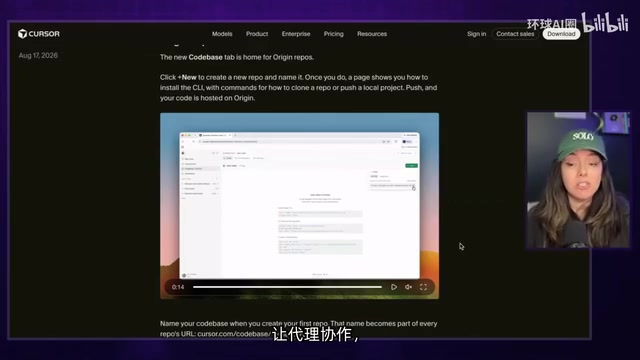
Origin is the GitHub alternative Cursor announced at their conference this year, and it has finally entered "early beta." Its core value proposition is: build an "agent-native" GitHub.
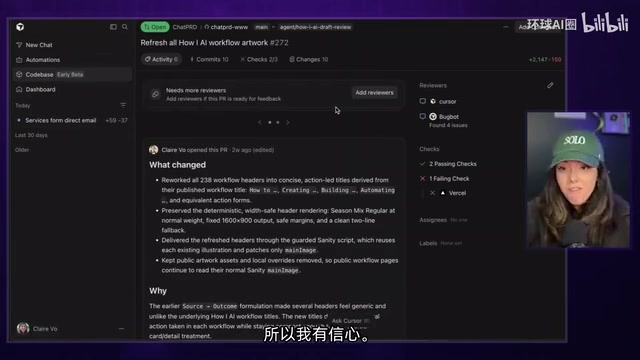
Origin retains all Git primitives — repositories, pull requests, reviewer assignments, CI/CD extensions (like Vercel preview branches) — but redesigns the UI and UX layer to make agent collaboration a first-class citizen, especially the coordination between Cursor cloud agents, the desktop app, and the CLI.
Cursor's bet is: We'll eventually want an agent-native GitHub, and GitHub itself isn't transforming fast enough.
Hands-On Experience: More Like a GitHub API Wrapper
Interestingly, Origin launched on the same day GitHub had a major outage — either embarrassing timing or "genius timing." During testing, importing a GitHub repository ran into slow sync issues, and having an agent fix a Vercel preview branch also hit errors. Whether these were Origin's problems or GitHub's outage that day was hard to untangle.
The gut feeling: the current GitHub integration feels more like a wrapper around the GitHub API. While the redesigned interface, BugBot feedback presentation, and smart suggestions at the top have their highlights, at the end of the day it's "like GitHub with fewer features, weaker external integrations, and stronger Cursor integration."
Bottom line: Origin's vision deserves recognition — it's laying the groundwork for "putting repos inside Cursor and making BugBot a first-class citizen in the repository." But for developers deeply embedded in the GitHub ecosystem (automation, code owners, various workflows), the current feature set isn't compelling enough to drive migration. This is the beginning of a "very, very early" long migration — worth watching and experimenting with, but it hasn't yet delivered a jaw-dropping killer experience.
Grok 4.6: An Unexpected Dark Horse
Weighted Benchmark: Tied for First with GPT
What really had "everyone texting that they kind of like Grok" was the Grok 4.6 model. Since Cursor has switched some default models to Grok, developers naturally gave it a spin.
Testing used a custom "How I AI Clarity Weighted Index" with a scoring composition of 70% personal taste + 30% LLM-as-judge. Test dimensions included PRD writing, prototyping, design wireframes, and technical changes, with two new benchmarks added: letting the model autonomously decide how to redesign a page (design benchmark), and handling an insurance claims application with complex interactions.
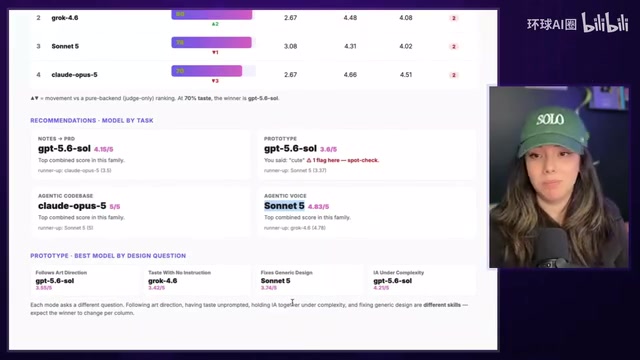
The results were surprising: Grok 4.6 tied with GPT 5.6 for first place on the Clarity Index, beating both Sonnet 5 and Opus 5.
Per-Task Performance: Each Model Has Its Strengths
Looking at specific tasks, different AI coding models showed distinct performance differences across scenarios:
- Direct PRD writing: GPT 5.6 is the top pick — clean writing, factual, comprehensive, and appropriately technical;
- OpenCore agent chat experience: Sonnet 5 still wins, "haven't found anything better";
- Prototypes following clear art direction: Still favoring GPT 5.6;
- Free-form design decisions: Grok 4.6 brought a "breath of fresh air" — one coffee shop ordering system design came close to a Claude-like style (orange-brown palette), with cute and complete interactions that were quite satisfying;
- Dense information architecture and complex UI: GPT 5.6 remains the strongest.
An Interesting Judging Divergence: AI Judges vs. Human Taste
A fascinating phenomenon emerged: if you remove the personal taste dimension and let an LLM judge purely — using the notoriously strict GPT 5.5 as the judge — the LLM hated Grok, favored Claude Opus and Sonnet, and actually disliked GPT 5.6. Human taste was the exact opposite, appreciating the design output of GPT 5.6 and Grok 4.6 more.
This divergence is a reminder that model evaluation is highly dependent on judging criteria. There's a systematic bias between "AI judges" and "human taste," and a single leaderboard may not reflect the real-world experience.
Is It Time to Become a "Grok Boy"?
After hands-on testing all three products, here's the takeaway:
- Grokbot: Simple to use with an excellent connector experience, especially the multiple-accounts-per-connector feature; but lacking in customization and personality tuning;
- Origin: "Not seeing the light" just yet — clear vision but too early in execution, still needs significant iteration;
- Grok 4.6: A competitor not to be underestimated — "none of it is bad" — and combined with the Cursor framework, the rethinking of Git, and products like Grokbot, the whole ecosystem is worth watching.
What you might not have noticed is that many developers still spend the bulk of their time on Codex and GPT 5.6, and are only starting to "consider" spinning up more Cursor coding sessions to see if they can consistently extract value from Grok.
So, is Claude Code dead? The answer is clearly no — Sonnet 5 remains irreplaceable for agent chat experiences, and GPT 5.6 still leads on complex UI. But one thing is certain: the Grok ecosystem has jumped from "supporting role" to "serious contender," and the AI coding tool landscape is being reshuffled. For developers, now might be the time to set aside tribal loyalties and let yourself become at least a little bit of a "Grok boy" — experience firsthand the possibilities this new wave of tools is bringing.
Related articles
Zero-Dependency AI Memory Layer: Agent Memory Without a Vector Database
Explore zero-dependency AI Agent memory layers that work without vector databases. Compare with traditional RAG architectures and learn when lightweight alternatives make more sense.
The Linear Startup Story: From Leaving Coinbase to Redefining Developer Tools
How Linear co-founder Jori Lallo left Coinbase in 2018 to build a developer-first project management tool, defying skeptics to carve out success in a market dominated by Jira, Asana, and Trello.
Why Is AWS S3 Called the Eighth Wonder of the World? The Invisible Power of Cloud Storage
A viral tweet listed AWS S3 as the Eighth Wonder of the World. Explore how S3's eleven 9s durability and architectural ubiquity make it the invisible cornerstone of modern digital civilization.