The Trap of the All-in-One Agent: Why Multi-Agent Collaboration Is the Reliable Path Forward

Monolithic agents fail in production; multi-agent collaboration with clear roles is the key to reliable Agentic AI.
This article challenges the common assumption that a single "all-powerful agent" can reliably handle complex tasks. While such agents may shine in demos, they become inconsistent under production workloads. The more robust architecture distributes tasks across specialized agents with clear boundaries, dedicated tools, and explicit handoff rules. The real engineering challenges lie not in the demo, but in workflow design, guardrail implementation, and evaluation. The most vulnerable point in multi-agent systems is the handoff stage, where upstream uncertainty silently propagates downstream and causes cascading failures.
Why "One Agent Does Everything" Is a Beautiful Illusion
A huge number of Agentic AI demos create a compelling illusion: that a sufficiently powerful agent, handed a task, can run the entire thing from start to finish. The demos often look stunning — but when you try to bring this kind of monolithic architecture into production, it tends to fall apart quickly.
The core issue is consistency. When you try to make a single agent responsible for research, judgment, execution, and error correction all at once, its behavior across different stages becomes unpredictable. One run it performs nearly flawlessly; the next, it drifts on the exact same step. This instability is especially fatal in complex workflows.
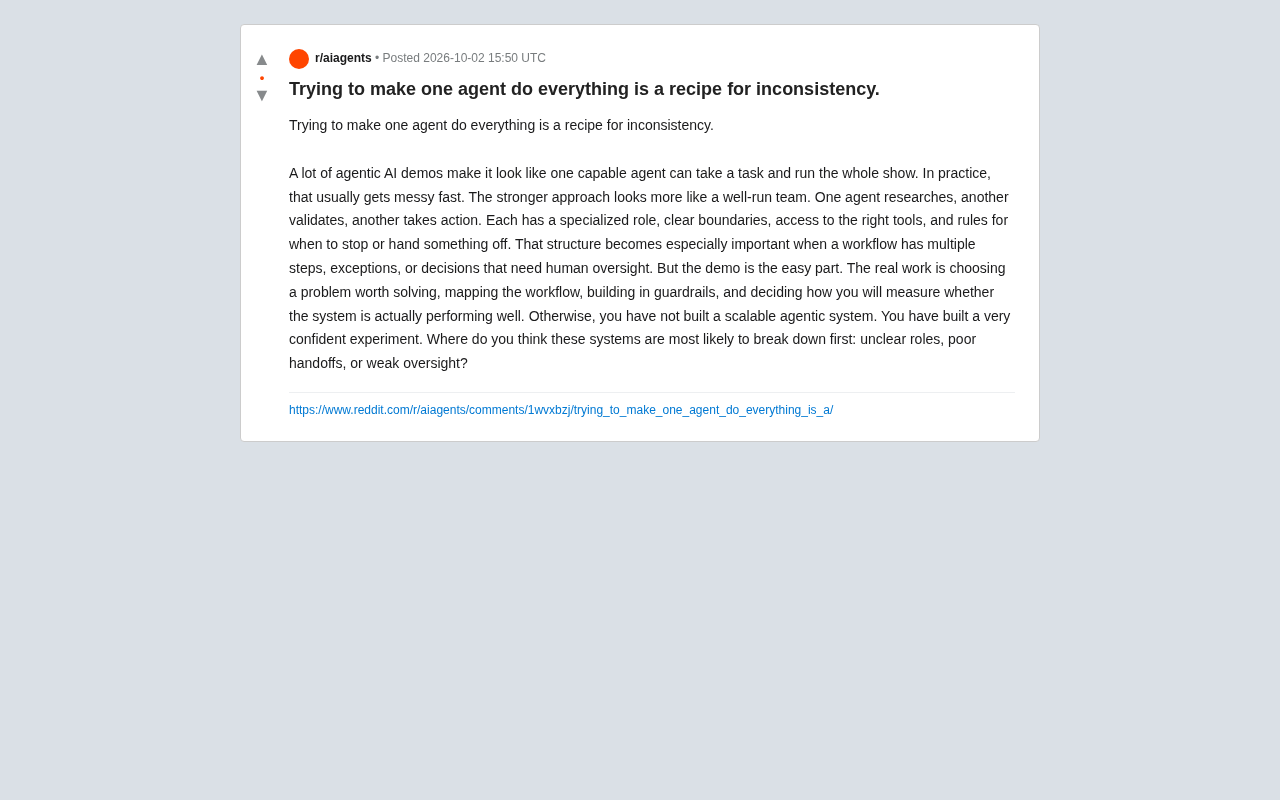
As this Reddit discussion points out: if you try to make one agent do everything, you're essentially paying the price for inconsistency. Truly reliable systems look more like a well-coordinated team than a single omnipotent super-employee.
Multi-Agent Collaboration: Operating Like a High-Performance Team
A more robust approach is to break tasks down across multiple agents, each with a specific role. One handles research and retrieval, another validates results, and a third executes actions. Each agent has a dedicated role, clear boundaries, the appropriate tool access, and explicit rules for when to stop or hand off.
This structure's value becomes apparent when workflows grow complex. When a process involves multiple steps, edge cases, or requires human intervention at critical decision points, role separation dramatically reduces fragility. The more focused an individual agent's responsibilities are, the more controllable and verifiable its outputs become.
Three Benefits of Specialization
- Predictability: Single-responsibility agents are easier to test and calibrate, and output deviations are easier to isolate.
- Auditability: Inputs and outputs at each stage are clearly defined, making it straightforward to trace where something went wrong.
- Scalability: When you need to improve a specific capability, you only need to optimize or replace the agent in that role — not rebuild the entire system.
Demos Are Easy. Engineering Is the Real Work.
One of the most thought-provoking lines in the original post is this: the demo is the easiest part. The real work lies in choosing a problem worth solving, mapping out the workflow clearly, building guardrails into the critical checkpoints, and deciding how to measure whether the system is actually working.
Skip those steps, and what you've built isn't a scalable agentic system — it's a "very confident experiment." It looks polished in a demo, but the moment it faces edge cases and unexpected inputs in a real business context, its fundamental fragility will be exposed.
This is a widely underappreciated reality in the current Agentic AI landscape: most teams focus their energy on making agents look capable, rather than making them reliably capable. The former can be achieved with a clever prompt. The latter requires a full engineering stack — workflow design, permission management, exception handling, and evaluation frameworks.
Guardrails refer to the set of constraint mechanisms built into an agent's execution pipeline to prevent the system from producing harmful outputs, performing unauthorized actions, or blindly proceeding under uncertainty. Common guardrail implementations include: input/output filtering layers (compliance checks on user inputs and model outputs), confidence thresholds (automatically triggering human review when the model's certainty falls below a threshold, rather than continuing to execute), operation allowlists (restricting agents to only call pre-approved tools and APIs), and rollback mechanisms (undoing executed actions when anomalies are detected). The quality of guardrail design directly determines a system's safety at the edges — an agentic system without guardrails is like a car without brakes. It runs fast in a controlled test environment, but the moment it encounters unexpected real-world inputs, the risks multiply exponentially.
Where Do These Systems Break First?
The original post raises a compelling question: in multi-agent systems like these, which component is most likely to fail first — unclear roles, poor handoffs, or weak oversight?
In practice, all three are deeply interconnected:
- Unclear roles: When the responsibility boundaries between two agents are fuzzy, you get duplicated work, buck-passing, and contradictory outputs.
- Poor handoffs: If information passing between agents lacks a standardized format and well-defined trigger conditions, lost context forces downstream steps to run on incomplete or corrupted inputs.
- Weak oversight: Without human review checkpoints or clear stopping rules, a small early error gets amplified through the pipeline, ultimately producing an uncontrollable outcome.
From an engineering standpoint, the handoff stage tends to be where things break first — because it depends on the clarity of role definitions and determines whether errors get caught in time. A sloppy handoff is equivalent to passing all the uncertainty from one stage directly into the next.
From a systems engineering perspective, the Handoff Protocol between agents is essentially an interface contract. Robust handoff design typically requires three things to be explicitly defined: first, a structured format for what gets passed (e.g., a JSON Schema), ensuring downstream agents can parse upstream outputs without ambiguity; second, trigger conditions — meaning the upstream agent only transfers control when it has reached a clearly defined state, not when the task is "more or less done"; and third, explicit labeling of error states, so downstream agents know whether the context they're receiving contains known uncertainties or missing fields. Many cascading failures in production environments aren't rooted in any single agent being incapable — they stem from an upstream agent passing an "unresolved state" in a format that looks normal, allowing errors to quietly propagate downstream.
What This Means for Builders
For teams currently building agentic systems, this discussion offers a simple but important reminder: don't get seduced by the "all-powerful agent" narrative. Truly deployable systems are built on a deep understanding of the workflow, clearly defined roles, and rigorous evaluation criteria.
Start by asking yourself three questions: Is this problem actually worth solving with an agent? Can the workflow be clearly broken down and mapped? What metrics will I use to determine whether this system is genuinely working? Without answers to those three questions, even the most powerful model is just an elaborate experiment dressed up to look like a product.
Related articles

Build an AI Super Employee System at Zero Cost: A Full Breakdown of Automated Agent Workflows
A deep breakdown of the AI super employee system demoed on Bilibili: agent orchestration, digital human voiceovers, map and enterprise lead generation, 24/7 customer service, and legal modules. We analyze the business logic and compliance risks behind zero-cost signup to help entrepreneurs judge the real ROI of this AI digital employee system.

The Essential Difference Between Chatbots and AI Agents: Crossing from Conversation to Execution
What's the difference between a chatbot and an AI agent? Based on the MCP series on the Learn Tech channel, this article uses examples like booking flights and summarizing notes to explain: a chatbot only gives answers, while an agent actually completes tasks through a think-act-observe loop. It breaks down the four core components—model, tools, memory, and goal—as well as MCP's role as a bridge, and discusses agents' applicable boundaries and permission risks.

Free GitHub Repo: 342 Hours of AI Courses, from Math to MCP Servers
A free GitHub repo offers 342 hours of AI courses: 523 lessons across 20 phases, from math fundamentals to agent building and MCP servers. Nearly 100,000 learners have started.