The Truth About America's Westward Expansion: The Brutal History Hidden Behind the Myth of Manifest Destiny

A Nat Geo documentary exposes how America's westward expansion was built on conquest, slavery, and broken promises.
Based on the Nat Geo documentary *What Really Happened: America's Wild West*, this article reveals how America's westward expansion was not a divinely ordained destiny but a calculated campaign of territorial conquest. From Texas's founding as a slaveholding republic and the Mexican-American War's land grab, to the genocide of California's Native peoples during the Gold Rush, Chinese workers' sacrificed lives building the Transcontinental Railroad, and the erasure of Black and Hispanic cowboys from popular mythology—the article exposes the brutal realities behind America's frontier myth.
Introduction: A Carefully Packaged "American Dream"
When people think of the American West, they often picture cowboys, gold mines, pioneers, and endless stretches of free land. The Nat Geo documentary What Really Happened: America's Wild West attempts to peel away this romanticized veneer, revealing a far more complex and brutal truth: the so-called "Westward Expansion" was not a God-given manifest destiny, but rather a land grab orchestrated by the federal government, driven by military force and sophisticated propaganda.
As one scholar states in the documentary: "The American Dream was largely a propaganda campaign, a marketing exercise." This statement sets the tone for the entire work—the freedom, opportunity, and hope of the West were often built upon the loss of freedom, the denial of opportunity, and the breaking of promises made to others.
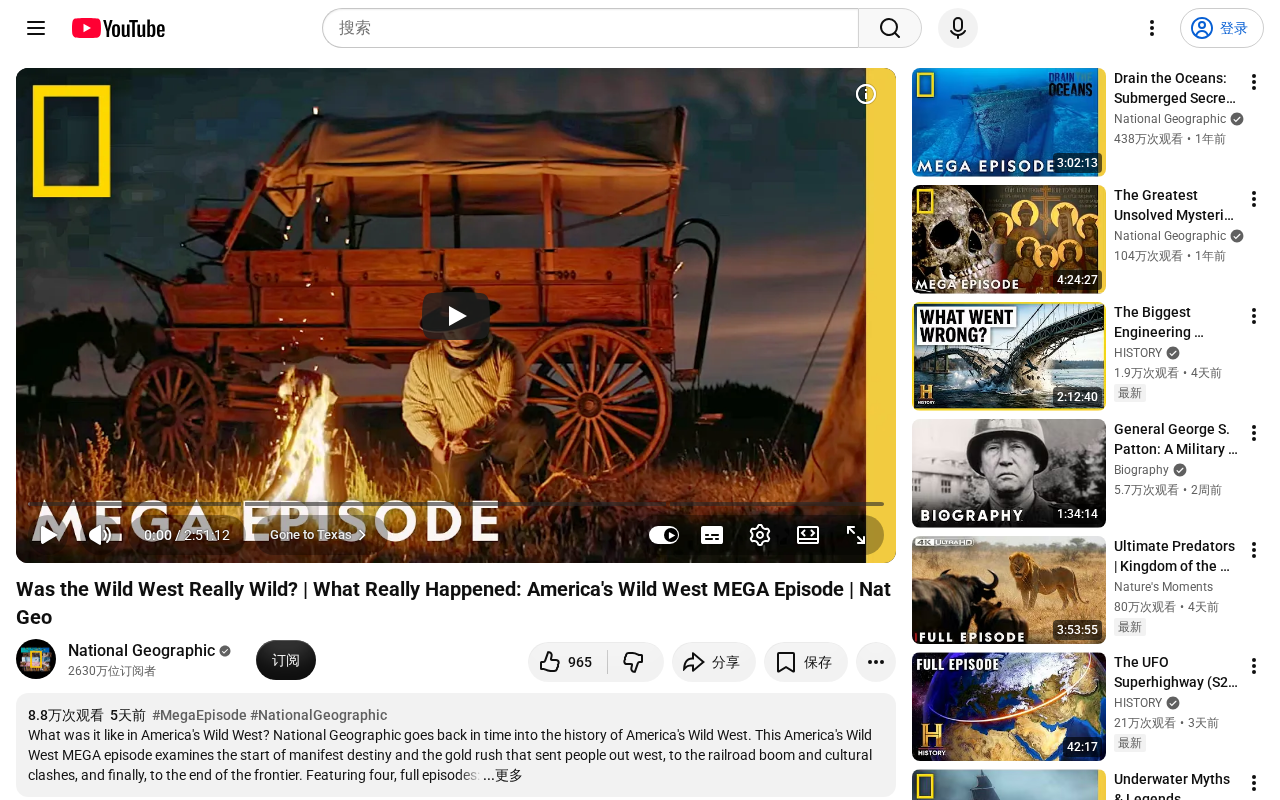
The Texas Revolution: From Mexican Frontier to a Slaveholding Republic
A Deal Built on Debt and Land
In the 1820s, Mexico—having just won independence from Spain—had a sparsely populated, poorly defended northern frontier (present-day Texas, New Mexico, and Arizona). The Mexican government hoped to bring in armed American settlers as a "buffer zone" against the powerful Comanche nation.
The Comanche were among the most powerful horse-mounted peoples of the North American Great Plains during the 18th and 19th centuries. Historian Pekka Hämäläinen even referred to their domain as the "Comanche Empire." They were master horsemen and archers, capable of firing arrows with deadly precision at full gallop, controlling vast grasslands stretching from Kansas to Texas. Spain, France, and even the Mexican government proved unable to effectively counter Comanche military power—which is precisely why Mexico was so eager to recruit armed American settlers as a buffer.
This coincided with the U.S. banking crisis of 1819, which left masses of Americans bankrupt from war debts and desperate for a fresh start. This crisis—the Panic of 1819—was the first large-scale economic collapse in American history. Its roots lay in the excessive credit expansion following the War of 1812, a land speculation bubble, and the Second Bank of the United States' contractionary policies. When European demand for American agricultural products plummeted, banks tightened lending, driving countless farmers and small business owners into bankruptcy, with the western and southern regions hit hardest. This crisis profoundly altered America's class structure and political landscape, directly producing a wave of "economic refugees" seeking new lives on the Mexican frontier.
Thus, a seemingly win-win deal was struck: Mexico gained frontier defense, and Texas settlers gained cheap land. At the time, land in the U.S. cost about $1.25 per acre, while in Texas, a combined "league" (approximately 4,428 acres) and "labor" (177 acres of riverfront land) could be had for just a few hundred dollars. On doors across Mississippi, Alabama, and other states, "GTT" (Gone to Texas) became the mark of debt fugitives.
The Transplanting of Slavery and Texan Independence
Ironically, these American settlers—nominally Mexican citizens—were neither Catholic nor willing to abandon slavery, which was illegal in Mexico. Mexico even offered incentives of "50 acres for every slave brought in." By the mid-1830s, the number of enslaved Black people in Texas may have exceeded the local Mexican-descent population.
When Mexico attempted to abolish slavery in 1829 and enacted new regulations in 1830 to restrict immigration and slave importation, Southern settlers felt their "way of life" was under attack. They rebranded their slaves as "indentured servants" to circumvent the law. Ultimately, Mexico's attempt at centralization ignited revolution. In 1836, after the brutal siege of the Alamo and a surprise counterattack at the San Jacinto River, Texas declared independence and explicitly protected slavery in its constitution—a republic founded on slavery was born.
Manifest Destiny and the Mexican-American War: America's "First War of Greed"
A Territorial War Deliberately Provoked
In 1844, Polk won the presidency with westward expansion as his core campaign platform. The concept of "Manifest Destiny" emerged in the mid-1840s—America was endowed with a sacred right to expand "from sea to shining sea."
The intellectual origins of this concept are extremely complex. The term "Manifest Destiny" was first coined by journalist John O'Sullivan in 1845 in the Democratic Review, to justify America's annexation of Texas. It blended Puritan "City upon a Hill" mission consciousness, Enlightenment-era progressivism, Anglo-Saxon racial supremacism, and the Jacksonian democratic emphasis on the rights of "ordinary white men." It was never a systematic political theory but rather a pervasive cultural sentiment that provided a veneer of moral legitimacy for territorial expansion, allowing naked conquest to be packaged as "the spread of civilization" and "God's will."
Yet the documentary states bluntly that the Mexican-American War "was the first war America fought based on greed, with no great moral justification." Polk coveted California and the deep-water ports of San Francisco and San Diego, so he deliberately pushed troops into disputed border territory to manufacture a pretext for war. Even Abraham Lincoln, along with many other Americans, was deeply troubled by this "naked war of conquest." Mass anti-war protests and soldier desertions erupted during the conflict.
The Reshaping of Borders and Racial Calculations
After U.S. forces captured Mexico City, the Treaty of Guadalupe Hidalgo of 1848 forced Mexico to cede over 525,000 square miles of territory—including present-day California, New Mexico, Utah, Nevada, and parts of Colorado and Wyoming.
The treaty's impact far exceeded the boundary changes on a map. The vast newly acquired territory ignited fierce debate over whether slavery should extend to the new lands, directly leading to the Compromise of 1850, Bleeding Kansas, and ultimately tearing the Union apart as a major trigger for the Civil War. The treaty also stipulated protections for the property rights and citizenship of Mexicans remaining in the ceded territories, but these promises were almost entirely violated in practice—large numbers of Mexican-descent landowners lost their ancestral lands through unjust legal proceedings, language barriers, and violent intimidation. This historical legacy continues to shape ethnic relations and identity politics in the U.S.-Mexico border region today.
Notably, there was an "All Mexico Movement" in Congress advocating the annexation of all of Mexico, but it was ultimately abandoned due to racial considerations—the mainstream white Protestant culture believed that absorbing too many Mexicans, mixed-race peoples, and Catholics would "threaten democracy." Thus, the final border was drawn to "acquire as much territory as possible while including as few Mexicans as possible." One scholar's reflection is particularly profound: everything about America as a global superpower can be traced back to the results of this war.
The California Gold Rush: A Racial Bloodstain Beneath the Golden Legend
A Global "Gold Magnet"
In 1848—the very same year Mexico ceded California—gold was discovered in a riverbed. The Gold Rush attracted approximately 300,000 migrants from China, Hawaii, South America, Europe, and the East Coast, making California's mining regions "the most international corner of America, and indeed the world."
Yet the reality was far from the legend of "scooping up gold with a spoon." Disease was rampant, conditions were filthy, and violence was pervasive. Those who truly made money were often not the miners but the merchants—just as young Jewish immigrant Levi Strauss made his fortune selling jeans to miners. Chinese workers, known for their patience, panned for gold dust in tailings abandoned by white miners and gradually transitioned into commerce and labor, becoming a vital force in California's economic rise.
The Genocide of California's Indigenous Peoples
The documentary does not shy away from using the word "genocide" to describe the Gold Rush's impact on California's Native peoples: "White Californians waged a war to exterminate California's Native peoples in order to create a white El Dorado." Through disease, warfare, and enslavement, California's Indigenous population collapsed catastrophically. This is the darkest chapter behind the West's "myth of opportunity."
Railroad Chinese Workers and the Cowboy Myth: The Erased Diverse Faces
Chinese Workers' Blood and Sweat Built the Transcontinental Railroad
In 1869, the Transcontinental Railroad was joined at Promontory Summit, Utah. This 1,912-mile railroad was built by the Union Pacific Railroad Company (building westward) and the Central Pacific Railroad Company (building eastward). The section built eastward from California was primarily completed by Chinese workers.
The engineering challenges were almost unimaginable: crossing the Sierra Nevada at elevations exceeding 7,000 feet required blasting through 15 tunnels, the longest being the Summit Tunnel at 1,659 feet, carved entirely through solid granite. Chinese workers advanced only about 8 inches per day, using extremely unstable nitroglycerin explosives in sub-zero temperatures. In the snow-covered mountains, Chinese workers lived "underground lives," and the death toll remains impossible to determine precisely—some estimates suggest Chinese workers lost their lives for every mile of track. They even went on strike for their rights, shattering the stereotype of "docile Chinese laborers." The railroad's completion reduced transcontinental travel from six months to six days, fundamentally transforming America's economic geography and providing the material infrastructure for large-scale western colonization.
Yet in the famous "champagne photograph" and the railroad centennial celebration speech, Chinese workers' contributions were completely erased—"Who but Americans could have built such a marvel?" Not a single word in the celebration address mentioned the Chinese. This "disposability"—where labor is needed but lives are not valued—is yet another cruel footnote to western development.
The True Origins of Cowboy Culture
Regarding cowboys, the documentary offers a subversive perspective: "The first cowboy was Black." The roots of cowboy culture can be traced to Africa—North African horsemanship and enslaved Africans' lasso techniques combined on Mexico's eastern coast in 1521, giving birth to the earliest "vaqueros" (cowboys), most of whom were enslaved Black people.
Of approximately 30,000 cowboy positions, between 5,000 and 10,000 were held by African Americans. Yet wages reflected clear discrimination: white cowboys earned $1 per day, Black cowboys 75 cents, and Hispanic cowboys only 50 cents. The familiar images of gun-toting cowboys, saloon shootouts, and frequent brothel visits are described as "grossly exaggerated"—most cowboys didn't even carry guns. These myths primarily originated from 1870s dime novels, Buffalo Bill's traveling shows, and the 1902 novel The Virginian, which added the template of "guns and romance."
The Tragic Finale for Native Peoples: From Little Bighorn to the Wounded Knee Massacre
As railroads penetrated deep into the western heartland, the fate of Native peoples moved toward a tragic conclusion. The military operated on the logic that "killing the buffalo means killing the Indian," slaughtering the once 60-million-strong North American bison herds to fewer than a thousand by 1900.
At the 1876 Battle of Little Bighorn, a Sioux and Cheyenne alliance annihilated Custer's 7th Cavalry Regiment, but this also became the "last stand" of large-scale armed Indigenous resistance. Afterward, the Dawes Act of 1887 dismantled traditional tribal structures. This act was the core legal instrument of the federal government's "assimilation policy" toward Native peoples, dividing tribally held reservation lands into individual allotments (typically 160 acres per family), with "surplus" lands opened to white settlers. Ostensibly this was meant to "help" Native peoples become self-sufficient farmers and integrate into mainstream society, but its actual effects were catastrophic: from 1887 until the act's repeal in 1934, Native peoples lost approximately 90 million acres of land—equivalent to two-thirds of their original reservation territory. Many Native people, unfamiliar with private property systems, unable to pay taxes, or deceived, lost their land and fell into deeper poverty.
Meanwhile, the Carlisle Indian Industrial School operated under the motto "Kill the Indian, save the man," forcibly stripping Native children of their languages, beliefs, and cultures—the recent discovery of thousands of unmarked graves has led many scholars to conclude this meets the definition of genocide.
The 1890 Wounded Knee Massacre saw 500 soldiers slaughter approximately 300 Lakota people, many of them women and children. The documentary argues that rather than being "the last battle of the Indian Wars," it was more accurately "one of the earliest massacres of the reservation era." By the end of the 19th century, the Indigenous population had plummeted from millions to fewer than 238,000, labeled a "vanishing race."
Conclusion: A Superpower Built on Broken Promises
The documentary concludes with "the closing of the frontier." In 1890, historian Frederick Jackson Turner declared that the American frontier had "closed." Turner's 1893 paper The Significance of the Frontier in American History, delivered at the Chicago World's Fair, is one of the most influential essays in American historiography. He argued that the fundamental driving force behind American democracy and national character was not European heritage, but rather the continuously westward-advancing frontier experience—where the primitive environment "stripped off the garments of civilization" and transformed European immigrants into true Americans. Turner's Frontier Thesis profoundly influenced 20th-century American self-perception and foreign policy, but it has also been widely criticized by later scholars: it completely ignored Indigenous agency, women's roles, and minority contributions, and romanticized violent conquest as a "democratizing process." The documentary's discussion of the "closing of the frontier" is a direct response to and deconstruction of the Turner narrative.
But the closing of the frontier was not a natural evolution—it was "a deliberate design by the American government and military"—driving Native peoples onto marginal lands to make room for a white republic.
Subsequently, the very immigrants who had helped build the nation began to be viewed as threats. The Chinese Exclusion Act of 1882 became the only law in American history to exclude a specific racial group. This act was a watershed moment in American immigration history—marking a fundamental shift from an "open door" policy to exclusionary immigration control, profoundly shaping immigration policy for decades to come. Initially set for a ten-year term, it was extended by the Geary Act of 1892, made permanent in 1902, and not repealed until 1943 (due to the U.S.-China wartime alliance). During this period, Chinese residents could not naturalize, and those already in America faced strict "re-entry certificate" requirements, with many permanently separated from their families. The act also spawned underground networks like the "Paper Sons" system, profoundly shaping Chinese American community structures and collective memory.
As for "Manifest Destiny," the documentary deconstructs it as "America's greatest marketing campaign"—territorial expansion was not divine grace, but rather the combined result of population growth, military power, the relative weakness of Mexico and Native peoples, and politicians' skillful use of ideological packaging.
The documentary's most profound value lies in its refusal of black-and-white historical narratives. It acknowledges that the West did indeed carry hope, opportunity, and the possibility of reinventing oneself, while insisting on reminding us: "That freedom, that possibility, that promise often came at the cost of others losing their freedom, having their possibilities denied, and watching their promised land become a land of broken promises." This is the true story of the American frontier.
Related articles

Fei-Fei Li on AI: Visual Intelligence, the Boundaries of Creativity, and Human Agency
Stanford professor Fei-Fei Li discusses AI and visual science on Huberman Lab, explaining how ImageNet ignited modern AI, AI's capability boundaries, healthcare applications, and why human agency is the central question in AI development.

DeepSeek Harness Hands-On Review: Core Advantages of a Plugin-Based Agent Framework
Hands-on review of DeepSeek Harness open-source Agent framework, analyzing its plugin architecture, coding capabilities, deployment, and comparison with Claude Code.

Building a 500K Domain Search Engine for $10: Lessons from an Indie Developer's Weekend Project
An indie developer built a 500K domain vertical search engine in one weekend for $10. We analyze the tech stack, vertical search opportunities, and rapid validation methodology.