The Truth Behind Anthropic's $80.7B Half-Year Loss: 90% Is Paper Valuation, and Q2 Is Already Profitable
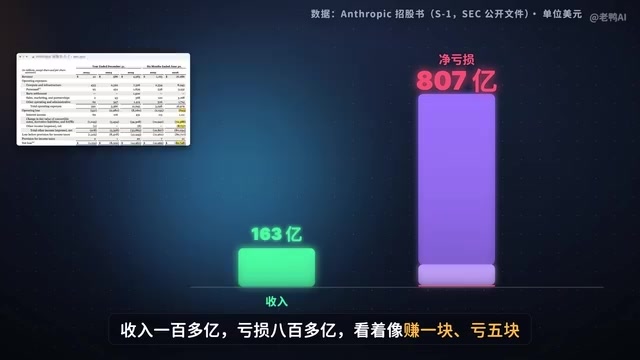
Of Anthropic's $80.7B half-year loss, only $700M is a real loss; Q2 operations are already profitable, but $265.6B in compute contracts hides risk.
Anthropic's prospectus shows a first-half net loss of $80.7 billion, but $81.2 billion comes from non-cash items such as convertible note fair value changes; the real operating loss is only $690 million, and on an adjusted basis it was even a $1.6 billion profit. Q2 operating profit reached $970 million, with revenue soaring from under $400 million in Q1 last year to $11.6 billion in Q2 this year, while compute cost as a share of revenue fell from 2.5x to 0.48x. The company's real risk lies in $265.6 billion of long-term compute contracts, against cash reserves of just over $30 billion—less than half. The IPO aims to lock in compute resources early, betting on continued revenue growth. The prospectus also admits that 5%-7% of revenue comes from non-compliant customers, and the barrier for Chinese users will not be lowered.
Anthropic's prospectus went public, and the figure "$80.7 billion loss in half a year" immediately flooded the internet. Many people's first reaction was: losing this much and still daring to go public? But if you break open the hundreds of pages of the prospectus, this account is actually being read backwards—of the $80.7 billion, only $700 million was actually lost doing business, while the company earned $1.1 billion just from interest on its cash. The remaining $80+ billion comes from a counterintuitive logic: the more valuable the company becomes, the more it appears to lose on paper.
Composition of the $80.7 Billion Loss: Paper Valuation Is the Big Chunk
First, look at the headline account. In the first half, Anthropic had revenue of $16.3 billion and a net loss of $80.7 billion—on the surface, it looks like earning one dollar and losing five. But breaking the loss down, the largest item is a $72.4 billion fair value change on convertible notes, and the second item is $8.8 billion in other expenses, also from several newly signed financing agreements being booked at market valuation. These two items add up to $81.2 billion, with not a single dollar of cash actually spent.
Why should a paper number count as a loss? This starts with an IOU. Big backers like Google and Amazon lent it money, signing convertible notes—we lend you the money first, and we expect not to be repaid in cash later, but converted into company shares at a discounted price. But Anthropic's valuation has risen too violently: in early 2025, financing was at $56 per share, and by May this year it was $589 per share, more than 10x in just over a year. The shares promised on the IOU also became 10x more valuable. The accounting rule is that when what you owe others becomes more expensive, the difference must be recorded as a loss. In Q2 alone this year, the financing price more than doubled, adding $59.6 billion to the paper loss. Put simply, this $80+ billion is a side effect of the company being too valuable.

Convertible Note is a hybrid financing instrument: investors first provide funds to the company as a loan, agreeing to convert them into company shares at a pre-agreed discounted price at some future point (or upon a triggering event such as financing or an IPO). For the borrower, if the company's valuation rises, conversion is more favorable to investors, and the company does not need to repay cash; but under accounting standards (such as IFRS or US GAAP), convertible notes must be measured at fair value. When a rise in company valuation increases the value of conversion, the fair value of the liability rises, and the difference is recognized in current profit or loss, creating a book loss. This loss involves no cash outflow but can significantly affect net profit—and it is the key to understanding Anthropic's huge loss.
The Real Books: Q2 Operations Are Already Profitable
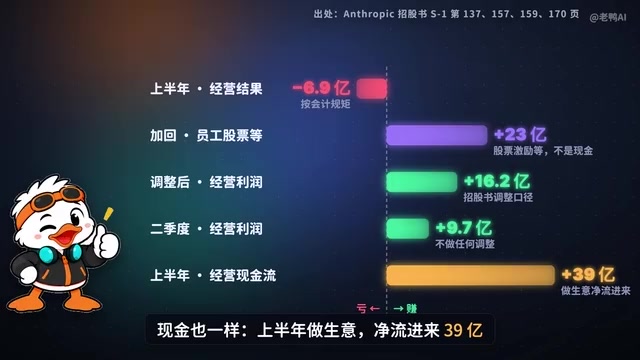
Subtract the paper portion and look at the real books. In the first half, operating loss was $690 million, of which $2.2 billion was stock issued to employees—also not cash. Under the adjusted basis in the prospectus, the first half was actually a profit of $1.6 billion operationally. More critically, in Q2—with no adjustments at all—the quarter was operationally profitable to the tune of $970 million, and cash was the same; in the first half, doing business brought in $3.9 billion net.
How did it turn around? Two words: compute efficiency. In Q1 last year, quarterly revenue was less than $400 million; in Q2 this year, it was $11.6 billion, a 30x increase. In Q1 last year, every $1 earned required $2.50 spent on compute; in Q2 this year, it required only $0.48. Revenue ran faster than the compute bill, so the loss shrank back.
Non-GAAP refers to a profit metric obtained by starting from net profit and excluding certain non-cash or non-recurring items (such as stock-based compensation, fair value changes, restructuring costs, etc.). The "adjusted operating profit of $1.6 billion in the first half" mentioned in Anthropic's prospectus means adding back $2.2 billion in stock-based compensation and other non-cash items to the $690 million operating loss. Stock-Based Compensation is when a company pays employees in shares; it generates no cash expenditure but dilutes shareholder equity. Investors should note that while Non-GAAP metrics can better reflect cash profitability, definitions vary by company, so they must be judged together with GAAP data.
The Real Landmine: $265.6 Billion in Compute Contracts
So is that the end of it? Not quite. What really deserves attention is another number: as of June this year, the fixed amount Anthropic must pay under signed compute contracts was $265.6 billion, up from $54.6 billion at the end of last year—nearly 5x in half a year. This money is payable over 1 to 20 years; once signed, it must be paid whether used or not. Meanwhile, its cash plus short-term investments signed amount to just over $30 billion—less than half.
So the IPO is not about needing money to survive, but about buying next few years' compute tickets in advance. This is a big bet—betting revenue can keep rising like this. If it can't, this $200+ billion becomes a real hole.

Compute Contract usually refers to a long-term compute procurement agreement signed between an AI company and a cloud service provider or chip supplier, committing to pay a fixed amount over the coming years (e.g., 1-20 years) to obtain computing resources such as GPUs/TPUs. Such contracts are rigid: regardless of whether the company actually uses the compute, it must pay as agreed, thus constituting a major off-balance-sheet liability. For AI companies with rapidly growing revenue, locking in compute in advance is a necessary measure to ensure model training and inference capacity, but it also brings fixed-cost risk. If revenue growth falls short of expectations, huge contracts will erode cash flow and may even lead to default. Anthropic's $265.6 billion contract amount far exceeds its cash reserves, highlighting its strategy of betting on continued high revenue growth.
What It Means for Chinese Users
The prospectus itself admits that in the first nine months of this year, 5% to 7% of revenue came from customers using the service in violation of the rules; such accounts are restricted and banned once detected, and enforcement has been intensified. So don't expect it to loosen up once it goes public—no matter how profitable it becomes, the barrier for us will not be lowered.
Back to the original question: why does it still dare to go public after losing $80.7 billion in half a year? Because almost all of that $80.7 billion is on paper, and the real business was already profitable in Q2. Its situation is not that it is about to collapse, but that it is borrowing money to grab compute. Next time you see a giant loss at some AI company, ask first: is the loss cash, or valuation?
Related articles
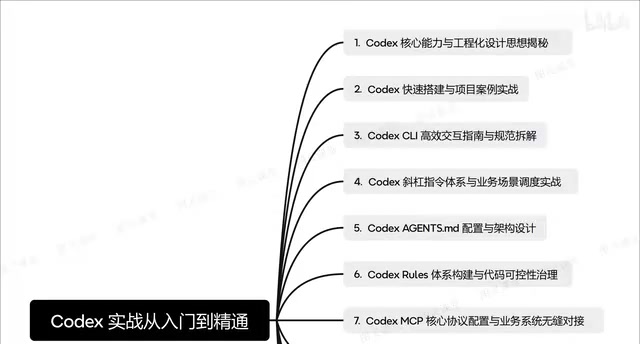
Codex in Practice: From Installation and Configuration to Multi-Agent Collaboration
Based on a Bilibili Codex course overview, this guide maps the full path of AI coding assistants from installation and agents.md context design to CLI commands, MCP integration, and multi-agent collaboration.

Claude Code Installation and Model Switching Guide for Users in China
How can developers in China install Claude Code reliably? This article compiles a Bilibili creator's hands-on solution: install via NPM, skip official login, use CC Switch to configure API Keys and freely switch between DeepSeek, Kimi, and other models to avoid account bans.
AI Supply Chain Security: What Canary Tokens Reveal
Starting from a Hacker News discussion, this article analyzes the role of canary tokens in AI supply chain security: how they detect abnormal access to model weights, training data, and credentials, as well as coverage blind spots and cost constraints during implementation.