The Truth Behind Anthropic's Account Bans: Client Detection Logic and a Wave of AI Model Launches

Anthropic's hidden client detection logic exposed, alongside a wave of AI model launches from Claude, OpenAI, NVIDIA, and Google.
Reverse engineering revealed that Anthropic's Claude client secretly checks user timezones and proxy domains, triggering account bans without user consent — sparking a major privacy controversy. Simultaneously, Anthropic launched Claude Sonnet 5 with near-flagship performance, added Linux support, and released a science workbench. OpenAI, NVIDIA, and Google DeepMind also rolled out new benchmarks, quantized models, and multimodal tools.
The Truth Behind Anthropic's Account Bans: Hidden Detection Logic in the Client
Reverse engineering reports circulating on social media and GitHub have recently uncovered the technical truth behind Anthropic's wave of account suspensions. The story began when a developer, while attempting to restore a disabled proxy feature, stumbled upon an unusual piece of logic embedded in the Claude client.
According to analysis hosted on GitHub, this code has existed since v2.91. The mechanism is triggered when users set an unofficial API endpoint. It checks two things: whether the device's timezone is set to "Asia/Shanghai" or "Asia/Germany", and whether the proxy domain appears in an obfuscated list of 147 entries.
From a technical standpoint, timezone detection is OS-level metadata that can be easily retrieved via standard APIs like Intl.DateTimeFormat without any special permissions. The domain list obfuscation typically uses Base64 encoding or simple XOR encryption to make reverse engineering harder. The legal and ethical boundary between this kind of "covert telemetry" and "compliance detection" is particularly sensitive under GDPR and CCPA frameworks — collecting user system configuration data without explicit disclosure may implicate data minimization principles and informed consent requirements.
Notably, the domain list covers Chinese tech companies like Baidu and Alibaba, along with several AI labs and API relay service domains. While detecting unauthorized reselling and traffic redirection is understandable from a business perspective, the real controversy lies in the implementation — the client silently transmits information about users' system configurations and proxy settings without their knowledge or consent. The core tension in this incident is the overlap of two issues: "is the detection itself reasonable" and "is collecting data without disclosure lawful" — a combination that fundamentally undermines user trust.
Facing public backlash, Anthropic engineer HQ212 responded by explaining the rationale behind the feature and stating that the relevant code would be rolled back in an update the following day. This incident serves as a reminder to the industry that AI vendors need to find a more transparent balance between combating abuse and respecting user privacy.
Export Control Lifted and a Cluster of Claude Model Updates
On the regulatory front, the U.S. Department of Commerce has officially lifted export controls on two of Anthropic's AI models. Anthropic subsequently announced that the affected models would resume global availability on the Claude platform, with Pro, Max, Team, and select Enterprise subscribers receiving phased usage allocations during a limited period before transitioning to a credit-based billing model.
More noteworthy is the launch of Claude Sonnet 5. Compared to Sonnet 4.6, the new version delivers across-the-board improvements, with overall performance now closely approaching the flagship Opus 4.8.
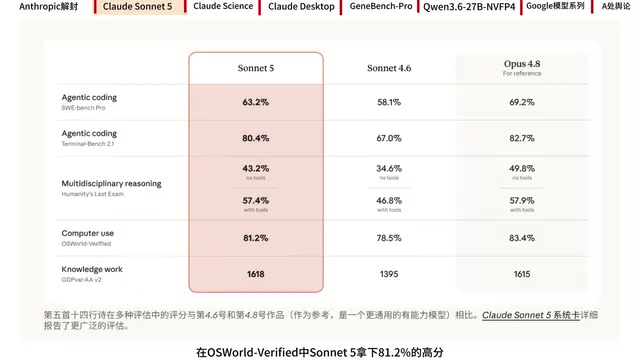
Looking at the specifics: on the SWE Bench Pro coding benchmark, Sonnet 5 scored 63.2%, narrowing the gap with Opus 4.8's 69.2% to single digits. On OS World Verified, Sonnet 5 achieved an impressive 81.2%, just 2.2 percentage points behind Opus 4.8's 83.4%.
It's worth explaining what SWE Bench Pro measures: designed by Princeton University, it draws closed Issues from real GitHub repositories and requires models to automatically generate code patches that pass the corresponding unit tests — measuring end-to-end problem-solving capability in real-world software engineering scenarios. The benchmark incorporates strict data contamination controls to prevent inflated scores from training data leakage. Human professional engineers typically score above 80%, so the 63%–69% range, while industry-leading, still represents a meaningful gap from human-level performance. This confirms the trend of mid-tier models rapidly closing the gap with flagship models on core capabilities.
On pricing, API users can take advantage of an introductory rate: $2 per million input tokens and $10 per million output tokens. After the promotional period, standard pricing kicks in at $3 per million input and $15 per million output — a strategy clearly designed to accelerate developer migration through time-limited incentives.
Claude Ecosystem Expands: Research Workbench and Linux Support
Another highlight of Anthropic's latest updates is its expansion into vertical use cases. Claude for Science is a new AI workbench built specifically for scientists, designed to consolidate fragmented research tools into a unified environment — freeing researchers from tedious data processing and constant tool-switching.
The workbench's core capabilities include reproducibility, automated peer review, and elastic computing, with 60 scientific databases pre-integrated for out-of-the-box use. It's currently available in Beta to Pro, Max, Team, and Enterprise users on macOS and Linux, with Team and Enterprise users requiring admin-enabled access.
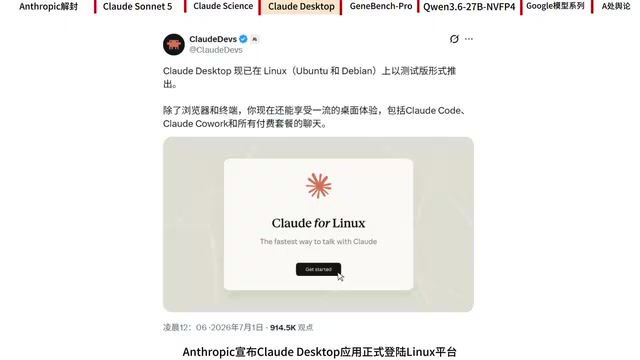
Separately, Anthropic announced that the Claude Desktop app has officially launched on Linux with a public Beta. The Linux version maintains feature parity with the macOS and Windows versions, marking a further commitment to the developer ecosystem. As a Beta release, however, the Linux version currently does not support Computer Use, voice input, or global keyboard shortcuts.
OpenAI and NVIDIA: Research Benchmarks and Quantized Models
In the research evaluation space, OpenAI released GeneBench Pro — a comprehensive research benchmark for AI agents and a major upgrade to the earlier GeneBench. GeneBench Pro includes 129 evaluation tasks spanning 10 major domains and 21 sub-disciplines, with genomics at its core alongside quantitative biology and translational biomedicine. OpenAI has published results for several frontier models on this benchmark, with top scores reaching 31.5% — a relatively low figure that reflects how much room for improvement AI still has on complex scientific tasks.
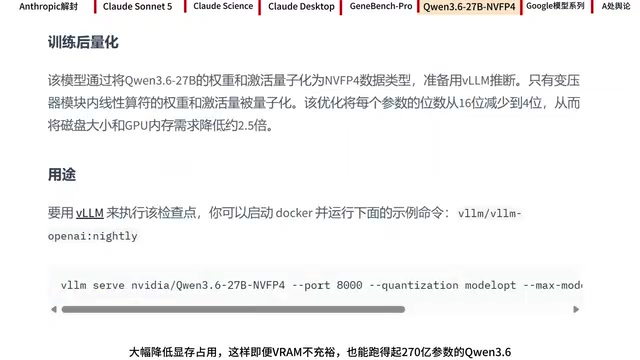
On the hardware and deployment front, NVIDIA released an NVFP4 quantized version of Qwen3 235B on Hugging Face. Understanding this requires some background on quantization: model quantization compresses neural network weights from high-precision floating-point representations (like BF16 at 16 bits) to lower-precision formats. NVFP4 (NVIDIA Float Point 4) is a custom 4-bit floating-point format developed by NVIDIA for Hopper and Blackwell architecture GPUs. Compared to traditional INT4 integer quantization, floating-point formats preserve more accuracy when handling Transformer models with large dynamic ranges. Compressing Qwen3 235B from BF16 to NVFP4 theoretically reduces VRAM requirements from roughly 470GB to about 156GB, enabling it to run on a single 8× H100 node — down from at least 16 GPUs for the original. This means users can run models with hundreds of billions of parameters even on VRAM-constrained hardware, further lowering the barrier to local deployment of large models and representing a key step in the "democratization" of AI infrastructure.
Google DeepMind: Images, Video, and Tabular Data on All Fronts
Google's updates were equally prolific. Google DeepMind introduced Nano Banana 2 Lite, internally codenamed Gemini 3.1 Flash Lite Image. Its 4-second image generation speed represents a 5× reduction in latency compared to the standard version, while the pricing of $0.0336 per 1,000 images is roughly half the standard rate — making it particularly attractive for cost-sensitive, high-volume use cases.
Also released the same day was a preview of the Gemini Omni Flash video generation model, priced at $0.10 per second of video with a 10-second maximum per clip, further rounding out Google's generative video product lineup.
In the structured data domain, Google Research officially launched TabFM — a zero-shot foundation model designed for tabular data classification and regression tasks. This release carries significant technical context: gradient boosting trees (such as XGBoost and LightGBM) have long outperformed deep learning methods on structured data tasks. The core reasons are that tabular data features are highly heterogeneous, sample sizes are typically limited, and there's no local continuity assumption like those found in images or text. Earlier zero-shot tabular models like TabPFN made breakthroughs but were constrained by sample size limits.
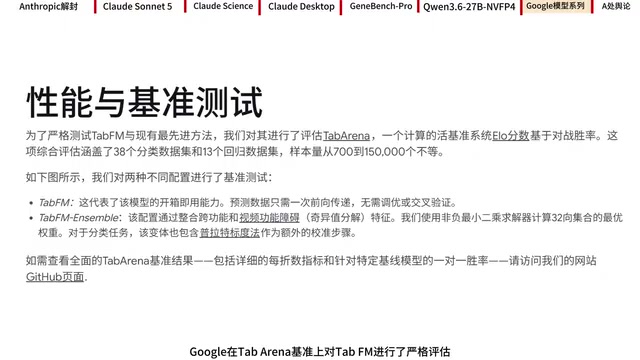
TabFM integrates advances from leading architectures like Tab PFN and Tab ICL, employing three key mechanisms: alternating row-column attention (addressing the semantic asymmetry between rows and columns), row compression (supporting larger datasets), and in-context learning Transformers. Google rigorously evaluated it on the Tab Arena benchmark, covering 38 classification datasets and 13 regression datasets with sample sizes ranging from 700 to 150,000. The results show TabFM Ensemble ranked first in both classification and regression tasks, with base TabFM coming in second. This signals that the AI foundation model paradigm is expanding from unstructured content into the core territory of traditional machine learning — structured business data — with far-reaching implications for industries that rely on tabular data, such as financial risk management and medical diagnostics.
Summary
This wave of AI industry developments reveals two main threads: first, the Anthropic account ban incident has exposed the sensitive boundaries around privacy and compliance for AI vendors, with transparency issues warranting vigilance across the entire industry; second, major players continue to double down on model capabilities, deployment efficiency, and vertical use cases — from Claude Sonnet 5 closing in on flagship performance and NVIDIA's 4-bit quantization, to Google's broad push across image, video, and tabular data. AI applications are accelerating toward lower costs and greater specialization.
Related articles

Apple HomeView Hands-On Review: Is the $300 Smart Home Hub Worth It?
Apple HomeView hands-on: a $300 smart home hub with facial recognition for quick account switching, but no App Store or voice recognition. Is the wall-mounted version worth it? Should you buy the first generation?

Meta Muse Wonder Launch: What It Means for Meta's Return to the Frontier AI Race
Meta releases Muse Wonder and WonderFull, benchmarks reach the frontier, community feedback is polarized. An in-depth look at Meta's return to the frontier AI race, its personal agent strategy, and Zuckerberg's different path.

Apple Home Smart Home Lineup Leaked: LG and Schneider Team Up, UWB Door Lock on Board
Apple Home ecosystem gains new LG and Schneider devices: UWB smart lock with proximity unlock, 2.5K dual-camera doorbell, privacy indoor camera, and AirPods-like seamless pairing.