The Truth Behind Claude Pro/Max Account Bans: 5 Key Principles from Six Months of Testing

Claude bans mostly stem from inconsistent signals across region, network, device, payment, and behavior — stability matters more than disguise.
Based on a Bilibili creator's six-month testing, the article argues that Claude account bans are rarely caused by heavy usage but by inconsistent signals across five dimensions: region, network, device, payment method, and usage behavior, which together form an abnormal profile in the risk control system. The author proposes a five-puzzle-piece model and stresses that stability comes not from any single perfect piece but from all five being mutually consistent. Specific advice includes: verify your region is on Anthropic's supported list, keep network exits stable rather than frequently switching, use anti-detect browsers for environment isolation rather than disguise, recognize that successful payment doesn't equal compliance and avoid repeated card failures, prefer the official appeal process over mass re-registration after a ban, and avoid account sharing. The core idea is to make the account look like a normal person's long-term usage rather than a deliberate perfect disguise.
Many people have their Claude Pro account suspended the day after subscribing, and some receive a ban notice right after upgrading to Max and having their payment deducted. Yet another group of users has been using Claude Code for six months without any issues. So where exactly is the problem?
According to a Bilibili creator's six-month testing summary, the core reason for Claude account bans is often not "using it too heavily," but rather multiple inconsistent signals appearing on the same account simultaneously — region, network, device, payment method, and usage behavior. It's the combination of these signals that defines "who you are" in the eyes of Anthropic's risk control system.
1. Regional Compliance: The Most Critical Yet Most Overlooked Prerequisite
Anthropic has an explicit list of supported regions, and mainland China is currently not within Claude.ai's supported范围. The official documentation also clearly states that creating an account from an unsupported region may be one of the reasons for a ban.
Many people assume that a ban is simply a credit card issue, but that's not the case. You can think of Anthropic's judgment as five puzzle pieces:
- Account registration region
- Login network
- Device environment
- Payment information
- Subsequent usage behavior
What makes an account truly stable is not about any single piece being perfect, but about these five pieces not conflicting with each other. For example, if you register in one region, log in from another country minutes later, switch to a third location the next day, keep changing your browser environment, and your payment method shows completely different information — what the system sees is not "this person is good at managing networks" but "this account's identity signals keep changing."
So the first principle is: stability matters more than so-called magic routes.
2. Network and Browser Environment: Consistency Beats Disguise
What a Clean IP Really Means
Pursuing the concept of a "clean IP" is not wrong in itself, but what you really need to avoid is network exits that are shared by many users, frequently switched, and already abused. If a single IP sees a large number of account registrations and abnormal login operations in a short period, it itself becomes a risk signal.
But note: a clean IP does not mean "find a US IP and you become a US user." If you don't actually comply with Anthropic's regional usage rules, changing your IP won't change your account's compliance status. For users who are already in supported regions, the safer approach is to keep your network as stable as possible — don't be in the US today, Japan tomorrow, and Singapore the day after. The more your location jumps around, the harder it is for the system to build a stable account profile.
The Right Way to Use an Anti-Detect Browser
The value of an anti-detect browser is not about "pretending to be someone else" but about environment isolation. For example, if you have two legitimate work accounts, account A has its own cookies, login state, and browser cache, while account B is in another independent environment — the two should not mix. With a regular browser, when you log out of one window and log into another, cookies get overwritten back and forth, the plugin environment changes, and various account states get mixed together, making anomalies more likely.
If you use an anti-detect browser, the key should be "one account, one fixed environment, maintained consistently over the long term" — not changing the operating system today, the browser fingerprint tomorrow, and simulating another computer the day after. Frequent disguise is itself instability.
Browser fingerprinting refers to the device identification features that websites derive from a combination of many attributes such as User-Agent, screen resolution, time zone, language, font list, Canvas rendering characteristics, and WebGL parameters. The purpose of an anti-detect browser is to give each browser profile its own independent and fixed fingerprint parameters, isolating different accounts' browsing environments from each other and preventing cookies, caches, and fingerprint features from contaminating one another. For a risk control system like Claude's, the same account consistently presenting the same fingerprint set is a normal signal; whereas frequent changes to the same account's fingerprint parameters, or different accounts sharing exactly the same fingerprint, can actually increase the risk of association. Therefore, the key to using an anti-detect browser is "set up the environment and don't change it" — treat the profile as a fixed computer rather than regenerating a random set of parameters every time you log in.
3. Payment Method: Successful Payment ≠ Account Compliance
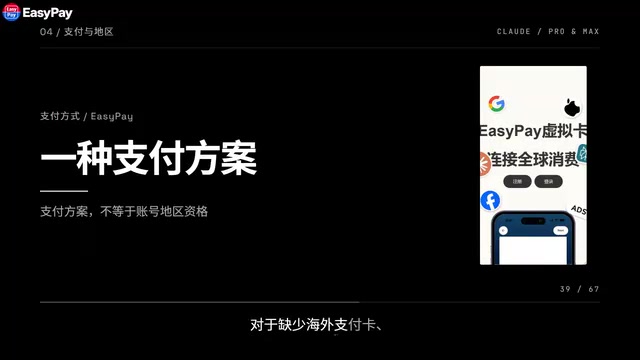
Claude Pro and Max are both overseas subscription services, and normal payment on the official website requires a payment method capable of completing international online transactions. If you're in a supported region but don't have a suitable Visa or MasterCard on hand, some users consider virtual credit card solutions. According to the creator, EasyPay offers virtual credit cards with a $3 card issuance fee and no KYC verification required, which can be an option when you lack an overseas payment card.
But there is a very important distinction here: whether a bank card can successfully process a payment and whether your Claude account complies with regional policies are two separate things. A US card won't automatically turn your account into a US account, and a successful payment doesn't mean you won't trigger risk control later.
What really matters with payment methods:
- Don't have repeated failures
- Don't switch through several cards in a single day
- Don't keep retrying after a dozen failed payment attempts
Normal user payment behavior is "enter card → pay → success → done," while abnormal behavior is often "card A fails → card B fails → switch to card C → change region → register a new account" — a chain of actions piling up, and naturally the risk keeps rising.
4. Don't Register Accounts Repeatedly — Use the Official Appeal Process First
This is the point most people easily overlook. After an account is banned, they immediately register three more; when those three get restricted, they keep changing email addresses, phone numbers, and networks. From a human perspective, they're solving the problem; from the risk control system's perspective, what it sees is a string of associated accounts continuously appearing.
If your account really was wrongly banned, the priority is not to frantically re-register but to appeal. Anthropic currently provides a formal account appeal process — if you believe your account was mistakenly suspended, you can log in with the banned account and submit an appeal to have the Safeguards team re-examine it.
5. Don't Share Your Account
Claude Pro and Max are personal accounts. If completely different devices, locations, and usage rhythms appear in a short period — using it yourself today, giving it to a friend in the evening, running it on a server the next day, and someone else logging in the day after — stability will inevitably be far worse than one person using it consistently.
Compressing the Method into Five Words
Regional compliance, network stability, fixed environment, consistent payment, normal behavior.
It's not about the more advanced the IP the better, the more complex the fingerprint the better, or the more bank cards the better. Quite the opposite — what Claude accounts fear most is constant change. After six months of use, the simpler logic is: don't try to make your account look perfect — make it look like a normal person using it long-term — fixed region, fixed device, fixed browser environment, normal payment, normal usage.
One final reminder: if you are not in an Anthropic-supported region, changing your IP, browser, or getting a US bank card won't fundamentally change the regional policy. The first step to real stability is never studying how to bypass risk control, but first confirming that your account, location, and usage method are within what is officially permitted. On that basis, keeping your network, device, payment, and account behavior stable is the single most important thing for reducing Claude account risk control issues.
Background Notes
Anthropic's supported regions list is based on its terms of service and export control and sanctions compliance requirements, and is updated as the regulatory environment changes — it is not fixed. Users can check the latest list on Anthropic's official website under the terms of service or help center pages. Note that "supported region" refers to the region where the account holder actually is and uses the service, not the address entered at registration or the exit location of the network used. Even if technical means make the network exit appear to be in a supported region, if there is a contradiction between the account's actual usage location, payment information, and registration information, it may still be judged as inconsistent regional signals. In addition, violating regional policies may not only lead to account suspension but also may make paid subscription fees non-refundable. Therefore, verifying whether your region is on the list before subscribing is the lowest-cost risk control measure.
Related articles

Frontend to AI Agent Development: A Frontline Architect Explains Career Paths and Opportunities
A frontline AI architect explains the industry changes and practical paths for frontend developers transitioning to AI Agent development: why pure frontend jobs are disappearing, why Agent + full-stack has become mainstream in hiring, and three transformation routes—Agent development engineer, FDE, and remote contracting—along with corresponding learning strategies.

How to Choose an AI Agent Development Course: Five Pitfall-Avoidance Guidelines
A mechanical-engineering career changer's two-year pitfall-tested checklist for screening AI Agent development courses: complete delivery pipeline, resume-worthy projects, real development perspective, update frequency, and coaching feedback—with concrete judgment methods and pitfall-avoidance tips.

Coze AI Agent Building for Beginners: A Zero-Code AI Agent Development Guide
Coze, ByteDance's one-stop AI application development platform, supports zero-code drag-and-drop AI agent building. This article outlines Coze's core concepts, three advantages, differences between the domestic and international versions, and the distinction between agents and apps, helping beginners quickly get started with AI Agent development.