The Truth Behind Long-Context Failure: Distractor Competition Is Deadlier Than Length

Long-context retrieval failures are mainly caused by distractor attention competition, not length itself.
The study challenges the intuition that length causes long-context failure, testing retrieval tasks on five open-source models. Results show neutral filler extension leaves accuracy almost unchanged (0.97-1.00), meaning length itself is cheap; but same-format distractor statements drop accuracy to 0.16-0.33, with a single competing statement expanding loss 9-110x cumulatively. Attention mass on evidence explains up to 58% of loss variance, while log length explains only 8%. The masked-filler protocol introduces extra interference; with visible filler, loss at 32K tokens is zero. Optimization should shift from compressing length to reducing candidate conflicts and monitoring attention allocation.
Long context is a core capability of large language models (LLMs), but why do models repeatedly fail on long inputs? Most people blame length, but a new study offers a颠覆性 (subversive) perspective: in retrieval tasks, length itself is cheap—the real killer is attention competition among distractors.
Length Is Not the Culprit: Neutral Filler Barely Hurts Accuracy
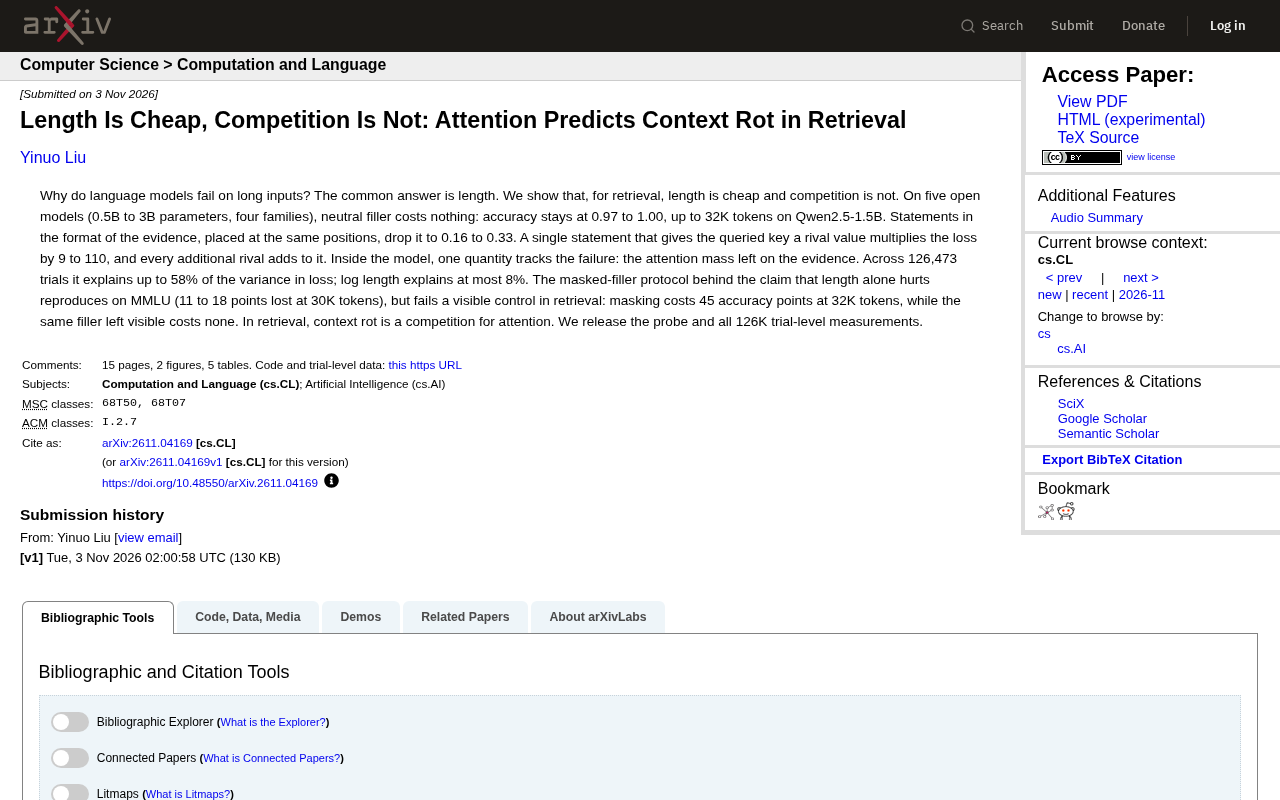
The researchers conducted systematic tests on five open-source models (parameters ranging from 0.5B to 3B, covering four model families). When the context was extended with neutral filler text, retrieval accuracy was almost unaffected, remaining between 0.97 and 1.00, and on Qwen2.5-1.5B it even held steady up to 32K tokens.
This result directly challenges the intuition that "long context inevitably leads to performance degradation." The phenomenon often called "context rot" does not hold on the pure length dimension—at least for retrieval tasks, models are highly robust to lengthy but non-competitive contexts.
Competition Is the Key: Same-Format Distractors Drastically Lower Accuracy
What really makes models "crash" is distractor statements in the same format as the evidence. When the researchers replaced neutral filler with statements in the same format as the evidence and placed them in the same positions, accuracy plummeted to 0.16–0.33. This means format similarity triggers internal confusion in the model.
More seriously, merely adding one statement that provides a competing value for the query key expands the loss by 9 to 110 times, and each additional competing statement causes further cumulative damage. This shows that retrieval failure is not about "failing to remember" but about "failing to distinguish"—the model experiences attention contention among multiple candidate values.
"Same-format distractors" refer to statements that are highly similar to the correct evidence in sentence pattern, field structure, or expression template but have different values. They are more harmful because models often rely on format cues (e.g., "the value of X is...") to locate answers during retrieval. Format consistency makes distractors and evidence highly close in representation space, making it difficult for attention to distinguish them by format alone, forcing competition among multiple candidate values. This contrasts sharply with random neutral filler: the latter differs greatly in format from the evidence and is unlikely to be mistaken for a candidate answer. This phenomenon also explains why repeated or near-duplicate retrieved passages in RAG significantly degrade performance, and why deduplication and re-ranking can directly alleviate competition.
Attention Mass: Explains Far More Than Length
The researchers further delved into the model's internals and found a key metric that tracks failure: the attention mass remaining on the evidence. Across 126,473 trials, this metric explained up to 58% of the loss variance, while log length explained at most 8%.
This provides mechanistic evidence for the "competition hypothesis." The model does not lose information because the sequence is too long, but because competing items divert attention that should be concentrated on the evidence. The quality of attention allocation, not the physical length of the context window, determines retrieval success.
"Attention mass" refers to the proportion of total attention weights that the model allocates to specific positions in the input sequence (such as the evidence passage) when making predictions. It measures "where attention is concentrated," not "how long the window is." In retrieval-style tasks, if the model allocates most of its attention to the correct evidence, this metric is high; if attention is diverted by numerous format-similar distractors, the metric is low. The researchers obtained this value by reading attention maps from each layer during inference and aggregating them onto evidence tokens, then performed regression analysis against final correctness to quantify its explanatory power. This metric is closer to the failure mechanism than input length and can therefore serve as a runtime monitoring signal for long-context systems.
The Experimental Trap of Masked Filler
Some previous studies concluded that "length itself is harmful" using a "masked filler" protocol, but the new study points out that this protocol is flawed. On the MMLU benchmark, masked filler does reproduce an 11 to 18 percentage point performance drop due to length (at 30K tokens).
However, in retrieval tasks, a visible control experiment revealed the problem: when filler was masked, accuracy loss at 32K tokens was as high as 45 percentage points; when the same filler remained visible, the loss was zero. This shows that the masking operation itself introduces additional interference, rather than length being the cause.
"Masked filler" is a common protocol in long-context evaluation: to control for the length variable, researchers replace irrelevant filler text with special placeholders or mask it directly so the model cannot see the content. The original intent was to eliminate semantic interference from filler, but the new study points out that the masking operation itself changes the input distribution—special tokens or blank positions may be treated by the model as anomalous signals, inducing additional attention competition or out-of-distribution behavior. Thus the measured performance drop is misattributed to length when it is actually a protocol artifact. The control experiment (same filler under visible and masked conditions) was designed precisely to separate this confound, and the results show that length is almost harmless with visible neutral filler, while losses only appear substantially under masking.
Implications for Long-Context Optimization
This research has direct guiding significance for RAG systems and long-document question answering. If competition is the main contradiction, then the optimization direction should shift from "compressing length" to "reducing candidate conflicts." For example, in retrieval-augmented generation, re-ranking or deduplication can reduce the number of same-format distractors; in prompt design, avoid mixing irrelevant but format-similar statements with evidence.
The researchers open-sourced the probes and all 126K trial-level measurement data, providing a foundation for subsequent reproduction and extension. For teams building long-context applications, an actionable check is: monitor the model's attention mass on evidence, rather than focusing solely on input length or recall.
Conclusion: Redefining "Context Rot"
"Length is cheap; competition is not." This study uses a chain of evidence across multiple models and tasks to shift the attribution of long-context failure from length to attention competition. For the industry trend of pursuing longer context windows, this reminds us: window size is only an entry ticket; how to manage competition within the window is the key to determining actual model performance.
One-line Summary
Long-context retrieval failures are mainly caused by distractor attention competition, not length itself.
Paragraph Summary
This study challenges the intuition that "length causes long-context failure" and systematically tests retrieval tasks on five open-source models. Results show that extending context with neutral filler leaves accuracy almost unchanged (0.97–1.00), indicating length itself is very cheap; but when replaced with same-format distractor statements, accuracy plummets to 0.16–0.33, and a single competing statement can expand the loss by 9–110 times with cumulative effects. Mechanistically, attention mass on evidence explains up to 58% of loss variance, while log length explains only 8%. The study also points out that the masked-filler experimental protocol introduces additional interference, and with visible filler the loss at 32K tokens is zero. Optimization should shift from compressing length to reducing candidate conflicts and monitoring attention allocation.
Related articles

9 AI Subscription Plans Compared: The Real Cost Per 100M Tokens Revealed
Bilibili creator tests 9 AI subscription plans from Volcano, Alibaba, Tencent, Baidu, Zhipu, Xiaomi, MiniMax and more, converting them all to real cost per 100M tokens, breaking down fixed-quota vs. three-tier coefficient billing and how caching, time-of-day discounts, and window limits affect actual quota.

Vibe Coding for Beginners: Expressing Intent Instead of Handwriting Code
What is Vibe Coding? A 137-episode Bilibili course defines it: the core is expressing intent, not writing code. This article analyzes Vibe Coding's productivity logic, target audience, and entry expectations to help beginners decide if it's worth learning.

LangChain Beginner's Guide: An Agent Development Roadmap from LangGraph to Deep Agents
Clarify the encapsulation relationship among LangChain, LangGraph, and Deep Agents, and master the learning path and selection logic for agent development frameworks—suitable for beginners in large model development.