The U.S. Router Ban Takes Effect — How Asus 'Slipped Through' While Staying Silent

Asus cleared the U.S. foreign router ban but refuses to disclose how it passed, sparking transparency concerns.
The U.S. this spring banned future foreign-made consumer routers unless manufacturers prove no security threat and submit domestic manufacturing plans. Asus became one of the first to clear this bar as of September 9, but has stayed completely silent on how it achieved compliance. This "pass without explanation" stance may reflect commercial confidentiality needs, but also highlights the growing politicization of tech regulation and opacity in security reviews — narrowing consumer choice, pressuring prices upward, and accelerating supply chain reshoring across the industry.
A Single Regulation Reshapes the Router Industry
This spring, the U.S. government introduced a sweeping regulatory measure: a ban on all future foreign-manufactured consumer-grade routers entering the American market — effectively covering nearly every router product yet to be released. To continue selling, manufacturers must meet two conditions: first, prove to the U.S. government that their products pose no national security threat; second, submit a "detailed, time-bound plan" committing to establish or expand manufacturing capacity on U.S. soil.
At its core, this policy elevates supply chain security to a matter of national strategy. Routers serve as the central hub of home and enterprise networks — any backdoor or vulnerability could become an entry point for large-scale cyber surveillance and attacks. U.S. regulators clearly intend to use "domestic manufacturing" as a lever to reshape the supply chain landscape for critical networking equipment.
The direct regulatory basis for this ban stems from the International Emergency Economic Powers Act (IEEPA) and an expansion of the Bureau of Industry and Security (BIS) export control framework. Its policy roots trace back to a series of U.S. restrictions on Chinese telecom equipment makers in recent years — from placing Huawei and ZTE on the Entity List, to the 2022 Secure Equipment Act prohibiting federal agencies from purchasing equipment from certain brands. The router ban is the latest link in this policy chain. Consumer-grade routers have become a key target because they are widely deployed at the network perimeter of U.S. homes and small businesses, and have historically been exploited in large-scale botnet attacks — such as the 2023 Volt Typhoon incident, in which compromised home routers served as intermediate relay nodes.
Asus 'Passes' — But Refuses to Explain How
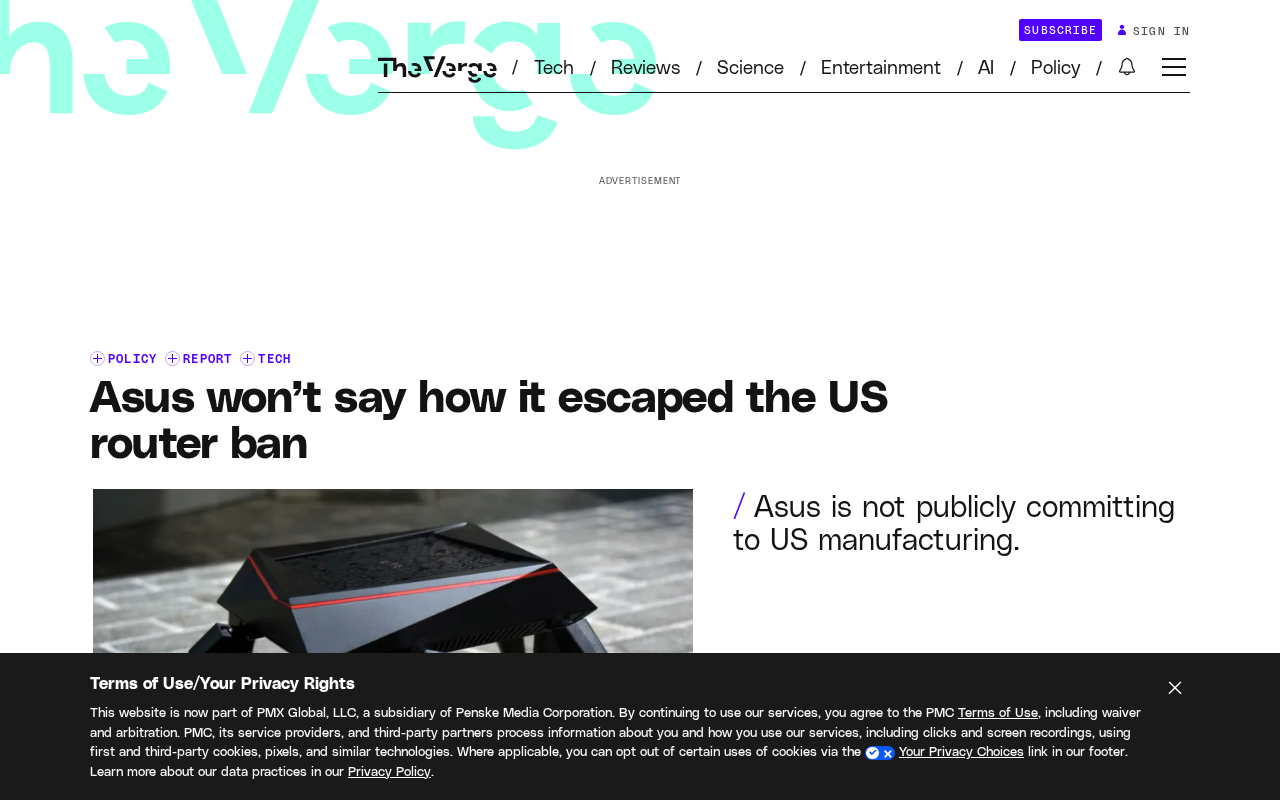
According to reports, as of September 9, Asus has become one of the manufacturers permitted to continue selling routers under this ban. In other words, Asus successfully cleared the threshold set by the U.S. government.
What's striking, however, is that Asus has not publicly explained how it managed to "slip through" this regulatory barrier. Did it pass a security review proving its products are trustworthy? Did it submit a compelling plan for expanding domestic manufacturing? Or both? On these critical questions, Asus has chosen silence.
This "pass without explanation" stance leaves a significant information vacuum. Consumers have no way to assess what kind of scrutiny their Asus routers actually underwent. Competing manufacturers have no compliance roadmap to reference. And for industry observers, the opacity raises serious questions about the consistency of regulatory enforcement.
The Many Possible Reasons for Staying Silent
Asu's reticence may stem from several considerations. Security assessment details, supply chain arrangements, and communications with the government involved in the compliance process often contain commercially sensitive information that manufacturers typically prefer not to disclose. Furthermore, if Asus's approval hinged on specific arrangements, early disclosure could invite imitation by competitors or invite additional regulatory scrutiny.
From an industry perspective, this episode reflects a broader trend toward the politicization of tech product regulation. National security reviews are increasingly becoming a new gateway to market access — and the standards and enforcement of such reviews often lack public transparency. Manufacturers are both the subjects of these reviews and potential beneficiaries of differentiated competitive advantages: whoever passes first gains a head start in capturing market share vacated by the ban.
The problem of opaque national security reviews is far from unique in U.S. tech regulation. The review process of the Committee on Foreign Investment in the United States (CFIUS) similarly operates under a confidentiality principle, with applicants typically explicitly prohibited from disclosing review details and outcomes. When hardware security certifications involve source code audits, firmware vulnerability assessments, or vendor due diligence, making the results public could actually expose the specific weaknesses of the reviewed products, creating new security risks. This objectively provides a rationale for regulatory opacity — but it also means that outside observers cannot assess whether review standards are being applied consistently across different manufacturers, raising legitimate industry concerns about potentially uneven enforcement.
Far-Reaching Implications for Consumers and the Industry
For ordinary consumers, the most immediate impact is a narrowing of choices. With foreign-manufactured routers broadly restricted, the number of available brands and models may shrink considerably, and prices could face upward pressure. Products that remain on shelves will, in many cases, signify some form of compliance certification.
For the broader networking equipment industry, this ban may accelerate the reshoring of manufacturing to the United States, while forcing manufacturers to reassess their supply chain resilience and security compliance capabilities. Going forward, "whether a router has passed U.S. security review" may well become an important marker of trustworthiness.
What happens next deserves close attention: Which other manufacturers will eventually clear the bar? Will regulators increase review transparency? Will Asus ultimately disclose its compliance pathway? The answers to these questions will largely determine the trajectory of this supply chain realignment.
Conclusion
On the surface, Asus's quiet passage through the router ban is a single manufacturer's compliance story. But beneath it lies the intersection of tech product regulation, national security, and global supply chains. With information still opaque, consumers and the industry alike can only wait for more details to emerge. The regulatory battle over routers has only just begun.
Related articles

Free Unlimited Claude Code Solution: Agnes AI + CC Switch Setup Guide
No paid subscription needed — pair the free AI platform Agnes AI with the open-source tool CC Switch to provide a backend for Claude Code, enabling unlimited free calls to text, image, and video models. This guide covers the full setup, test results, and usage boundaries.

A Complete Zero-Cost Guide to Getting Started with Claude Code for Beginners in China
A beginner's guide to Claude Code for users in China: two installation methods (command line and IDE plugin), full configuration steps for replacing the official API with the free domestic LongCat model, and a hands-on demo of building a small tool with natural language, plus tips.

When the NSA Gets Involved: The AI Supply Chain Crisis Behind Open-Source CVEs and API Key Hijacking
Multiple open-source projects disclosed severe CVEs in one day, PHP flaws alarmed the FBI, and Railway and OpenCode were breached with API keys stolen. This article breaks down the vulnerability window, AI-accelerated exploitation, and the AI supply chain crisis behind the API key black market, with a developer defense checklist.