The Worst Cyberattacks of 2026 So Far: Data Breaches, Ransomware, and Compromised Infrastructure

2026's worst cyberattacks: DOGE data breach, infrastructure intrusions, and federal surveillance systems compromised.
2026 has already seen several major cybersecurity incidents, including a massive DOGE data breach, critical infrastructure intrusions, and the compromise of federal surveillance systems. These events share common threads: attackers are targeting high-value systems, shifting from data theft to physical system control, and exploiting basic failures like misconfigurations and weak supply chains rather than sophisticated zero-days. For businesses, defense-in-depth and supply chain scrutiny are urgent priorities; for individuals, enabling MFA and avoiding password reuse remain the most effective defenses.
The battle between attackers and defenders in cybersecurity never stops — and 2026 has already seen several major security incidents that have shaken the industry. From massive DOGE-related data breaches to critical infrastructure intrusions and the compromise of federal surveillance systems, these events have not only exposed organizations' security blind spots but also signal that attackers are continuously escalating their tactics.
This article reviews the most destructive security incidents and data breaches of 2026 so far, examining the patterns behind them and their far-reaching implications for businesses and individuals alike.
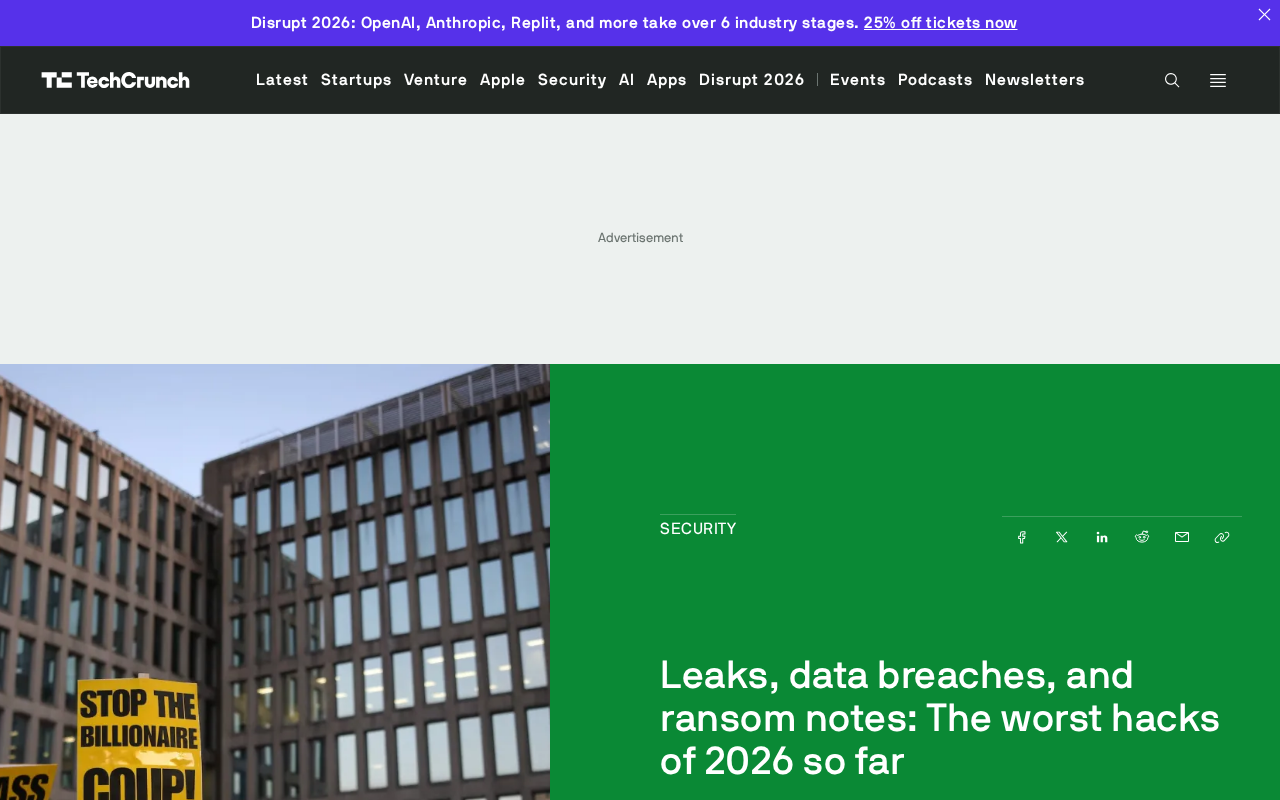
The DOGE Massive Data Breach
Among the many security incidents that have come to light this year, the large-scale data breach linked to DOGE stands out as particularly alarming. These types of breaches typically involve enormous volumes of sensitive information that, once sold on underground markets, can be weaponized for identity theft, targeted scams, and follow-on attacks.
The harm from a large-scale data breach doesn't end with the incident itself. Stolen data is routinely resold multiple times on the dark web, fueling an entire black-market ecosystem. Affected individuals may not feel the real consequences of their compromised privacy until months or even years after the fact — which makes accountability and remediation extraordinarily complex.
Critical Infrastructure Under Siege
The security of critical infrastructure has always been a core national security concern. The infrastructure intrusions that occurred in 2026 serve as yet another wake-up call: once systems controlling power, water, energy, and transportation are compromised, the impact can far exceed that of an ordinary commercial data breach.
What makes these attacks particularly dangerous is their ability to translate threats from the digital world directly into the physical one. Attackers are no longer merely stealing data — they are capable of disrupting or even paralyzing the essential services that keep society functioning. This explains why governments and regulators worldwide are dedicating increasing resources to critical infrastructure protection.
The Shift from Data Theft to System Control
One trend worth highlighting is that the objective of infrastructure attacks is shifting — from pure information theft toward seizing control of the systems themselves. This means traditional defense strategies centered on data protection are no longer sufficient to counter modern threats. Defenders must now address the security convergence of Operational Technology (OT) and Information Technology (IT) simultaneously.
The convergence of OT and IT security is one of the central challenges in protecting infrastructure today. IT systems handle data and business logic, while OT systems directly control physical equipment — such as Industrial Control Systems (ICS), Supervisory Control and Data Acquisition systems (SCADA), and Programmable Logic Controllers (PLCs). Traditionally, OT systems relied on physical isolation ("air gaps") to stay secure, but as the Industrial Internet of Things has expanded, more and more OT devices have been connected to corporate networks and even the public internet, blurring the boundary between the two. Attackers can first infiltrate an IT network through phishing emails, then move laterally into the OT environment, ultimately executing destructive operations on factory equipment, power grid controls, or water treatment processes. The 2021 Florida water treatment plant intrusion and the Ukraine power grid attacks have already demonstrated the very real threat of this attack path.
Federal Surveillance Systems Breached
The compromise of federal surveillance systems is one of the most ironic and deeply troubling incidents of the year. Systems built to monitor and ensure security became the targets themselves — not only exposing sensitive surveillance data, but potentially giving attackers insight into the inner workings of law enforcement and intelligence agencies.
Events like these reveal a sobering truth: even the most security-conscious, resource-rich government agencies are not invulnerable. When any single link in a defensive architecture is weak, the entire system faces cascading risk.
Common Patterns Across These Incidents
Looking across the major security incidents of 2026, several clear threads emerge. Attackers are increasingly targeting high-value, high-impact systems — whether vast repositories of personal data, critical infrastructure, or core government systems. Meanwhile, ransomware remains a go-to monetization tool, with ransom notes appearing with alarming frequency on the screens of victim organizations.
Another pattern that cannot be ignored: the root cause of many major breaches was not some sophisticated zero-day exploit, but rather basic failures — misconfigurations, lax access controls, or weak supply chain security. This is a reminder to all organizations that effective security isn't just about countering the most advanced attacks; it's equally about getting the fundamentals right.
Supply chain attacks are an intrusion path that has been repeatedly validated in recent years and deserve special attention. Rather than directly attacking the target organization, adversaries infiltrate its software vendors, hardware manufacturers, or service providers, planting malicious code inside legitimate products or update packages, which then propagate to tens of thousands of downstream users through normal software distribution channels. The 2020 SolarWinds incident is the canonical example of this pattern — attackers poisoned a network management software update and compromised approximately 18,000 organizations, including multiple U.S. federal agencies. What makes this attack style so difficult to defend against is that it exploits an organization's implicit trust in its trusted vendors; traditional perimeter defenses are nearly blind to it. The Zero Trust architecture's core principle — "never trust, always verify" — is a direct response to exactly this class of threat.
Implications for Businesses and Individuals
For businesses, these incidents underscore the importance of defense-in-depth, the principle of least privilege, and rigorous supply chain security reviews. Regular security assessments, timely patch management, and well-rehearsed incident response plans are all critical components of reducing risk.
For individual users, in the face of increasingly frequent data breaches, adopting multi-factor authentication, avoiding password reuse, and closely monitoring accounts for suspicious activity has become more essential than ever. In an era where data breaches have become routine, operating with the assumption that your information could be exposed at any time — and preparing accordingly — is a more pragmatic security mindset.
2026 is still far from over, and these events may well be just a preview of the year's full security landscape. It is safe to predict that as attack techniques continue to evolve, the offensive-defensive arms race in cybersecurity will keep intensifying, placing ever-greater demands on the protective capabilities of all organizations and individuals.
Multi-Factor Authentication (MFA) is widely recognized as one of the highest-value security measures available. It requires users to provide a second layer of verification beyond a password, with common forms including SMS one-time passwords (OTP), time-based OTP apps (such as Google Authenticator), hardware security keys (such as YubiKey), and biometric authentication. Research shows that enabling MFA can block more than 99% of account takeover attacks. It's worth noting that SMS-based verification codes carry relatively higher risk due to SIM-swapping vulnerabilities; where possible, opting for an authenticator app or hardware key provides stronger protection. For enterprise users, combining MFA with Single Sign-On (SSO) can dramatically raise the overall account security baseline without significantly adding friction for end users.
Related articles

Complete Guide to Running Your Own Local DeepSeek: Web Access, Knowledge Base & Privacy
Step-by-step guide to deploying a private DeepSeek locally using Ollama, Chatbox, and AnythingLLM — with web access, RAG knowledge base, and full privacy.
AI Agent Development: A 4-Stage Learning Roadmap from Beginner to Enterprise-Level Practice
A complete AI Agent learning roadmap from zero to enterprise-level: covering ReAct, multi-agent collaboration, Prompt tuning, RAG, MCP, and real-world projects.
A New DeepSeek Harness Experiment: Agent Supervising Agent for Self-Evolution
A developer built an "Agent supervising Agent" self-evolution system using DeepSeek Harness, with a ledger mechanism enabling near-unattended overnight software iteration.