They Want Your Blood: The Frenzy Around Wearables and Blood Testing

Tech companies are turning blood testing into the next consumer health data entry point, but frequent testing without medical supervision may lead to overdiagnosis and health anxiety.
Using The Verge reviewer Victoria Song's experience of 12 blood donations in six weeks as a starting point, the article reveals that the tech industry's hunger for blood data is seeping from medical settings into consumer-grade health management. Direct-to-consumer blood testing companies claim to help users detect problems early and track lifestyle effects, but critics point out that frequent testing without medical supervision can lead to overdiagnosis, unnecessary anxiety, and overinterpretation of minor fluctuations. Business logic is the core driver: hardware profits are limited, and blood biomarkers can support subscription services and personalized recommendations while becoming a product differentiation barrier. The article also discusses how optimization culture rationalizes frequent testing as self-improvement, as well as regulatory fragmentation and data privacy risks. The conclusion is that for healthy individuals, frequent blood testing lacks medical evidence support—more data and higher testing frequency are not necessarily better.
When Health Tracking Extends from the Wrist to the Veins
With the wearable device market becoming increasingly saturated, tech companies are searching for the next entry point into health data. In her column Optimizer for The Verge, senior reviewer Victoria Song documented a disquieting personal experience: donating blood for testing for the 12th time in six weeks. This wasn't medically necessary—it was to satisfy a range of health monitoring products claiming to "change your life." Song's ordeal reveals a trend taking shape—the tech industry's hunger for blood data is seeping from professional medical settings into consumer-grade health management.
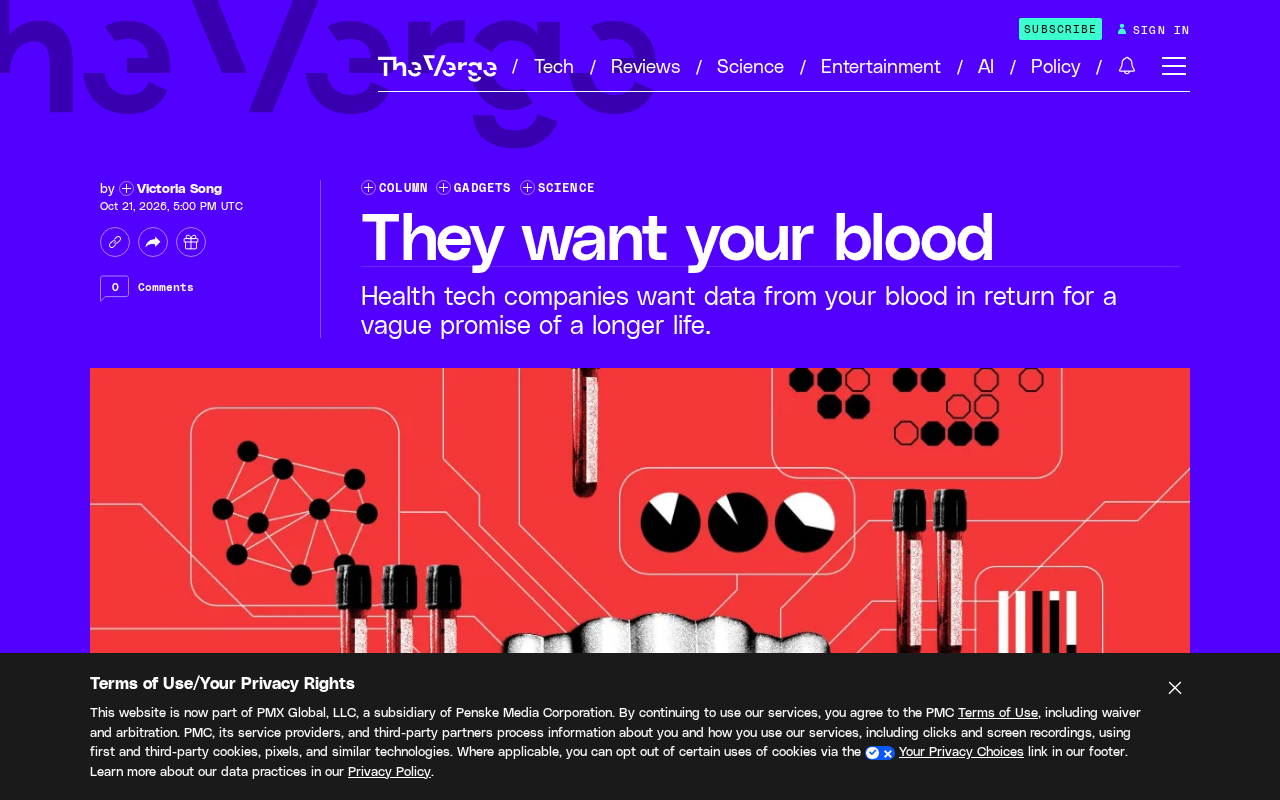
Wearables can already track heart rate, blood oxygen, and sleep quality, but blood testing promises deeper biochemical metrics. From vitamin levels to hormone balance to inflammatory markers, these data points hold natural appeal for health optimization enthusiasts. The question is: when "optimization" becomes a consumerist narrative, is frequent blood testing really necessary?
The Two Sides of Democratizing Blood Testing
Traditionally, blood testing has been the domain of hospitals and clinics, tightly regulated and usually based on clear medical indications. In recent years, a wave of startups has sought to "democratize" this process—through partner lab networks and direct-to-consumer models, allowing users to order various blood panels without a doctor's referral.
Proponents of this model argue that more convenient testing can help people detect potential problems early and track the effects of lifestyle interventions. But critics point out that frequent testing without medical supervision can lead to overdiagnosis, unnecessary anxiety, and overinterpretation of minor fluctuations. Song's frequency of 12 blood donations in six weeks far exceeds clinical guidelines for healthy individuals—which is alarming in itself.
Data Hunger and Business Logic
Why are tech companies so eager for users' blood data? The answer lies partly in the business model. Hardware profit margins for wearables are limited; the real value lies in subscription services and the data ecosystem. Blood biomarkers offer a "deeper" data dimension than step counts or heart rate, capable of supporting higher-priced personalized health advice and supplement recommendations.
Another part of the answer is product differentiation. When nearly every smartwatch can measure heart rate and blood oxygen, blood test data becomes a new competitive barrier. Companies can attract users willing to pay for optimization by showcasing "full-stack health insights." But where the boundaries of this data collection lie remains without clear social consensus.
Biomarkers refer to objectively measurable and evaluable indicators that reflect physiological or pathological processes, typically detected through blood, urine, or tissue samples. Common blood biomarkers include blood glucose, blood lipids, C-reactive protein (an inflammatory marker), vitamin D, and thyroid hormones. In consumer-grade health products, biomarkers are used as a source of "deep data" to distinguish them from behavioral data like heart rate and step counts. Their commercial value lies in: biomarkers can reveal an individual's biochemical state, thereby supporting value-added services such as personalized nutrition, supplement recommendations, and health risk scores. However, clinical interpretation of biomarkers is highly context-dependent—age, sex, time of testing, recent diet, and exercise all affect the values. Without medical supervision, users can easily misinterpret normal fluctuations as health problems—one of the core controversies of the direct-to-consumer testing model.
Overdiagnosis is a core concept in the field of medical screening, referring to the discovery of abnormalities that would not cause symptoms or death during a patient's lifetime, but where the diagnosis itself leads to unnecessary testing, treatment, and psychological burden. In blood testing scenarios, overdiagnosis often manifests as: detecting indicators that slightly deviate from reference ranges, subsequently triggering repeat testing, specialist referrals, or even pharmaceutical intervention, when in fact these fluctuations may have no clinical significance. For healthy individuals, frequent comprehensive blood panels are more likely to trigger such chain reactions. The medical community generally holds that screening should target people with clear risk factors or symptoms, rather than being indiscriminately applied for "optimization" purposes. Song's frequency of 12 blood donations in six weeks is an extreme example of the risk of over-testing.
Health Anxiety Under Optimization Culture
Song's column title "They Want Your Blood" carries a double meaning: it refers literally to blood collection, and metaphorically to tech companies' extraction of users' biological data. This extraction occurs against the broader backdrop of "optimization culture"—sleep scores, recovery indices, biological age, and other metrics constantly remind users they "could be better."
When blood testing is packaged as a tool for self-improvement, frequent testing is easily rationalized as an investment in health. However, the medical community is cautious about routine blood screening for healthy individuals. Over-testing can uncover clinically meaningless fluctuations, trigger unnecessary follow-up tests, and even lead to overtreatment. For people without clear symptoms or risk factors, frequent comprehensive blood panels rarely yield net health benefits.
The Gray Zone of Regulation and Ethics
Direct-to-consumer blood testing faces different regulatory requirements across jurisdictions. Some regions require lab tests to be ordered by a physician, while others allow consumers to order them independently. This fragmented regulatory landscape means that user protection levels depend largely on local regulations rather than product design itself.
Data privacy is another unresolved issue. Blood biomarkers are sensitive health information; if leaked, they could affect insurance eligibility or employment opportunities. Whether tech companies' policies for storing, using, and sharing such data are sufficiently transparent warrants careful scrutiny by users.
Direct-to-Consumer (DTC) testing refers to laboratory testing services that consumers can order themselves without a physician referral. In the United States, such services are governed by the Clinical Laboratory Improvement Amendments (CLIA), but states vary in their permission for consumers to order tests independently; in Europe, some countries require testing to be ordered by medical professionals. Regulatory fragmentation leads to significant differences in user protection levels for the same product across markets. Moreover, the privacy risks of DTC testing are particularly prominent: blood biomarkers are sensitive health data, and HIPAA protection in the U.S. is limited in scope—many DTC companies are not HIPAA-covered entities, and their data-sharing policies may permit the sale of de-identified data to research institutions or commercial partners. Users should carefully read privacy terms when choosing such services.
Taking a Rational View of the Boundaries of Health Data
Song's experience offers an opportunity for reflection: in the pursuit of health optimization, more testing and more data are not necessarily better. For most healthy individuals, evidence-based regular checkups are sufficient; additional frequent testing is more commercially driven than medically necessary.
Wearables and consumer-grade health testing have indeed brought new tools to health management, but the value of tools depends on how they are used. When testing shifts from "on-demand" to "habit," from "diagnostic aid" to "optimization ritual," users need to judge more clearly: whose interests do these data serve?
Before blood testing becomes the next health tech风口 (trend), discussions about necessity, frequency, and data need to precede product expansion. After all, blood is not free—whether in physiological cost or privacy cost.
One-line Summary
Tech companies are turning blood testing into the next consumer health data entry point, but frequent testing without medical supervision may lead to overdiagnosis and health anxiety.
Paragraph Summary
Using The Verge reviewer Victoria Song's experience of 12 blood donations in six weeks as a starting point, the article reveals that the tech industry's hunger for blood data is seeping from medical settings into consumer-grade health management. Direct-to-consumer blood testing companies claim to help users detect problems early and track lifestyle effects, but critics point out that frequent testing without medical supervision can lead to overdiagnosis, unnecessary anxiety, and overinterpretation of minor fluctuations. Business logic is the core driver: hardware profits are limited, and blood biomarkers can support subscription services and personalized recommendations while becoming a product differentiation barrier. The article also discusses how optimization culture rationalizes frequent testing as self-improvement, as well as regulatory fragmentation and data privacy risks. The conclusion is that for healthy individuals, frequent blood testing lacks medical evidence support—more data and higher testing frequency are not necessarily better.
Related articles

Cursor AI Programming in Practice: Build a Student Management System from Scratch in 30 Minutes
A Bilibili creator demonstrates Cursor AI programming: generating a student management system in 30 minutes with natural language. Details on Agent mode, Claude selection, prompt techniques, and thresholds.

Top 20 AI Coding Tools Ranking: From Rock-Solid to Lackluster, a Scored Matrix
Bilibili creator releases top 20 AI coding tools ranking, tiered T0–T4 from rock-solid to lackluster, with Claude Code and Codex tied at T0. This article details the scoring dimensions (capability, reliability, robustness, durability, cost, domestic availability) and tool performances to help developers choose the right AI coding assistant.

Vibe Coding Systematic Tutorial: Master AI-Assisted Programming from Zero
A three-month Vibe Coding tutorial from a Bilibili creator covering Codex, ClaudeCode, and Cursor, from core logic to commercial project practice for beginners.