Through the Lens of Navier-Stokes: Why I'm Still Bearish on LLMs
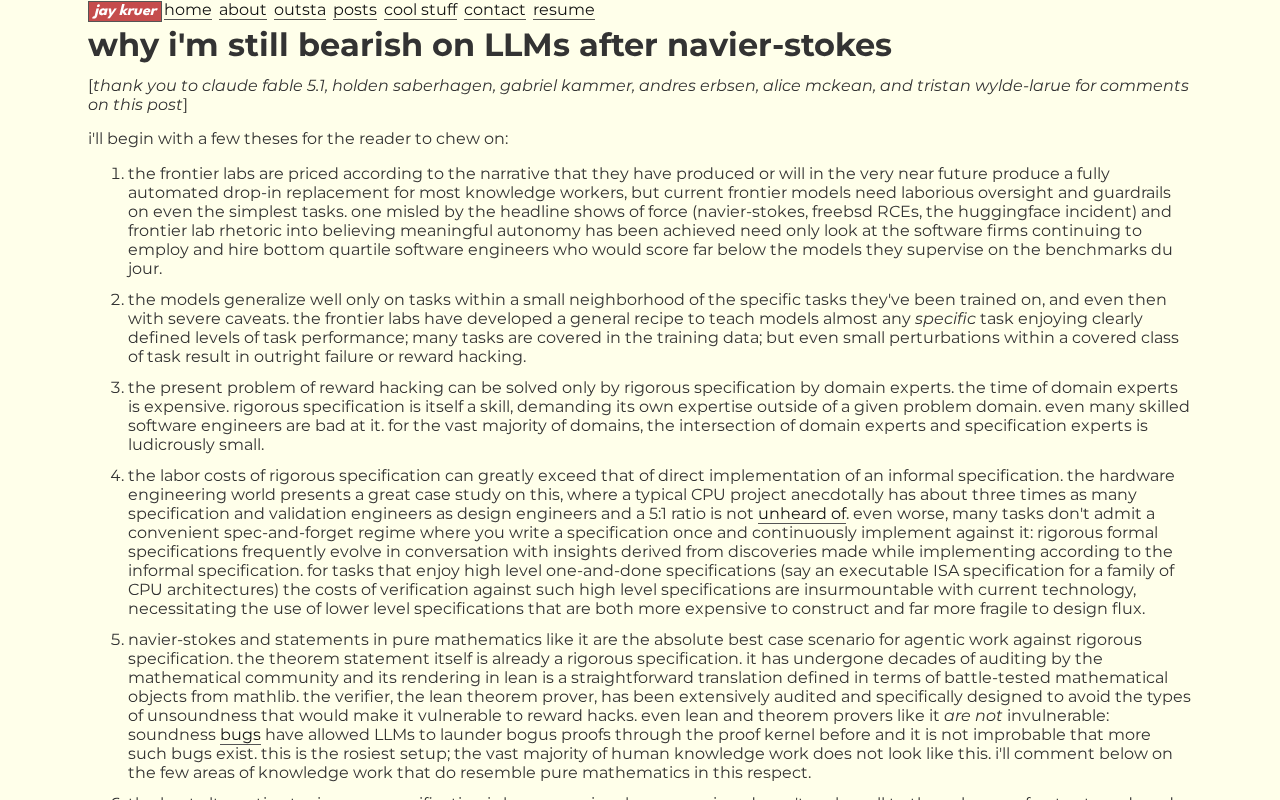
Using Navier-Stokes as a mirror to examine the true reasoning limits of LLMs and the case for staying bearish.
A Hacker News post uses the Navier-Stokes equations — one of math's seven Millennium Prize Problems — to argue why the author remains bearish on LLMs despite incremental progress. The bearish case breaks down into three layers: generalization is constrained by training distribution and cannot truly extrapolate to the frontier of human knowledge; unsolved problems lack verifiable ground truth, making any "breakthrough" unconfirmable; and scaling alone yields diminishing returns, suggesting genuine abstract reasoning may require architectural reinvention. The community is divided — optimists point to LLM-plus-formal-verification pipelines, while skeptics see current reasoning as sophisticated imitation. The key takeaway: acknowledging local progress and questioning general reasoning can coexist, and practitioners should favor human-AI collaboration over blind trust in model output.
A Mathematical Puzzle Sparks Debate on AI Capabilities
A recent Hacker News post titled Why I'm still bearish on LLMs after Navier-Stokes has sparked considerable discussion. The central thesis seems almost paradoxical: even as large language models (LLMs) show certain progress on highly challenging mathematical problems like Navier-Stokes, the author remains cautious — even pessimistic — about their long-term capabilities.
The Navier-Stokes equations sit at the heart of fluid dynamics, and the question of whether their solutions exist and remain smooth is still one of mathematics' seven Millennium Prize Problems. When LLMs are discussed alongside such problems, the deeper question being asked is fundamentally this: are these models truly reasoning, or are they performing sophisticated pattern matching in high-dimensional space?
The Navier-Stokes equations were independently derived by 19th-century mathematicians Claude-Louis Navier and George Stokes to describe the motion of viscous fluids like water and air. They form the theoretical foundation of aerospace engineering, weather forecasting, and ocean simulation. The specific Millennium Challenge asks: in three-dimensional space, starting from any smooth initial condition, do solutions to the equations always exist and remain smooth — i.e., never "blow up" to infinity in finite time? The Clay Mathematics Institute has offered a $1 million prize since 2000, and no one has claimed it. The problem is extraordinarily difficult because it involves the global behavior of nonlinear partial differential equations — territory that current mathematical tools cannot fully conquer. Placing LLMs in this same context is really asking: can a system built on statistical learning touch the mathematical frontier that human reason has yet to reach?
Why Mathematical Problems Have Become the Ultimate Litmus Test
Mathematical proof has become a key benchmark for measuring AI intelligence precisely because it leaves almost no room for "guessing right." A proof is either logically closed or it has gaps — the middle ground is vanishingly small. This stands in fundamental contrast to natural language generation, which tolerates ambiguity and approximation, whereas rigorous mathematical derivation demands that every step be verifiable.
The author's bearish stance likely rests on a core observation: when faced with problems requiring long chains of multi-step rigorous reasoning, LLMs tend to make subtle logical leaps at intermediate steps. Even when the final answer looks plausible, the reasoning process may not hold up under line-by-line scrutiny. This phenomenon — "right answer, wrong process" — exposes the gap between current models and truly formal reasoning.
Three Possible Arguments Behind the Bearish Case
Based on the post's title and the prevailing threads in technical communities, the author's pessimistic judgment can be broken down into several layers.
The Limits of Generalization
LLMs excel at interpolating within the distribution of their training data. But frontier mathematical problems like Navier-Stokes sit at the very edge of human knowledge, where ready-made answers are essentially absent from training corpora. If a model appears to "perform" on such problems, we must carefully distinguish between genuine creative derivation and a recombination of fragments from existing literature.
The distinction between "interpolation" and "extrapolation" in machine learning is crucial for understanding LLM limitations. Interpolation means handling new inputs within the range covered by training data — essentially generalizing from seen patterns. Extrapolation requires making valid judgments in regions outside the training distribution, which is a fundamental challenge for statistical models. A large body of research (such as Chollet's ARC benchmark) shows that current LLMs exhibit a dramatic performance cliff on tasks requiring genuine extrapolation. What makes Navier-Stokes special is that human mathematicians solving such problems rely on deep structural insight and creative construction — not retrieval and recombination of known solutions. Determining whether an LLM's output constitutes "high-quality interpolation" or "genuine extrapolation" is an unavoidable core question when evaluating its performance on frontier mathematical tasks.
The Absence of Verifiability
For a problem that humanity has not yet solved, there is no ground-truth answer against which to check model output. This means that even if an LLM produces seemingly stunning results, their correctness is extremely difficult to assess. Without reliable verification mechanisms, any claimed "breakthrough" is little more than probabilistic speculation.
Diminishing Returns from Scaling
A common argument from the bearish camp is that simply stacking more parameters and data is yielding diminishing marginal returns. Crossing the threshold to genuine abstract reasoning may require fundamental architectural innovation — not a linear extension of the current paradigm.
Divisions Within the Technical Community
The post received 39 upvotes and 8 comments — modest in volume, but squarely targeting one of the most central debates in AI. Optimists argue that LLMs combined with tool use and formal verification systems (such as proof assistants) can achieve substantive breakthroughs in mathematics. Skeptics counter that current models' "reasoning" is more like sophisticated imitation, still qualitatively short of the insight that human mathematicians bring.
Notably, this debate is not black and white. Acknowledging that LLMs show progress on specific mathematical tasks and remaining skeptical of their general reasoning capabilities are not mutually exclusive positions. The author's phrasing — "still bearish" — captures exactly this stance: not denying local progress, but keeping a clear head about grand narratives.
Formal verification systems like Lean, Coq, and Isabelle are a key tool frequently cited by optimists in this debate. These "proof assistants" require mathematical proofs to be constructed step by step in a strict formal language, with each inference mechanically verified by a computational kernel — fundamentally eliminating logical gaps that human reviewers might miss. In recent years, DeepMind's AlphaProof project and several academic teams have attempted to combine LLMs with Lean: the LLM generates candidate proof steps, and the formal system handles verification — a complementary arrangement. The promise of this approach lies in decoupling the LLM's "creative guessing" from the rigor of mechanical verification, potentially bypassing the bottleneck of unverifiable model output. However, critics point out that when a problem lacks even a reference proof from humans, the formal steps generated by an LLM still lack meaningful guidance, and the overall system remains unable to break through the boundaries of existing knowledge.
Implications for Practitioners
For AI developers and researchers, discussions like this provide an important reality check. In product marketing, "AI can solve mathematical problems" is often oversold; in actual deployment, verifiability, interpretability, and robustness of reasoning are the critical considerations.
When applying LLMs to scenarios requiring strict logic, human-AI collaboration and the integration of external verification tools is far more pragmatic than blindly trusting model output. Mathematical problems serve as stress tests that help us see clearly where the boundaries of current technology actually lie.
Conclusion
This brief yet thought-provoking post uses a mathematical problem as an entry point to reignite the debate about the true nature of LLMs. Whether you're bearish or bullish, the value lies not in reaching a final verdict, but in reminding the entire industry: beyond impressive demos, we still need to maintain critical scrutiny of models' genuine reasoning capabilities. Navier-Stokes won't be cracked easily — and the exploration of AI's capability boundaries is equally an endless marathon.
Related articles

Enterprise AI Agent in Practice: A Dual-Track Strategy with Low-Code and Hardcore Frameworks
A dual-track enterprise AI Agent framework: low-code platforms (Coze/Dify/n8n) and code frameworks (LangChain/LangGraph/CrewAI), covering MCP protocol, nine smart job roles, and four real-world projects.

OpenSpec in Practice: Taming AI Code Generation with Spec-Driven Development (SDD)
AI code goes off-rails after 30 minutes? Learn how OpenSpec uses Spec-Driven Development (SDD) to make AI-generated code trackable, verifiable, and deliverable.

Getting Started with LLM Development: Alibaba Cloud Model Studio Setup and API Key Configuration
A hands-on beginner's guide to LLM development: covers Alibaba Cloud Bailian registration, real-name verification, API Key creation, and free quota management for RAG and Agent development.