Enterprise AI Agent in Practice: A Dual-Track Strategy with Low-Code and Hardcore Frameworks
A practical dual-track framework for deploying AI Agents in enterprise settings — from low-code to hardcore dev.
Large models can answer questions but can't execute business workflows — AI Agents exist to bridge that gap. This article maps out an enterprise AI Agent learning framework based on a Bilibili course, covering a dual-track strategy of low-code platforms (Coze, Dify, n8n) for rapid validation and code frameworks (LangChain, LangGraph) for deep customization. Three technical modules span workflow building, MCP protocol for data integration, and multi-agent collaboration frameworks, all grounded in nine real enterprise job functions and four hands-on projects.
Large language models are everywhere, but many people return to the office and find their workload hasn't lightened one bit. ChatGPT and DeepSeek can write copy and analyze data, but they can't automatically format your WeChat articles, query orders in your CRM, or proactively follow up on tasks in DingTalk. A Bilibili course on enterprise AI Agent applications targets exactly this pain point: a large model is nothing more than a brilliant brain without hands or feet — building an AI Agent is the process of giving it those limbs.
This article draws on that course's overview to map out a practical learning and implementation framework for deploying AI Agents in enterprise settings — exploring what really separates a "question-answering chatbot" from a "process-executing digital employee."
A Dual-Track Approach: Low-Code Platforms and Code Frameworks
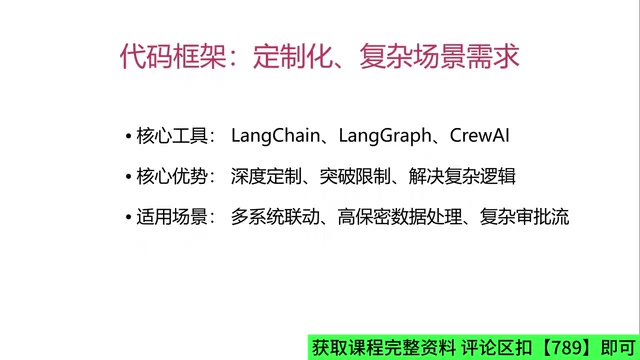
The course's core design philosophy is to run "low-code platforms" and "code frameworks" in parallel — a choice that mirrors real-world enterprise practice.
If your goal is to quickly validate ideas and boost day-to-day productivity, low-code platforms are like LEGO bricks. With prompt engineering and drag-and-drop nodes, you can build a short-video production pipeline for your business team in a single week. Platforms like Coze, Dify, n8n, Tencent Yuanqi, and Alibaba Cloud Bailian fall into this category. Even without a technical background, as long as you can articulate your requirements in natural language, you can build functional workflows.
But when enterprises need to handle core business processes, highly sensitive data, or extremely complex approval flows — think cross-departmental data integration, custom approval logic, core customer data handling, or multi-agent collaborative customer service — code development becomes the only viable option. That's when you reach for hardcore frameworks like LangChain and LangGraph to break free from platform constraints and achieve full customization.
In short: low-code handles rapid validation and efficiency gains; code frameworks handle deep customization and high-value complex problems. This division of labor answers a question that trips up many teams during tool selection — it's not an either/or choice, but a context-driven combination.
Three Core Technical Modules
The course breaks the tech stack into three categories of tools, each building on the last.
Low-Code and Workflow Platforms
The first category covers low-code and workflow platforms, with hands-on practice using mainstream tools like Manus, Coze, Dify, n8n, Tencent Yuanqi, and Alibaba Cloud Bailian to build deployable enterprise applications from scratch — such as a WeChat ecosystem AI engine or a DingTalk-and-Alipay-connected shopping guide system. These tools have the lowest barrier to entry and are ideal as a starting point for beginners looking for quick wins.
MCP Protocol: The Key to Breaking Down Data Silos
The second category is the MCP (Model Context Protocol). In many companies, data is locked away in on-premises databases and internal APIs that AI simply can't reach. The course describes MCP as a "master key" — once you understand it, you can let Agents securely read local files and call internal APIs, completely breaking down an enterprise's internal data silos. This layer is often the most overlooked yet most critical part of enterprise-grade AI applications.
MCP (Model Context Protocol) is a standardized communication protocol proposed and open-sourced by Anthropic in late 2024, designed to let AI models connect to external data sources and tools in a unified way. Before MCP, every Agent application that wanted to integrate with an internal enterprise system had to write custom adapter code for each data source — making maintenance costs extremely high. MCP's core idea is a three-layer "host–client–server" architecture: the AI application acts as the host, communicating with various MCP servers through a standardized MCP client, while each server encapsulates the logic for specific database queries, file reads, or API calls. This means that as long as a system has an MCP server implementation, any MCP-compatible AI application can connect to it directly — no redundant development required. Today, community-maintained MCP server implementations already exist for common systems including GitHub, Google Drive, Slack, and various databases. For enterprises, MCP's most important value is clear permission boundaries — Agents can only interact with data through interfaces explicitly exposed by the server, without bypassing the company's existing access control systems.
Agent Development Frameworks: The Hardcore Code Layer
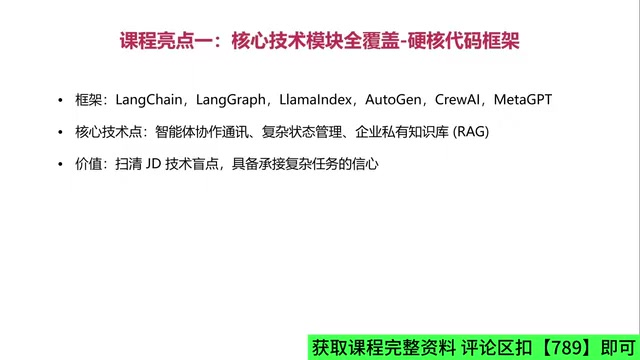
The third category covers Agent development frameworks — the course's hardcore code section — including LangChain, LangGraph, LlamaIndex, AutoGen, CrewAI, and MetaGPT. These frameworks address inter-agent communication, state management, and enterprise knowledge base construction. The course emphasizes that once you master these technologies, you won't feel anxious when confronted with unfamiliar technical terms in job postings or development specs.
Each framework has its own focus; a quick breakdown helps with selection. LangChain is the oldest and most ecosystem-rich Agent framework, providing foundational modules for tool calling, memory management, and RAG (Retrieval-Augmented Generation) — suitable for rapidly building single-agent applications. LangGraph, released by the LangChain team as an advanced framework, introduces directed graphs combined with state machines to manage Agent execution flows, making complex multi-step and multi-branch business logic predictable and debuggable — currently one of the leading choices for enterprise-grade Agent development. CrewAI and AutoGen both focus on multi-agent collaboration: the former organizes Agent teams through "role-playing plus task assignment," while the latter emphasizes conversational negotiation between Agents. LlamaIndex specializes in enterprise knowledge base construction and retrieval, excelling at vector indexing and semantic querying over large document collections. MetaGPT maps software company roles — product manager, architect, engineer — onto multiple collaborative Agents, making it well-suited for automating complex software development tasks.
From Technology to Business: Nine Core Intelligent Job Functions
One of the course's most commendable design choices is the deep integration of technology with real business scenarios. Many technical courses only teach you how to write code, but when you get to a company, you quickly discover that the hardest part isn't writing code — it's not knowing where the business pitfalls and pain points actually are.
The course anchors its case studies in nine core intelligent job functions operating inside real enterprises, following the principle of "target where it hurts most":
- Marketing: Automatic lead syncing and cleansing, replacing manual lead exports and spreadsheet matching;
- Finance: An intelligent bookkeeping assistant that cuts account processing from hours to seconds;
- R&D: Text to SQL — ask the Agent questions in natural language and let it retrieve answers from the database, no complex SQL writing required;
- PR & Operations: A real-time public sentiment monitoring system that automatically alerts and pushes response plans the moment a crisis starts to emerge;
- And more: HR resume screening, multi-round customer service complaint handling, product manager data analysis, and automated content operations pipelines.
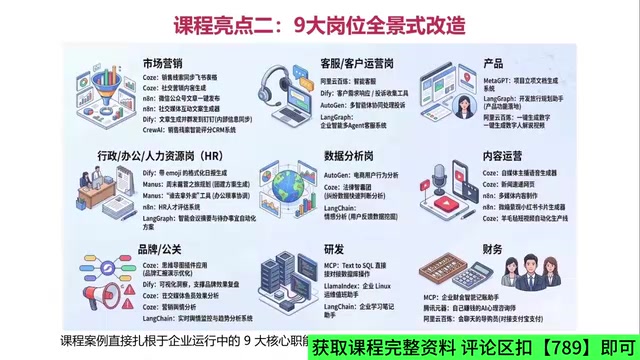
The course repeatedly makes one point: the value of learning isn't in memorizing tool names, but in grasping the "underlying logic of business AI transformation" — developing an "AI eye" that can spot repetitive labor and pinpoint business pain points with precision. This perspective carries far more long-term value than any purely tool-focused curriculum.
Four Comprehensive Hands-On Projects
The course ties everything together through four enterprise-grade comprehensive projects, each targeting a different tech stack and business scenario.
Project 1: CrewAI-Based Intelligent Sales Lead Scoring CRM System. Simulates a complete sales team: one Agent scours the web for intelligence, while another applies business logic to score leads precisely. The core challenge is converting non-standardized customer lead data into quantifiable scoring results using a scientifically grounded evaluation framework.
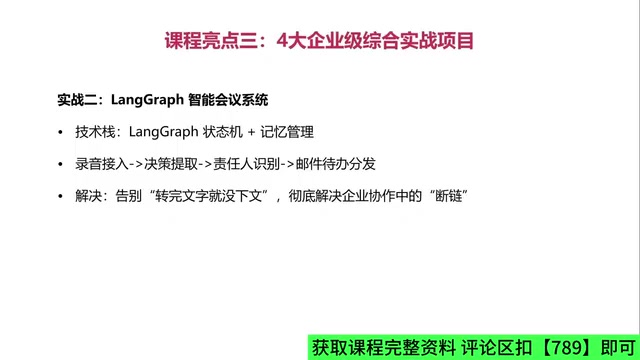
Project 2: LangGraph-Based Enterprise Intelligent Meeting Summary and Action Item Tracking System. This is a real-world LangGraph state machine project of the kind currently popular at major tech companies. The goal isn't to "summarize a paragraph" — it's to "get things done" — taking meeting recordings as input, automatically identifying responsible parties, and dispatching tasks to email to-do lists to close the business loop. This project focuses on training Agent memory and state management under complex logic.
Project 3: Coze-Based Short-Video Automated Production Pipeline for Self-Media. Input a keyword, and the system automates the entire workflow — from topic selection and shot-by-shot scripting to automatic voiceover and video synthesis. For content operations teams, this is a cost-cutting, efficiency-boosting solution to the "fear of missing a posting schedule."
Project 4: n8n-Based Global Industry News Intelligent Intelligence-Gathering System. Leverages n8n's connectivity to build an intelligence system with real reasoning capability — one that automatically navigates global news sites, structures content, distills key insights, and distributes them logically with precision. It's an upgrade from a "rigid web scraper" to a "Chief Intelligence Officer."
Final Thoughts: The Architect's Mindset Matters More Than Any Tool
Looking at the course's overall design, its ambition goes beyond teaching tool usage — it aims to convey an "architect's mindset": from agile development for rapid deployment to deep customization for complex systems, unpacking the design logic behind Agent development.
For developers or business professionals looking to enter the AI Agent space, this learning path offers a useful reference: start with low-code platforms to build business intuition, use the MCP protocol to connect data sources, and finally use code frameworks for deep customization. One caveat worth noting: this article is based on the course's promotional materials, and actual learning outcomes will depend on individual background and effort. Tools will keep evolving, but the methodology of "using AI Agents to precisely cut into business pain points" is a far more durable competitive advantage.
Background Note
LangGraph's "state machine" concept deserves its own explanation. Traditional LangChain Agents use a linear call chain — if a middle step fails or the result requires branching into different paths, the control logic quickly becomes difficult to maintain. LangGraph models the Agent's entire execution process as a directed acyclic graph (DAG): each node in the graph represents a processing step (such as extracting meeting keywords, identifying responsible parties, or generating a task list), the edges between nodes represent transition conditions, and all steps share a single persistable "state object." This design offers three key advantages: first, it supports conditional branching — for example, "if the meeting exceeds one hour, split it into segments before summarizing"; second, it supports loops and self-correction, allowing an Agent to reflect on whether its output meets a standard after generating it, and re-execute if not; third, state can be saved at checkpoints so long-running tasks don't have to restart from scratch due to a network hiccup. These are the fundamental reasons why it's been widely adopted by major tech companies for complex business process automation.
Related articles
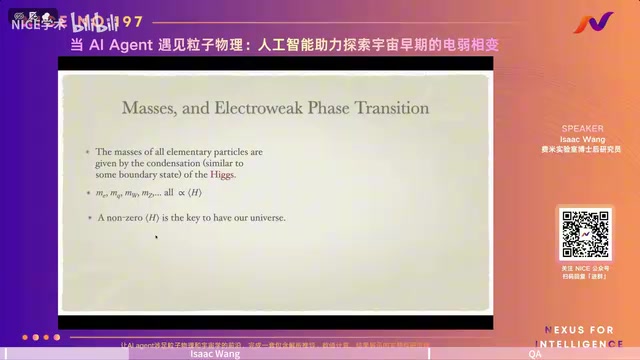
AI Agents Tackle Particle Physics: How the LEBRON Framework Computes Electroweak Phase Transitions
Fermilab postdoc Isaac Wang presents LEBRON, an AI Agent framework for computing electroweak phase transitions. Covers four LLM failure modes in rigorous physics, auditor mechanisms, and why AI hasn't revolutionized theoretical physics the way it has math.
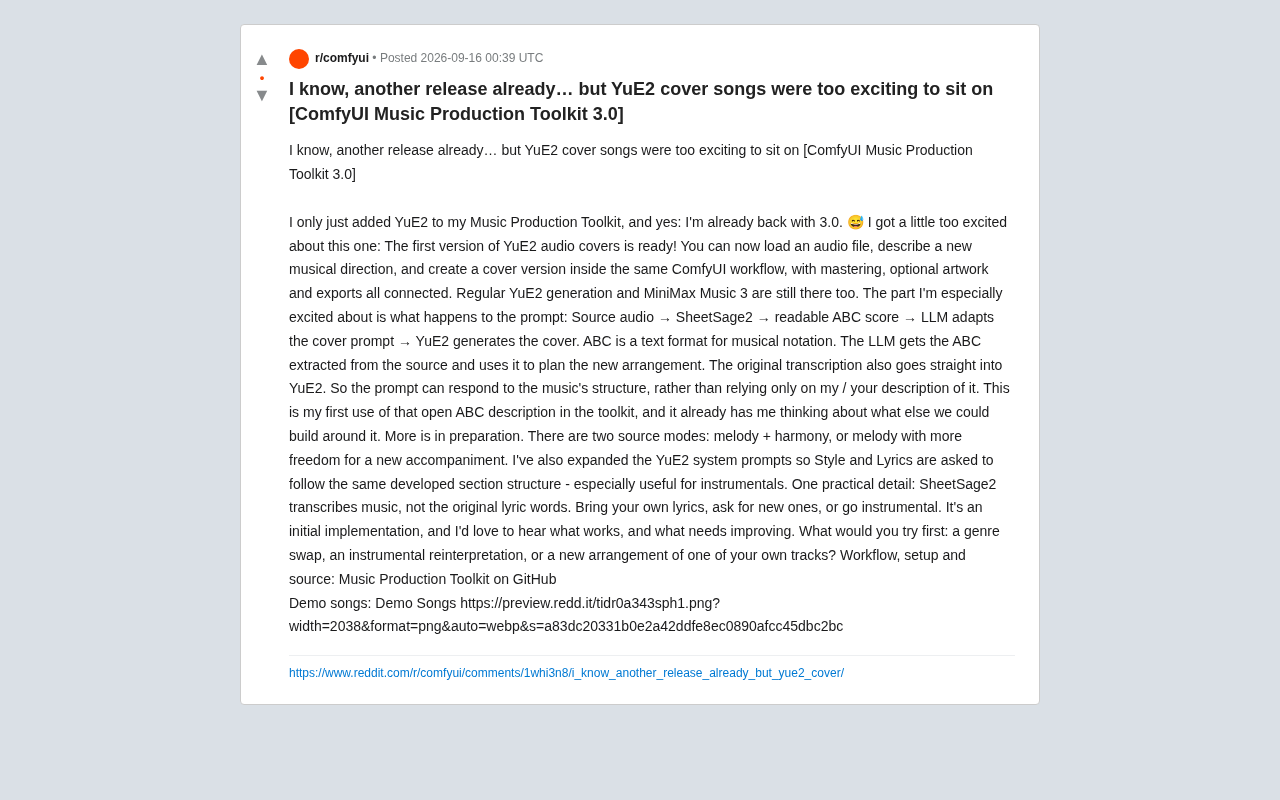
ComfyUI Music Production Toolkit 3.0: AI Arrangement with YuE2 Cover Generation and ABC Notation
ComfyUI Music Production Toolkit 3.0 adds YuE2 cover generation, transcribing source audio to ABC notation via SheetSage2 and using LLMs to rewrite structure-aware prompts for AI arrangement.
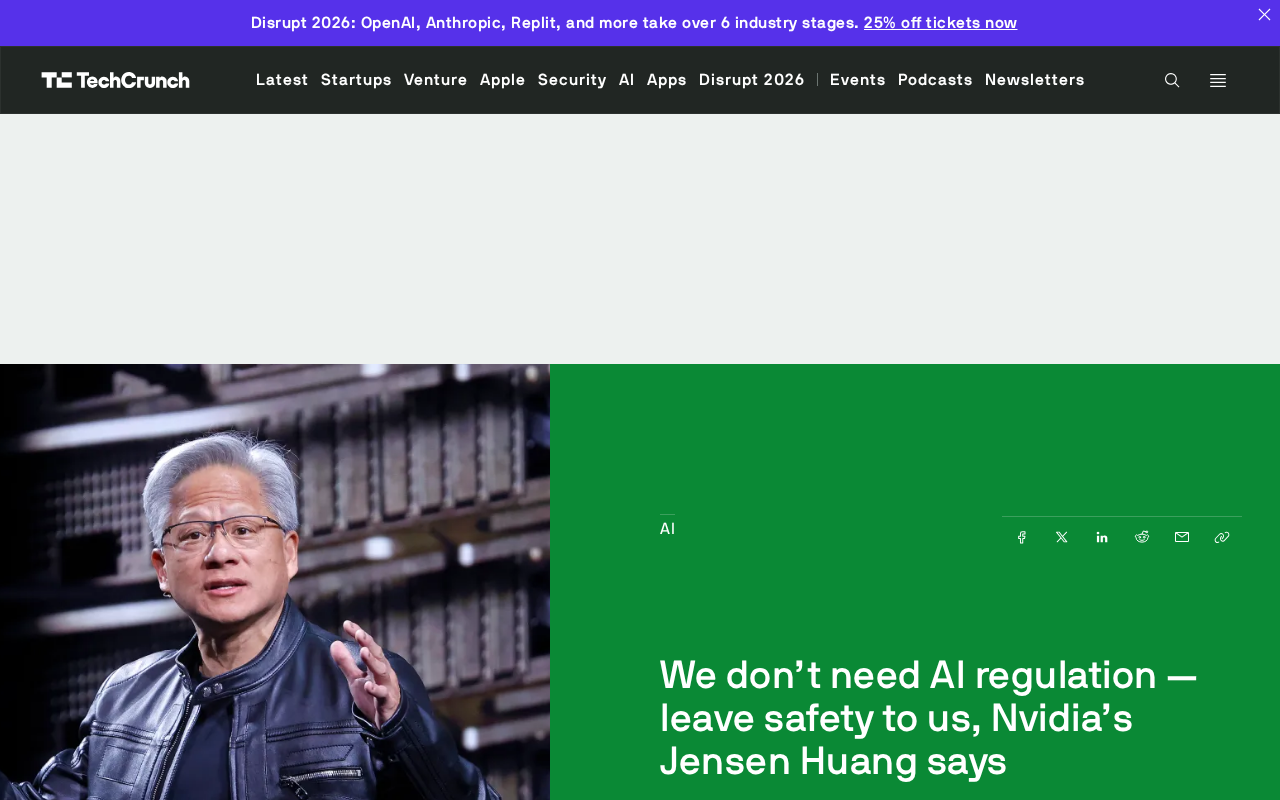
Jensen Huang Opposes AI Regulation: Safety Should Be Left to Vendors
Nvidia CEO Jensen Huang publicly opposes dedicated AI regulation, arguing AI is just hardware and software and safety should be handled by vendors. We examine the technical logic, commercial interests, and governance implications.