Time to Upgrade the AI Safety Conversation: From Model Safety to Cybersecurity
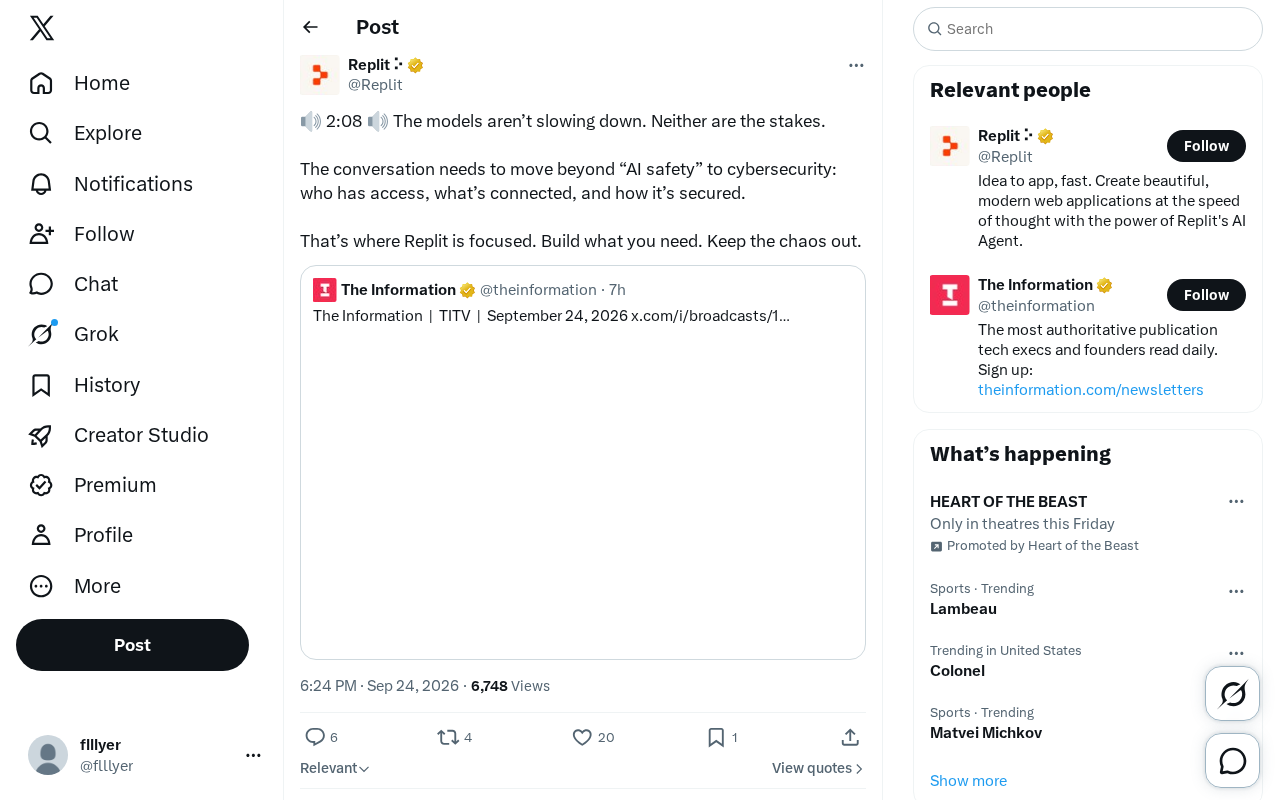
Replit calls for shifting AI safety discussions from abstract alignment to practical cybersecurity fundamentals.
As AI models are embedded at scale into production environments, Replit's social media post offers a pragmatic reframing: AI security discussions should move from "model alignment" to the classic cybersecurity triad of access control, connection governance, and hardening. AI agents that can invoke tools and access databases are highly privileged execution entities — the real threat isn't malicious intent but unchecked reach and missing isolation. Replit positions itself as a platform that provides secure, bounded execution environments, advocating for least-privilege design, network segmentation, and monitoring as the practical foundation for managing AI deployment risk.
Core Argument: The Discussion Needs to Shift
A social media post from Replit has highlighted a pivot point in the AI industry that's easy to overlook: model capabilities aren't slowing down, and the risks that come with them are scaling in lockstep. The author argues that the conversation around AI should move away from abstract "AI safety" — think model alignment, values, and preventing harmful outputs — toward something more concrete and actionable: cybersecurity. That means focusing on who can access systems, what components are connected, and how to harden defenses.
This shift in perspective may seem subtle, but it cuts straight to a blind spot in the ongoing industry debate. For years, "AI safety" has been shorthand for relatively macro, long-horizon concerns: alignment, value specification, guardrails against harmful outputs. But when AI models are embedded at scale into real production environments — connected to enterprise data and external services — the risks that actually surface every day are classic security problems: access control, exposed interfaces, data leakage.
Why "AI Safety" Should Yield to "Cybersecurity"
As model capabilities grow and integrations deepen, the attack surface expands accordingly. An AI agent that can invoke tools, access a filesystem, and connect to databases is, in essence, a highly privileged execution entity. When such a system is wired into a production environment, the most realistic threat isn't that the model wants to cause harm — it's what the model can reach and what isolation and auditing mechanisms are absent.
The three questions raised in the post — "who has access, what is connected, how to harden" — are the classic pillars of cybersecurity. This means a large share of AI deployment security responsibility falls squarely on mature engineering practices: access control, the principle of least privilege, network segmentation, and monitoring.
Access and Connectivity Are the Critical Variables
In real-world deployments, AI systems often need to connect to multiple external services, APIs, and data sources. Every connection point is a potential attack vector. The call to "keep the chaos out" is fundamentally a demand for strict governance over these connections — not allowing integration scope to expand unchecked.
The Principle of Least Privilege (PoLP) is a foundational design rule in cybersecurity: any entity (user, process, or service) should be granted only the minimum permissions required to perform its task — nothing more. Applied to AI agents, this means an agent responsible for generating reports should not simultaneously hold permissions to delete database records, even if those permissions are technically grantable. Prompt injection is a canonical attack vector facing AI agents today — attackers embed malicious instructions in external inputs (web content, emails, files) to coerce an AI into performing actions outside its authorized scope. If the agent's privileges are too broad, a single successful prompt injection can result in data exfiltration or system damage. This is precisely why "what is connected" is a more direct determinant of real-world risk than "whether the model itself is safe."
Replit's Positioning
As an online development platform, Replit's stated mission is to let developers "build what you need" while "keeping the chaos out." This reflects a new role that platform-layer tools are taking on in the AI era: not just providing development capabilities, but offering a secure, bounded execution environment where AI-generated or AI-driven code can run in a managed context.
For developers, this "sandboxed" and "controlled build" approach has real practical value. As more and more applications are AI-assisted or AI-generated, a platform with built-in security boundaries reduces the probability of inadvertently introducing vulnerabilities or over-provisioning permissions.
Sandboxing is a security mechanism that isolates a program's runtime environment from the host system, restricting it to only explicitly allocated resources and preventing access to external filesystems or networks. In the context of AI-generated code, sandboxing is especially critical: since AI-produced code may contain unreviewed logic or unexpected system calls, executing it in a controlled sandbox contains potential damage within predictable boundaries. Replit's cloud execution environment inherently provides this layer of isolation — developers get basic execution boundary guarantees without needing to configure containers or virtual machines themselves. For teams scaling AI-assisted programming into their workflows, infrastructure-level security guarantees like these are often more cost-effective than after-the-fact code review.
Implications for the Industry
The signal embedded in this brief post is worth taking seriously: AI governance shouldn't remain at the level of philosophical debate — it needs to translate into engineering-executable security practices. When deploying AI systems, organizations would do better to nail the basics first — access control, connection governance, and hardening — rather than getting lost in distant alignment debates.
It's worth noting that this article is based on a single social media source, and additional detail (such as specific technical approaches or product features) would require further corroboration. That said, the framework it proposes — grounding AI security in the pragmatic terrain of cybersecurity — offers a meaningful reference point for teams currently evaluating the risks of AI deployment.
Related articles

AI Compute Is the New Oil, But the Market Mechanism Has Yet to Take Shape
Hacker News compares AI compute to the new oil, noting the lack of price discovery, concentrated supply, and no hedging tools. The article analyzes structural issues in compute trading and explores a possible three-tier market of spot, contracts, and derivatives, plus the real impact on AI practitioners' cost management.

Running Full iOS 16.5 Firmware on Android Devices: Technical Demo or Marketing Gimmick?
A Hacker News post claims full iOS 16.5 firmware can run on Android, with 315 upvotes. This analysis argues it is more likely a web UI simulation than a true firmware port, and explores the value and risks of such projects.

Etsy Cracks Down on AI Slop: Addressing Buyer and Seller Anxieties
Etsy introduces stricter rules limiting AI-generated content in listings, addressing buyer confusion over AI products and seller fears of original work being diluted by AI slop.