TipSweep: Scaling Learning Rates by Precision for Efficient Transfer to Full-Model Training
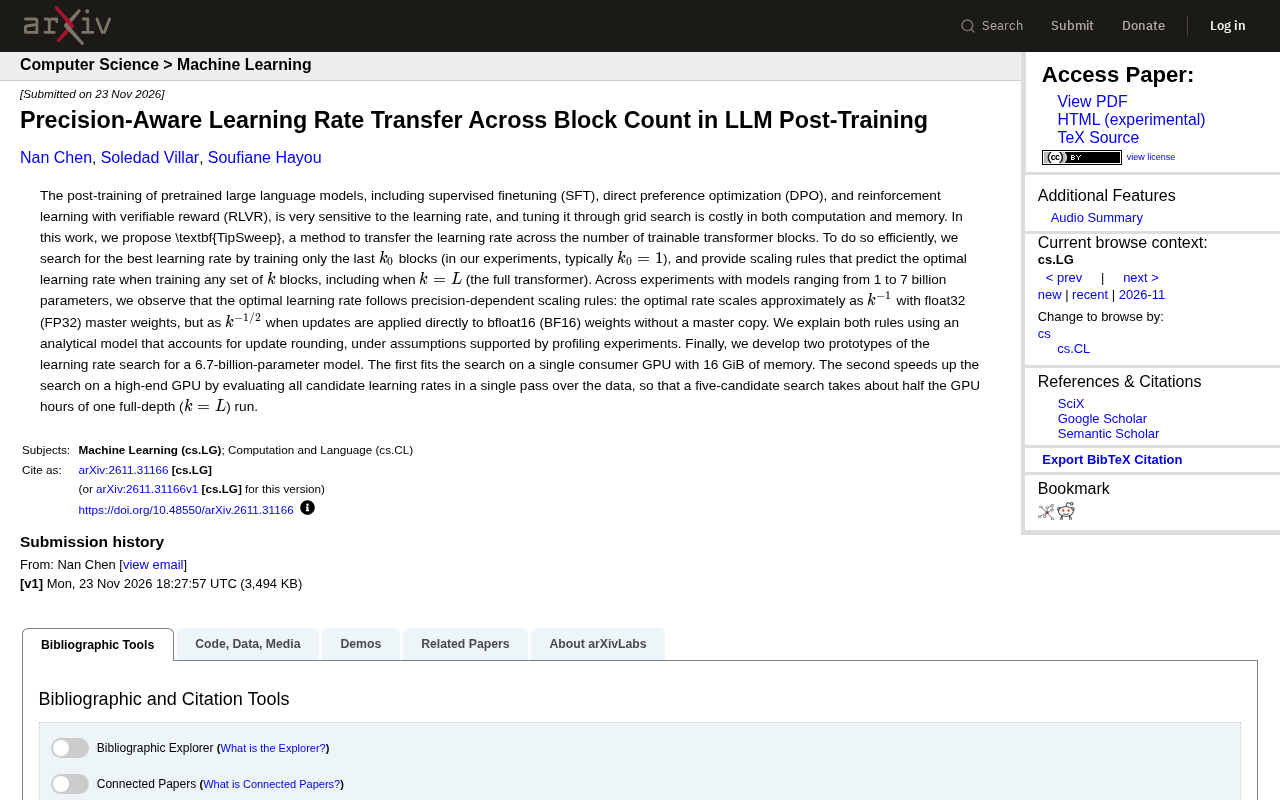
TipSweep searches learning rates by training only the last few blocks, then extrapolates to any number of blocks using precision-dependent rules.
To address the high cost of learning rate tuning in post-training of large language models, TipSweep proposes first performing a low-cost search with a small number of blocks (typically only the last block), then predicting the optimal learning rate for any number of blocks—even the full model—based on scaling rules. Its core finding is that the scaling exponent depends on numerical precision: under FP32 master weights, the optimal learning rate scales roughly as the number of blocks k to the power of -1; under direct BF16 updates, about -1/2. The authors explain and validate this difference with an analytical model based on update rounding. On a 6.7B-parameter model, the team implemented a single-card solution that runs on a 16 GiB consumer-grade GPU, as well as a high-speed solution that evaluates all candidates in a single pass, with five-candidate search taking about half the time of full-depth training. The method's limitation is that experiments cover only 1B to 7B parameters, and transfer under larger scales and changes in data distribution or batch size remains to be verified.
Post-training of large language models (including supervised fine-tuning SFT, direct preference optimization DPO, and reinforcement learning with verifiable rewards RLVR) is extremely sensitive to learning rate, while grid search tuning is costly in both compute and memory. A recent paper proposes the TipSweep method, which searches for learning rates by training only the last few blocks, then uses precision-dependent scaling rules to transfer them to any number of blocks—even full-model training.
Core Problem: The Cost Dilemma of Learning Rate Tuning
Learning rate selection during post-training directly affects model convergence and final performance. Traditional methods require grid search for each training configuration, and as model size grows, each full-parameter training trial consumes substantial GPU hours. More troublesome is that when the number of training blocks changes (e.g., from partial layer unfreezing to full-model fine-tuning), the optimal learning rate also drifts, making previously found results non-reusable.
The paper points out that this sensitivity forces researchers to re-tune for each new configuration, wasting resources. TipSweep's goal is to establish a transferable learning rate prediction mechanism that reduces repeated searching.
Post-training refers to the targeted training stage conducted on top of a pretrained base model, typically including methods such as supervised fine-tuning (SFT), direct preference optimization (DPO), and reinforcement learning with verifiable rewards (RLVR). Unlike pretraining, which uses massive unlabeled corpora and pursues general capabilities, post-training relies on smaller but higher-quality instruction or preference data, with the goal of aligning the model to specific tasks or human preferences. Because the data volume is small and training steps are few, post-training is especially sensitive to hyperparameters—too large a learning rate easily destroys knowledge learned during pretraining, while too small a rate makes it difficult to effectively adapt to downstream tasks. Thus learning rate selection often becomes the key variable determining success or failure.
Grid search is the most direct hyperparameter tuning approach: train and evaluate on a preset set of candidate values one by one, and select the configuration with the best validation set performance. Its advantages are simple implementation and parallelizability; its drawback is that cost grows linearly with the number of candidates. For large language models, each full-parameter training trial may consume tens to hundreds of GPU hours, and multiplying this by multiple learning rate candidates makes the cost prohibitive. This is exactly the core contradiction TipSweep attempts to alleviate: can low-cost small-scale trials replace repeated searching on the full model?
Precision Determines Scaling Rules: Differences Between FP32 and BF16
TipSweep's core finding is that the scaling law of the optimal learning rate with the number of training blocks k depends on numerical precision. Experiments covered models from 1B to 7B parameters and observed two distinctly different behaviors:
- When using FP32 master weights, the optimal learning rate scales roughly as k to the power of -1;
- When updates are applied directly to BF16 weights (no master copy), the scaling exponent becomes -1/2.
This difference stems from the effect of update rounding. The authors built an analytical model to explain the two rules and validated the hypothesis through alignment experiments. This means that in actual training, precision choice not only affects numerical stability but also changes the transfer law of hyperparameters—ignoring this may lead to order-of-magnitude deviations in learning rate prediction.
According to the paper, this analytical model was supported by profiling experiments, providing a theoretical basis for the scaling rules rather than purely empirical fitting.
FP32 master weights are a common practice in mixed-precision training: parameters are stored in a high-precision copy in 32-bit floating point format, forward and backward computations use lower-precision formats such as BF16 for acceleration, and optimizer updates accumulate onto the FP32 copy, which is then converted back to low precision for the next step. The purpose is to prevent small updates from being lost to rounding at low precision. In contrast, if updates act directly on BF16 weights (no master copy), each parameter change is rounded to the nearest value representable in BF16, and the smaller the update, the larger the relative rounding error.
This mechanism explains the difference in scaling exponents: as the number of training blocks k increases, the effective learning rate must be reduced accordingly to maintain stability; under FP32 master weights, accumulated updates can preserve subtle changes, so the optimal learning rate can decrease more steeply with k (about k^-1); while under direct BF16 updates, rounding noise effectively imposes a lower bound on update magnitude, and the learning rate cannot drop too fast or updates would be drowned by rounding, resulting in gentler scaling (about k^-1/2). Understanding this is necessary to see why precision choice changes the transfer law of hyperparameters.
Method Implementation: From k0 Blocks to the Full Model
TipSweep's workflow consists of two steps:
- Small-scale search: Train only the last k0 blocks (typically k0=1 in experiments) to find the optimal learning rate for that configuration at low cost.
- Scaling prediction: Based on the precision-dependent rules above, extrapolate the search result to any number of k blocks (including the full model with k=L).
This approach avoids the enormous cost of direct grid search on the full model. The authors validated the effectiveness of the scaling rules across multiple model sizes, showing that predicted learning rates are close to those obtained by exhaustive search.
Prototype Systems: Consumer-Grade GPUs and High-Speed Search
To verify practicality, the paper developed two prototypes for a 6.7B-parameter model:
- Single-card consumer-grade GPU solution: Completes learning rate search on a consumer-grade GPU with only 16 GiB of memory, using memory optimizations to fit the search process to limited hardware.
- High-end GPU acceleration solution: Evaluates all candidate learning rates in a single data pass, compressing the search time for five candidates to about half the GPU hours required for one full-depth (k=L) training run.
These two prototypes demonstrate TipSweep's flexibility under different hardware conditions: the former lowers the barrier, the latter improves efficiency. In particular, you may not have noticed that the high-speed solution significantly reduces the wall-clock time of search by evaluating candidate learning rates in parallel, which is valuable for scenarios requiring frequent tuning.
GPU memory is a hard constraint in learning rate search. During full-parameter training, in addition to model weights, gradients, optimizer states (such as Adam's first and second moments), and activations must be stored, and memory usage can be several times the number of model parameters. A 16 GiB consumer-grade GPU typically can only accommodate partial-layer training of smaller models, so the single-card solution must rely on memory optimization techniques such as gradient checkpointing, optimizer state sharding, or unfreezing only some blocks to complete the search without exceeding memory. This also indirectly shows the engineering rationality of TipSweep's strategy of "training only the last k0 blocks": the fewer the blocks, the lower the memory and compute overhead.
Evaluating multiple candidates in a single data pass is a parallelization approach different from conventional serial search: the conventional approach runs training once for each learning rate candidate, with wall-clock time accumulating linearly with the number of candidates; by placing multiple candidates in the same forward/backward propagation for parallel updates, all candidates can be evaluated within almost the same number of data passes, at the cost of memory usage increasing with the number of candidates. In the prototype, the five-candidate search took about half the time of one full-depth training run, which is exactly the manifestation of this "trading memory for time."
Significance and Limitations
TipSweep provides a systematic approach to learning rate transfer, changing hyperparameter search from "starting over each time" to "search once, predict many times." Its precision-dependent scaling rules are especially important, reminding researchers that a uniform scaling exponent cannot simply be applied in mixed-precision training.
However, the paper's experimental scope is limited to models from 1B to 7B parameters, and whether the scaling rules still hold at larger scales (e.g., tens or hundreds of billions) remains to be verified. In addition, the scaling rules assume that training configurations remain consistent except for the number of blocks; in practical applications, changes in factors such as data distribution and batch size may introduce additional deviations. Future work can explore more complex transfer scenarios and extend the method to other hyperparameters.
One-line Summary
TipSweep searches learning rates by training only the last few blocks, then extrapolates to any number of blocks using precision-dependent rules.
Paragraph Summary
To address the high cost of learning rate tuning in post-training of large language models, TipSweep proposes first performing a low-cost search with a small number of blocks (typically only the last block), then predicting the optimal learning rate for any number of blocks—even the full model—based on scaling rules. Its core finding is that the scaling exponent depends on numerical precision: under FP32 master weights, the optimal learning rate scales roughly as the number of blocks k to the power of -1; under direct BF16 updates, about -1/2. The authors explain and validate this difference with an analytical model based on update rounding. On a 6.7B-parameter model, the team implemented a single-card solution that runs on a 16 GiB consumer-grade GPU, as well as a high-speed solution that evaluates all candidates in a single pass, with five-candidate search taking about half the time of full-depth training. The method's limitation is that experiments cover only 1B to 7B parameters, and transfer under larger scales and changes in data distribution or batch size remains to be verified.
Related articles

Google Officially Supports Pi Coding Agent: The AI Programming Tool Ecosystem Expands Further
Google adds official Google AI plan support for the open-source coding agent Pi, signaling accelerating integration between large model vendors and coding agent tool ecosystems. This article analyzes the impact on developer workflows, the tool ecosystem landscape, and model binding relationships.

Loom: One Machine for Weaving, Knitting and Braiding
Loom is a device that aims to seamlessly combine weaving, knitting and braiding in a single machine, drawing attention on Hacker News. This article examines its engineering challenges, significance for flexible manufacturing, and lessons for makers and hardware developers.
Running Local AI Agents on Mac: A Full Breakdown of the MLX Four-Layer Stack
A breakdown of Apple engineer Joanna's local Mac AI agent solution: the MLX four-layer stack, a three-step setup, and how the neural network accelerator, continuous batching, and distributed inference solve local agent performance bottlenecks.