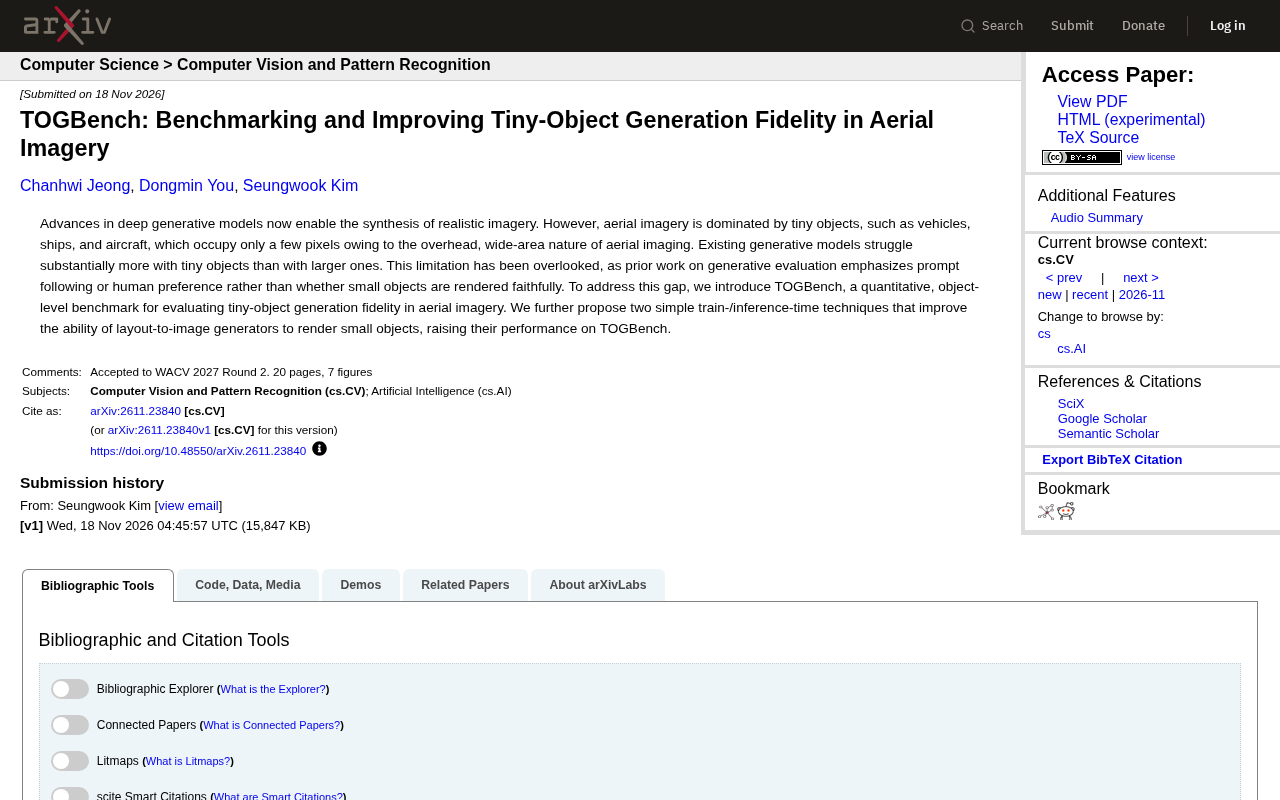
TOGBench: The First Benchmark for Evaluating Small Object Generation Fidelity in Aerial Images

TOGBench is the first object-level quantitative benchmark for evaluating small object generation fidelity in aerial images, and it proposes two low-cost improvement techniques.
The article introduces TOGBench, a quantitative object-level benchmark for aerial images that specifically evaluates small object generation fidelity. It notes that existing evaluations focus on prompt adherence or human preference, and that image-level metrics like FID and CLIP are insensitive to small object distortion, leaving the problem unquantified. TOGBench evaluates each small object instance individually, turning subjective impressions into measurable metrics. The paper also proposes two simple training/inference-stage techniques that improve layout-to-image generators' small object rendering without architectural changes, with gains verified on the benchmark. Small object fidelity directly affects whether aerial generated data can serve downstream tasks such as remote sensing data augmentation, simulation training, urban planning, and object detection.
Why Is Small Object Generation in Aerial Images So Difficult?
Generative models can already synthesize realistic images, but aerial scenes expose a neglected weakness: objects such as vehicles, ships, and aircraft often occupy only a few pixels in wide-area top-down views, and existing models render small objects far worse than large ones. According to the research team, previous generation evaluations focused mainly on prompt adherence or human preference rather than whether small objects were faithfully reproduced—a blind spot that has left the small object generation problem unquantified for a long time.
Layout-to-Image (L2I) generation is a controllable image generation paradigm: the model receives not only a text prompt but also a set of bounding boxes with class labels (the "layout"), and is required to generate objects whose position, size, and category match the layout. Compared with pure text-to-image, L2I turns "where to draw what, and how large" from an implicit constraint into an explicit condition, making it particularly suited to aerial scenes with dense objects and strict spatial structure. For this reason, the boxes corresponding to small objects in a layout are often only a few pixels wide, and the model must simultaneously satisfy category, position, and appearance constraints within a very small receptive field—far more difficult than free generation. TOGBench chooses to evaluate and improve L2I generators precisely because this paradigm allows precise localization of each small object instance, facilitating object-level quantitative comparison.
What Is TOGBench?
TOGBench is a quantitative, object-level benchmark for aerial images that specifically evaluates the fidelity of small object generation. Unlike the common image-level FID or CLIP scores, it focuses on the generation quality of each small object instance, thereby revealing the model's true performance at the micro scale. The proposal of this benchmark fills a gap in the generation evaluation system, turning "whether small objects are generated well" from a subjective impression into a measurable metric.
FID (Fréchet Inception Distance) and CLIP score are the two most commonly used types of metrics in generation evaluation. FID feeds real and generated images into an Inception network to extract features, then compares the mean and covariance distances of the two feature distributions—lower values indicate closer overall distributions; CLIP score measures the semantic alignment between an image and a text prompt. The shared limitation of both is that they are "image-level" or "global-level": if most of an image (sky, roads, buildings) is rendered well, even a few pixels of small objects that are completely distorted have negligible impact on FID and CLIP scores. This is the technical root of why the small object problem described in the article has "long been unquantified." Object-level benchmarks instead first crop out each instance according to the layout boxes, then evaluate each instance's appearance, category, and structural consistency one by one, thereby lowering the evaluation granularity from the whole image to individual objects.
How Can Small Object Generation Be Improved?
Alongside the benchmark, the authors also present two simple and effective training/inference-stage techniques for enhancing the ability of layout-to-image generators to render small objects. Experiments show that after applying these techniques, the model's performance on TOGBench improves.
Insights from the Technical Approach
Although the paper abstract does not elaborate on technical details, the positioning as "training/inference-stage techniques" means these improvements do not require redesigning the model architecture; instead, they guide the model to focus on small object regions by adjusting the training strategy or inference process. This offers a low-cost advantage for practical deployment and provides a reproducible starting point for future research.
Significance for the Industry
Aerial image generation has broad applications in remote sensing data augmentation, simulation training, urban planning, and other fields. Improving small object fidelity directly affects whether generated data can be used for downstream tasks (such as object detection and tracking). The emergence of TOGBench not only provides an evaluation yardstick but also reminds the community: the evaluation system for generative models needs to move from "does the whole look right" to "are the key details correct."
As generative models advance toward high resolution and multiple scenarios, fine-grained evaluation targeting objects at specific scales will become a necessity. TOGBench has taken the first step from 0 to 1, and optimization techniques for small object generation deserve continued attention.
One-line Summary
TOGBench is the first object-level quantitative benchmark for evaluating small object generation fidelity in aerial images, and it proposes two low-cost improvement techniques.
Paragraph Summary
The article introduces TOGBench—a quantitative object-level benchmark for aerial images that specifically evaluates small object generation fidelity. The authors point out that existing generation evaluations mostly focus on prompt adherence or human preference, and commonly used image-level metrics such as FID and CLIP are insensitive to small object distortion, leaving small object rendering quality unquantified for a long time. TOGBench instead evaluates the generation quality of each small object instance one by one, turning subjective impressions into measurable metrics and filling a gap in the evaluation system. At the same time, the paper proposes two simple and effective training/inference-stage techniques that enhance the ability of layout-to-image generators to render small objects without changing the model architecture, and verifies the improvement on the benchmark. The article emphasizes that small object fidelity directly affects whether aerial generated data can be used for downstream tasks such as remote sensing data augmentation, simulation training, urban planning, and object detection, and that generation evaluation needs to move from "does the whole look right" to "are the key details correct."
Related articles

Figma Workplace Scandal: Employee Sues CEO for Forcing Confrontation with Harasser
Figma and its CEO are sued by a current employee alleging sexual harassment and discrimination, and forcing the victim to confront her harasser. This article outlines the background, potential impact, and industry reflection.

Jensen Huang and Nvidia: Elite Privilege Behind the Revolving Door of Business and Politics
An opinion piece uses Jensen Huang's reappointment as Nvidia CEO to examine business-government ties and elite impunity, questioning free-market ideals and AI industry governance.
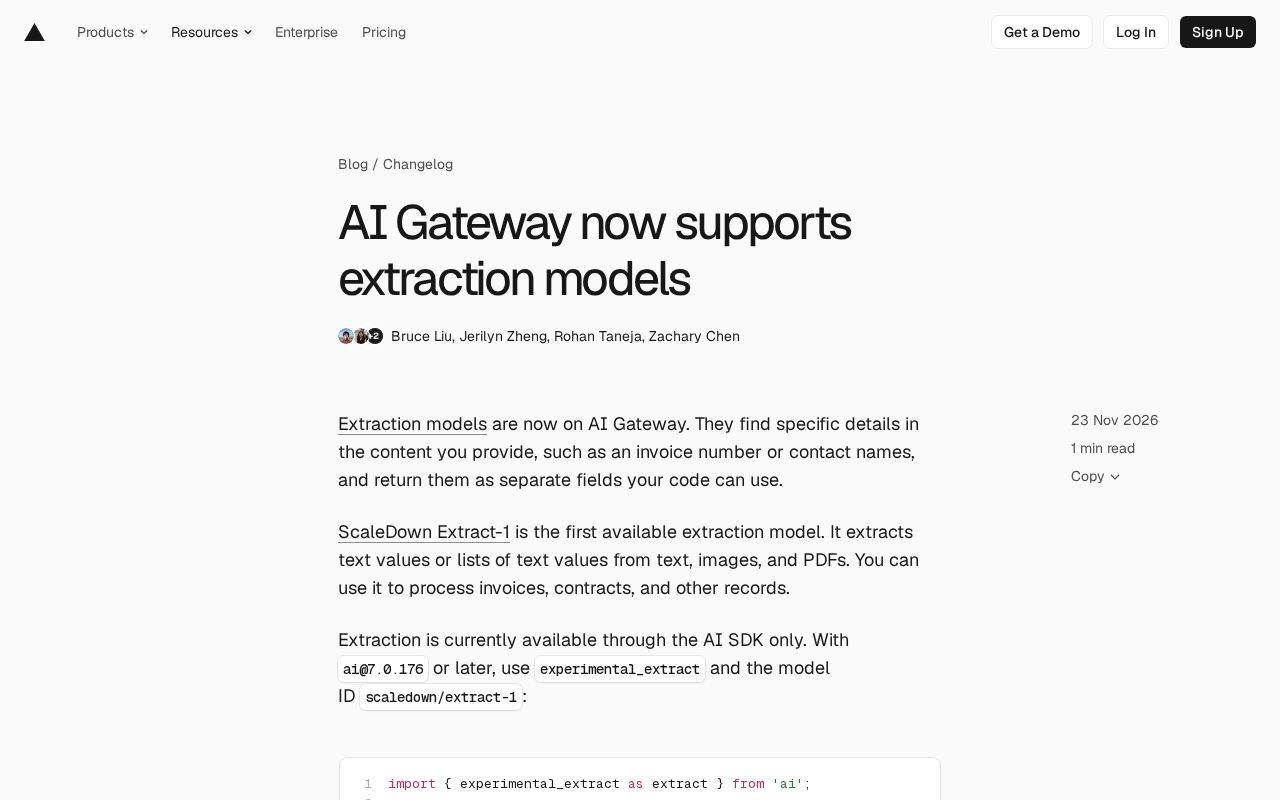
AI Gateway Launches Extraction Models: Precisely Pull Structured Fields from Invoices and Contracts
AI Gateway adds extraction models, debuting with ScaleDown Extract-1, which pulls fields like invoice numbers and contacts from text, images, and PDFs, returning confidence scores and character offsets via AI SDK's experimental_extract.