Token Economics: The New Unit of Value Measurement in the AI Era

How Tokens are becoming the fundamental currency and measurement unit of the AI economy.
This article explores how Tokens are evolving from a technical concept in large language models into the core economic unit of the AI era. It examines the Token consumption explosion driven by AI Agents, analyzes cost optimization strategies including model distillation and quantization, and discusses emerging Token management infrastructure like routing and observability platforms that form the backbone of the new AI economy.
Introduction: A Thought-Provoking Assertion
Recently, a tech investor posted this assertion on social media: "The future will be measured in tokens," announcing support for the Weave team through @theagentfund. Though just a few words, this brief tweet reflects a core trend taking shape in the AI industry — Token is evolving from a technical concept into the fundamental unit for measuring AI value, cost, and productivity.
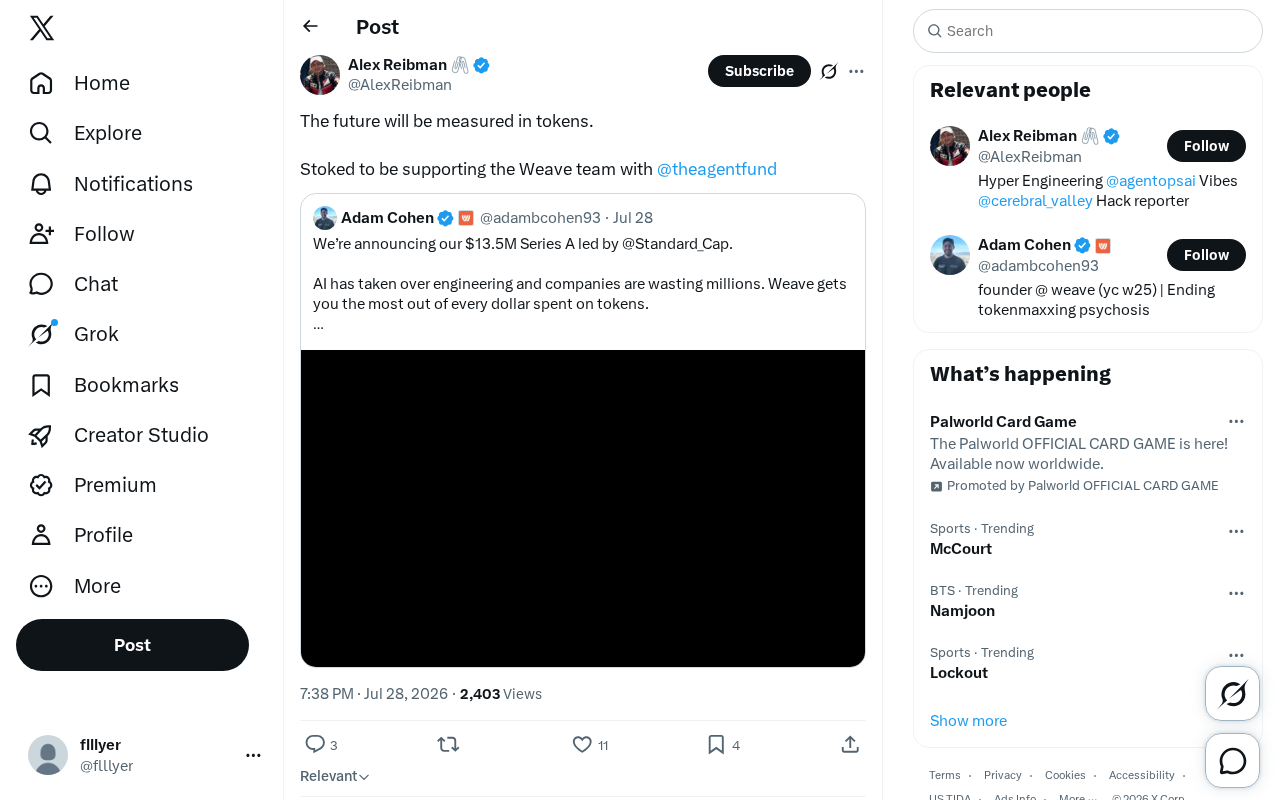
The information embedded in this statement is far richer than it appears on the surface. It's not merely an investment declaration, but a summation of the underlying logic of the entire AI economy: when computing power, model capabilities, and intelligent applications are all measured in Tokens as the smallest unit, Token itself becomes the "currency" of the new economy.
What Is a Token? Why Is It So Important in AI?
The Technical Essence of Tokens
In the world of large language models, a Token is the smallest unit of text that a model processes. A single English word may be split into one or more Tokens, while Chinese characters typically correspond to one or two Tokens. Model input, output, and inference costs are almost entirely billed and computed around Tokens.
The tokenization process relies on a Tokenizer, with mainstream large models generally adopting the BPE (Byte Pair Encoding) algorithm. The core idea of BPE starts at the character level and progressively merges the most frequently co-occurring adjacent character pairs in the corpus into longer subword units. For example, "understanding" might be split into "under" + "stand" + "ing" as three Tokens, while the high-frequency word "the" remains a single Token. OpenAI's GPT series uses the tiktoken library, with vocabulary sizes typically ranging between 50,000 and 100,000 Tokens. This design strikes a balance between vocabulary coverage and computational efficiency — a vocabulary that's too small leads to excessively long sequences that increase computational costs, while one that's too large causes embedding layer parameter bloat. For non-space-delimited languages like Chinese, tokenizers typically encode individual characters into 1-2 Tokens, with complex or rare characters potentially consuming more Tokens.
In other words, when you interact with ChatGPT, Claude, or Gemini, every exchange is essentially a "Token transaction." Your input Prompt consumes input Tokens, the model's generated response consumes output Tokens, and every Token behind the scenes corresponds to real computational overhead and business costs.
The Leap from Technical Unit to Economic Unit
The deeper meaning of "the future will be measured in tokens" lies in this: Token is transcending the purely technical domain to become an economic indicator for measuring AI application scale, enterprise cost structures, and even overall industry growth.
The pricing systems of mainstream AI providers have become fully Token-based — companies like OpenAI and Anthropic all use "per million Tokens" as their billing benchmark. Specifically, as of 2024-2025, Token pricing has formed a clear tiered structure: OpenAI's GPT-4o model prices input Tokens at approximately $2.5-5 per million Tokens, with output Tokens at approximately $10-15; Anthropic's Claude 3.5 Sonnet charges about $3/million Tokens for input and $15/million Tokens for output; Google's Gemini series offers more competitive pricing. Notably, output Tokens are typically 2-4x more expensive than input Tokens, because the generation process requires autoregressive decoding Token by Token, with each generated Token requiring a complete forward pass computation. Additionally, the industry has introduced differentiated pricing strategies such as "context caching" discounts (e.g., Anthropic's Prompt Caching can reduce repeated input costs by 90%) and batch inference discounts, making Token economics increasingly complex and refined.
When an enterprise evaluates the economic viability of its AI applications, the core question often boils down to: "How many Tokens does each user/each transaction consume, and at what cost?" This Token-anchored mindset is reshaping the business models of the software industry.
The Token Consumption Explosion in the AI Agent Era
From Single Conversations to Autonomous Agents
The @theagentfund (Agent Fund) and Weave team mentioned in the tweet point precisely to the key driver of this trend — AI Agents.
Unlike traditional single-turn Q&A conversations, AI Agents can autonomously plan, reason through multiple steps, invoke tools, and execute tasks in loops. Agent architectures typically follow a "Perceive-Plan-Act-Feedback" cycle pattern, with typical frameworks including ReAct (Reasoning + Acting), Plan-and-Execute, and tree-search-based reasoning architectures. Take a data analysis Agent as an example: it might first call a model to understand user requirements (consuming hundreds of Tokens), then generate an execution plan (hundreds more Tokens), then progressively invoke code execution tools and database query tools (each invocation involving tool description inputs and result parsing outputs), and when encountering errors, it needs to reflect and retry. A moderately complex Agent task might involve 10-50 LLM calls, cumulatively consuming 50,000 to 500,000 Tokens, while complex multi-Agent collaboration scenarios (such as software development Agent teams) can consume millions of Tokens per task. This consumption pattern causes per-task costs for Agent applications to surge from a few cents to several dollars or even tens of dollars.
This means that as Agent applications proliferate, global Token consumption will experience explosive growth. When "the future is measured in tokens," the Agent economy is the most important incremental source in this measurement system.
A Fundamental Shift in Investment Logic
The investor's choice to support the Weave team while emphasizing Token measurement reflects a new value assessment framework: whoever can efficiently produce, consume, and manage Tokens holds the value creation capability of the AI era.
For infrastructure providers, reducing per-Token cost is the core competitive advantage; for application developers, the key is how to achieve stronger functionality with fewer Tokens; and for investment institutions, Token consumption scale and its growth curve are becoming important references for evaluating AI project potential.
The Deeper Impact of Token Economics
The Battle Between Cost and Efficiency
The Token-based measurement system brings a direct consequence: efficiency becomes the lifeline of AI applications. For any given functionality, whether it can be achieved with fewer Tokens, smaller models, and better Prompt design directly determines a product's gross margin and sustainability.
This also explains why the industry is currently witnessing numerous technological innovations around "cost reduction" — from model distillation and quantization compression to Prompt optimization and context caching, all are essentially optimizing Token usage efficiency. Knowledge Distillation refers to using a large model's (teacher model) outputs to train a smaller model (student model), enabling the small model to achieve capabilities close to the large model with far fewer parameters. For example, using outputs from a GPT-4-level model to fine-tune a 7-billion-parameter small model, achieving over 90% of the large model's performance on specific tasks while reducing inference costs to one-tenth. Quantization compression converts model weights from 32-bit floating point to 8-bit, 4-bit, or even lower precision integer representations, directly reducing memory usage and computational overhead — quantization formats like GPTQ, AWQ, and GGUF have become standard for open-source model deployment. Furthermore, Mixture of Experts (MoE) architectures use sparse activation mechanisms to activate only a portion of parameters during each inference, dramatically reducing per-Token computation while maintaining total parameter count (and capability). These technologies together form the complete tech stack for Token cost optimization.
Opportunities in New Token Management Infrastructure
When Tokens become the new "currency," the "financial infrastructure" around Tokens emerges accordingly: Token metering, monitoring, optimization, routing, and scheduling are all giving rise to new tools and platforms. The emergence of teams like Weave is precisely targeting opportunities at this infrastructure layer.
As the number of available models explodes — from GPT-4 to Claude to various open-source models — enterprises face an increasingly complex "model selection" challenge: different tasks suit different models, and blindly using the most powerful model leads to serious cost waste. This has given rise to "Token routing" as an emerging infrastructure category — intelligently distributing Token traffic to the most cost-effective model based on request complexity, domain, and quality requirements. For example, simple format conversion tasks can be routed to lightweight models (costs as low as $0.1/million Tokens), while only complex tasks requiring deep reasoning are routed to top-tier models. Platforms like OpenRouter, Martian, and Unify are building this routing layer. Meanwhile, observability tools (such as LangSmith, Helicone, and Langfuse) enable enterprises to track every Token's destination, cost, and quality performance, achieving granular Token spend management — as indispensable as cost monitoring tools were in the cloud computing era.
It's foreseeable that more tool-focused companies specializing in Token management, cost optimization, and agent orchestration will emerge, forming the "utilities" that keep the AI economy running.
Conclusion: An Emerging Industry Consensus
"The future will be measured in tokens" — this concise assertion is actually a precise summary of the AI industry's development trajectory. When computing power, intelligence, and value can all be quantified in Tokens, we are witnessing the birth of an entirely new economic paradigm.
For developers, entrepreneurs, and investors, understanding Token economics is no longer optional — it's a required course for grasping the pulse of the AI era. Whether building applications, evaluating costs, or positioning investments, Token — this seemingly tiny technical unit — will become the critical yardstick for measuring success and failure.
Note: This article expands on analysis from a single investment viewpoint posted on social media. The related assertions represent the poster's personal position, and specific industry trends should be evaluated in conjunction with broader market data.
Related articles

EmbeddedSass for .NET: A Sass Compilation Solution Without Node.js Dependencies
EmbeddedSass for .NET uses the official Embedded Sass Protocol, enabling .NET developers to compile Sass/SCSS natively without Node.js. Learn how it works and integrates with ASP.NET.

San Francisco to Singapore Time Difference: The Trans-Pacific Routine of Silicon Valley Tech Workers
SF and Singapore are 15-16 hours apart, and frequent travel between them is now routine for tech workers. Explore the time difference challenges, AI industry globalization, and talent flows.

Anthropic Launches Official Claude Code Plugin Directory: A Curated High-Quality Extension Ecosystem
Anthropic launches claude-plugins-official, a curated directory of high-quality Claude Code plugins. Learn about its positioning, core value, and impact on the AI coding ecosystem.