TokenSpeed: An Open-Source Speed-of-Light LLM Inference Engine

TokenSpeed is an open-source LLM inference engine focused on speed-of-light performance, with 2,281 stars.
TokenSpeed is an LLM inference engine open-sourced by lightseekorg, officially positioned for speed-of-light inference, currently with 2,281 GitHub stars and 331 forks. The article notes that inference speed directly affects cost, user experience, and system architecture—core variables for LLM deployment. Compared with vLLM, TensorRT-LLM, and SGLang, TokenSpeed differentiates by making speed its single core metric, using a pragmatic Python-plus-CUDA/C++ architecture. The project is still early-stage; production stability and community responsiveness need verification, and future benchmarks will be key signals.
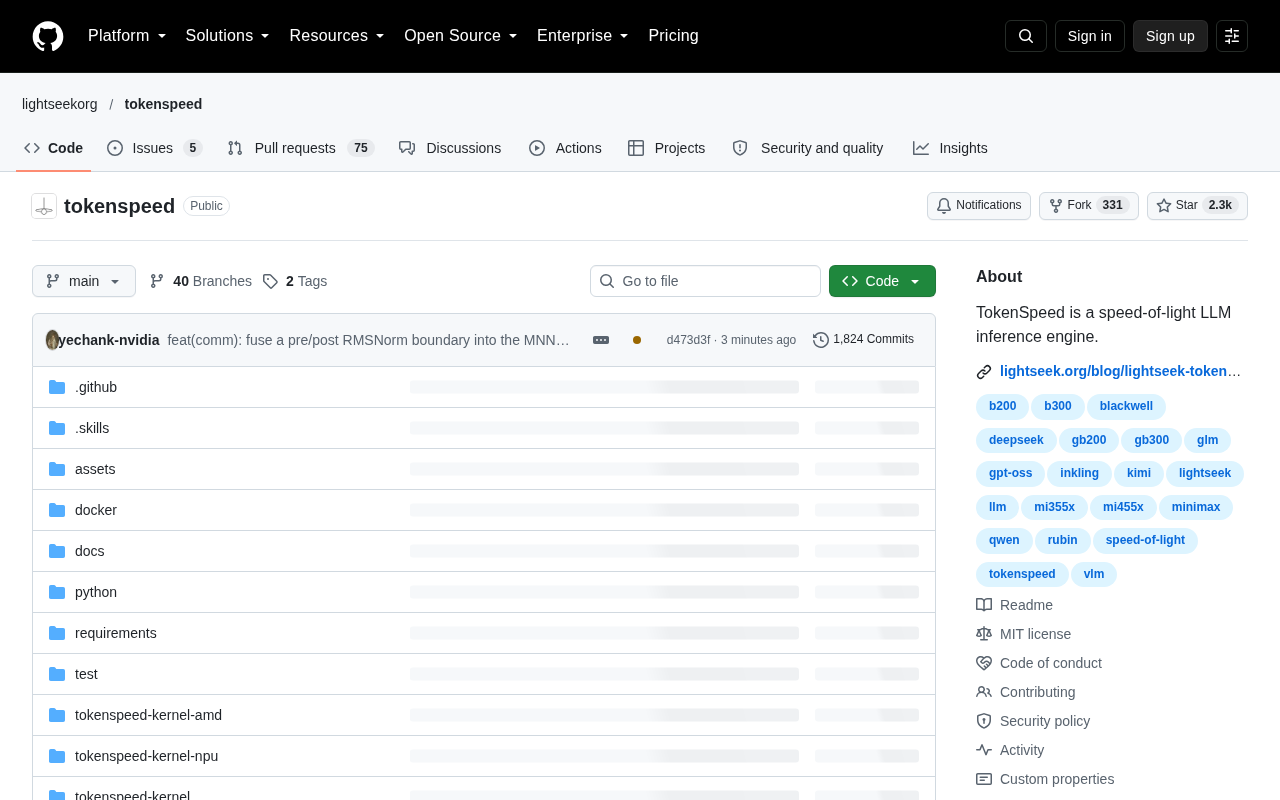
When deploying large models, inference speed often determines whether a product can actually get off the ground. An open-source project on GitHub called TokenSpeed is trying to push LLM inference to "speed-of-light" levels. It has already collected 2,281 stars, 331 forks, and 25 new stars in a single day.
What Is TokenSpeed
TokenSpeed is an LLM inference engine open-sourced by the lightseekorg team, officially positioned as a "speed-of-light LLM inference engine." The project uses Python as its primary language. From its name and slogan, it's clear that its core selling point centers on extreme optimization of inference speed.
Inference engines occupy a pivotal position in the LLM tech stack: above, they receive model weights and inference requests; below, they schedule GPU compute and memory resources. Mature solutions like vLLM, TensorRT-LLM, and SGLang already exist. TokenSpeed's decision to enter at this point suggests the team believes there is still untapped room in existing solutions on the speed dimension. While 2,281 stars isn't top-tier, for a clearly positioned vertical tool it already signals community recognition of its performance claims.
Inference engine is a software layer between upper-level applications and lower-level hardware. It loads trained model weights into GPU memory, receives inference requests, schedules compute tasks, and returns generated results. Its performance depends on coordination across multiple stages: how requests are batched, how KV Cache is allocated and reused, and how operators are scheduled across different hardware. vLLM, TensorRT-LLM, and SGLang are considered mature solutions precisely because they proposed widely reused engineering solutions in some of these stages. For a new engine to differentiate on speed, it typically means it has adopted a design trade-off different from the mainstream in at least one of these stages.
Why "Speed-of-Light Inference" Deserves Attention
Inference speed directly affects three levels of experience.
On the cost level, the higher the token generation rate, the shorter the GPU time per request, and the greater the concurrency the same hardware can handle. For API services billed by token, throughput improvement means margin improvement.
On the experience level, in streaming output scenarios, first-token latency and the generation interval of subsequent tokens together determine user perception. A slow engine makes chatbots feel "sluggish," while a fast engine brings interaction closer to human pace.
On the architecture level, inference speed bottlenecks are often not in computation itself but in memory bandwidth, KV Cache management, batch scheduling, and other system stages. An engine claiming "speed of light" must achieve substantive breakthroughs in these engineering details, not just call faster kernels.
KV Cache is a critical data structure in autoregressive generation with large models. When generating each new token, the model needs the Key and Value vectors of all previous tokens. If recomputed each time, the cost grows quadratically with sequence length. Therefore, inference engines cache historical K/V for reuse, but the cache expands rapidly with concurrent requests and context length, consuming large amounts of GPU memory. How these caches are paged, shared, swapped out, and recycled directly determines memory utilization and actual throughput. Much of what is called inference acceleration is essentially working on KV Cache management rather than simply speeding up matrix multiplication.
Differentiation Strategy from Existing Inference Frameworks
From the project positioning, TokenSpeed has not taken a "big and comprehensive" approach but instead polishes speed as a single core metric. This strategy has its rationale in the open-source ecosystem.
vLLM opened up the high-throughput inference landscape with PagedAttention, TensorRT-LLM leverages the NVIDIA ecosystem for deep compilation optimization, and SGLang focuses on structured generation and RadixAttention. Each framework has its own technical narrative. If TokenSpeed wants to build a moat on speed, possible areas of focus include more aggressive quantization strategies, finer-grained operator fusion, or scheduling optimizations for specific hardware topologies.
The project uses Python as its primary language, a pragmatic choice for an inference engine. The Python layer handles scheduling and interfaces, while performance-critical paths sink down to CUDA/C++ implementations. This maintains development iteration speed without sacrificing runtime performance.
PagedAttention is an attention implementation proposed by vLLM that borrows from operating system virtual memory paging. It divides KV Cache into fixed-size blocks allocated on demand, reducing memory fragmentation, supporting block-level sharing, and significantly improving batch throughput. RadixAttention is SGLang's approach, using a radix tree to reuse KV Cache shared across multiple requests at the prefix level, particularly suited for scenarios with identical system prompts or multi-turn conversations. These two concepts are often used as anchors for understanding inference engine technical roadmaps. For TokenSpeed to differentiate, it would typically need to offer different designs in such cache or scheduling mechanisms.
Who Should Follow This Project
If you are working on any of the following, TokenSpeed is worth adding to your watchlist:
- Building your own LLM inference service with hard requirements on throughput and latency
- Needing to squeeze higher concurrency from limited GPU resources
- Researching system optimization techniques for inference engines and wanting to reference different implementation approaches
- Evaluating multiple inference frameworks for production environment selection
It's worth noting that projects with 2,281 stars are typically in early-to-mid stages. Production stability, documentation completeness, and community responsiveness all need practical verification before making decisions.
When evaluating inference engines, throughput and latency are two metrics that must be distinguished. Throughput typically refers to the total number of tokens generated by the entire system per unit time, reflecting the hardware's capacity to handle concurrency. Latency focuses on the response speed of a single request, further divided into first-token latency and per-token generation interval. There is a trade-off between them: larger batch processing improves throughput but may increase latency for individual requests. Therefore, when selecting, one cannot simply look at the vague claim of "fastest" but must clarify whether their business leans more toward high-concurrency API services or low-latency interactive applications.
The Open-Source Inference Engine Track Continues to Heat Up
TokenSpeed's emergence is no coincidence. As open-source model capabilities approach closed-source models, inference efficiency has become a key variable distinguishing product competitiveness. Innovation at the infrastructure layer is accelerating—from attention mechanism optimization to memory management, from batch processing strategies to distributed inference, teams are attempting breakthroughs at every stage.
For developers, this is good news—more choices mean faster technological iteration and lower deployment costs. For the TokenSpeed team, the real test is whether they can turn "speed of light" from a marketing term into reproducible benchmark numbers and maintain stability under real workloads.
The project's subsequent benchmark data, community feedback, and production cases will be key signals for judging its value.
One-line Summary
TokenSpeed is an open-source LLM inference engine focused on "speed-of-light" performance, with 2,281 stars.
Paragraph Summary
TokenSpeed is an LLM inference engine open-sourced by the lightseekorg team, officially positioned for "speed-of-light" inference speed, currently with 2,281 GitHub stars and 331 forks. The article notes that inference speed directly affects cost, user experience, and system architecture—three levels that are core variables for LLM deployment. Compared with mature frameworks like vLLM, TensorRT-LLM, and SGLang, TokenSpeed differentiates by making speed its single core metric, adopting a pragmatic architecture where Python handles scheduling and interfaces while CUDA/C++ handles critical paths. The project is still in early stages; production stability, documentation completeness, and community responsiveness still need verification. Future benchmark data and real-workload cases will be key signals for judging its value.
Related articles

Bilibili's Hit Dify Tutorial: A Practical Guide to Building 20+ AI Apps from Scratch
A distilled guide to Bilibili's top-rated Dify tutorial: Windows + Docker deployment, MySQL connection, five app types, model integration strategy, and publishing.

Agent Skills Beginner's Guide: From Concepts to Multi-Agent Collaboration in Practice
A comprehensive guide to Agent Skills: core concepts, components, the importance of Description, standardization, beginner learning paths, and multi-agent collaboration.

One Neuron Detects Both Cats and Cars? We Reproduced It and Found a New Explanation
The cat-car neuron reinterpreted: researcher Cammarata argues it distinguishes pointy from round, not cats from cars. We reproduced the experiment and found the new explanation holds on most inputs—but cars are the exception. The interpretability debate continues on language models.