Top Three in Image Editing Benchmarks: What It Means to Surpass AI Models from Google and Meta
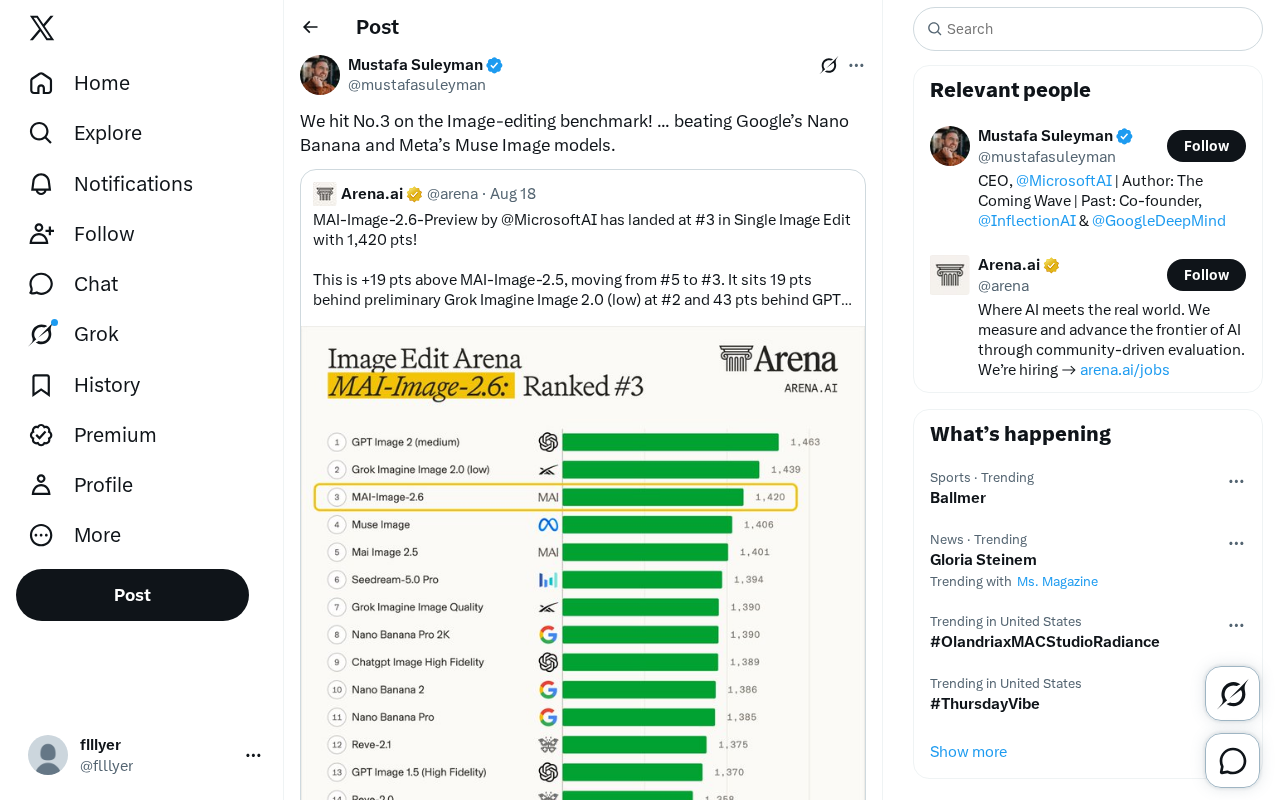
An AI model's top-3 image editing benchmark result reveals accelerating competition beyond tech giants.
A recent benchmark result showing an AI model ranking third in image editing—surpassing Google's Nano Banana and Meta's Muse Image—highlights the intensifying competition in AI image editing. This article analyzes the technical differences between image editing and generation, examines why giant-backed models were surpassed, explains what benchmarks actually measure, and identifies three key industry trends: AI democratization, vertical niche advantages, and the need to critically evaluate marketing claims.
A New Shake-Up in the Image Editing Race
Recently, a tweet sent ripples through the AI community: a certain image editing model claimed third place on an authoritative benchmark, directly surpassing Google's Nano Banana and Meta's Muse Image. While the announcement was brief, it reflects the white-hot competition currently gripping the AI image editing space.
For professionals who have been following generative AI closely, image editing and image generation are two related but distinct tracks.
Technical Differences Between Image Editing and Image Generation
Although image editing and image generation both fall under computer vision, their technical challenges are fundamentally different. Image generation creates entirely new images from noise or text descriptions. Representative models include DALL-E, Midjourney, and Stable Diffusion, which primarily rely on Diffusion Models architectures to generate high-quality images through progressive denoising.
Image editing, on the other hand, requires precisely modifying designated areas while preserving the integrity of the unedited portions. This demands three core capabilities: first, spatial localization—accurately identifying the regions that need editing; second, semantic understanding—interpreting complex editing instructions like "change the summer background to winter"; and third, consistency preservation—ensuring the edited image remains coherent with the original in terms of lighting, perspective, and style. Technically, image editing typically employs mask-based conditional generation, attention mechanism guidance, or control modules like ControlNet, with difficulty and precision requirements significantly exceeding those of pure image generation tasks.
Image editing places a stronger emphasis on precise manipulation of existing images—local modifications, style transfer, object replacement—demanding higher levels of semantic understanding and consistency preservation from models. Beating flagship products from tech giants in this specialized domain is worthy of in-depth analysis.
Why the Giants' Image Editing Models Were Surpassed
Google Nano Banana: The Cost of Going Lightweight
Nano Banana is Google's model codename for image editing, known for its lightweight design and fast response times. Backed by Google's deep expertise in multimodal AI (such as the Imagen series), it excels at text-guided editing. However, going lightweight often means compromising precision in complex editing scenarios—when users need multi-step, high-precision edits, the model's capability ceiling becomes apparent.
Meta Muse Image: The Trade-Off Between Speed and Control Precision
Meta's Muse Image represents a different technical approach.
Diffusion Models vs. Transformer Architectures
Two major technical approaches currently dominate the AI image editing space. The Diffusion Models approach, represented by the Stable Diffusion series, generates images through iterative denoising. Its strengths lie in high generation quality and rich detail, but inference is slower, typically requiring 20–50 sampling steps. Products like Google's Imagen Editor largely follow this path.
Meta's Muse represents a Transformer-based masked generation approach, drawing from BERT's masked language model concept. It treats images as discrete token sequences and generates or edits images by predicting masked tokens in parallel. The biggest advantage of this method is speed—inference steps can be compressed to fewer than 10—but it often falls short of diffusion models in detail precision and photorealism.
Each architecture has its merits: diffusion models are better suited for professional scenarios demanding ultimate quality, while Transformer architectures excel in real-time interaction and batch processing. The industry is exploring hybrid architectures to combine the best of both worlds.
Muse uses a Transformer-based masked generation architecture with a clear speed advantage in image generation, but it also faces challenges in fine-grained editing control. Balancing generation speed with editing precision remains an ongoing challenge for Meta.
One important caveat: benchmark rankings don't fully represent a model's comprehensive capabilities in real-world scenarios. A model ranking highly on a specific benchmark might have been optimized specifically for that benchmark's evaluation criteria, or it may have genuinely achieved a breakthrough in core capabilities. Claims of "beating the giants" should be viewed with nuance.
What Image Editing Benchmarks Actually Measure
Four Core Evaluation Dimensions
Mainstream image editing benchmarks typically evaluate model performance across the following dimensions:
- Editing Accuracy: Whether the model precisely executes the user's editing instructions
- Consistency Preservation: Whether unedited areas remain unchanged, avoiding the "butterfly effect"
- Visual Quality: Whether the edited image looks natural, free of obvious artifacts or visible seams
- Semantic Understanding: The ability to interpret complex, ambiguous, or even contradictory instructions
Ranking third overall across these dimensions—and surpassing products from two industry leaders—indicates the model has reached the cutting edge. However, benchmarks are ultimately "lab metrics," and a gap always exists between them and actual user experience in real workflows.
The Evaluation Framework for Image Editing Benchmarks
Authoritative benchmarks in the image editing field include EditBench, PIE-Bench, and MagicBrush, among others. These benchmarks typically contain thousands of carefully annotated editing tasks covering scenarios such as object addition/removal, attribute modification, style transfer, and background replacement.
Evaluation methods combine automated metrics with human assessment. Automated metrics include: CLIP-Score for measuring consistency between editing results and text instructions, LPIPS (Learned Perceptual Image Patch Similarity) for gauging perceptual image quality, and SSIM (Structural Similarity) for assessing preservation of unedited regions. Human evaluation involves annotators scoring results on realism, instruction adherence, and consistency.
Notably, different benchmarks emphasize different aspects. Some focus more on complex instruction comprehension, others on multi-turn editing ability, and still others on specific domains (such as face editing or product image processing). A single benchmark ranking cannot fully represent a model's overall capabilities—which is precisely why cross-validation across multiple benchmarks is necessary. The industry consensus is that a truly excellent image editing model should maintain consistently top-tier performance across various benchmarks.
Industry Value Beyond Rankings
From a practical deployment perspective, AI image editing is becoming one of the most commercially valuable applications of generative AI. Batch product image processing for e-commerce platforms, content creation for social media, workflow acceleration for professional designers—every one of these scenarios has strong demand for high-quality AI image editing capabilities.
This is the core reason why Google, Meta, and other giants continue to invest heavily in image editing. The market is large enough, the technical barriers are high enough, and whoever first achieves "useful and reliable" will seize the advantage.
Three Key Trends in the AI Image Editing Competitive Landscape
Behind this brief tweet lie several industry trends worth watching:
Trend 1: The Democratization of AI Is Accelerating
Cutting-edge model capabilities that were once accessible only to tech giants are increasingly being replicated—and even surpassed—by smaller teams.
How the Open-Source Ecosystem Is Reshaping AI Competition
The open-sourcing of Stable Diffusion in 2022 was a watershed moment in AI image generation. It democratized image generation capabilities previously held by a handful of tech giants, spawning a massive open-source community and derivative ecosystem. Control and fine-tuning techniques like ControlNet, LoRA, and DreamBooth emerged in its wake, dramatically lowering the barrier to model customization.
The open-source community has shown remarkable vitality in image editing as well. After papers on methods like InstructPix2Pix and Prompt-to-Prompt were published, they were quickly reproduced and improved upon, creating a virtuous cycle of rapid iteration. Smaller teams can collect high-quality data for specific editing tasks, fine-tune open-source base models, and surpass general-purpose models in vertical domains.
This open-source-driven innovation model has fundamentally altered the competitive landscape. While giants have advantages in compute power and data scale, they are actually less agile than focused small teams when it comes to rapid iteration for specific scenarios. Current AI competition increasingly resembles the open-source software era: foundational capabilities are converging toward parity, and true differentiation lies in deep understanding of niche scenarios and targeted optimization.
The flourishing open-source ecosystem, mature training frameworks, and lower barriers to accessing compute are all driving this trend. The ranking shift in image editing is the latest example of technology democratization in action.
Trend 2: Vertical Niches Offer Better Opportunities for Breakthroughs
Rather than competing head-on with giants in general-purpose large models, focusing on vertical scenarios like image editing makes it easier to build differentiated advantages. Teams dedicated to specific tasks can deeply optimize data collection, model architecture, and training strategies, achieving an "underdog victory" in their niche.
Trend 3: Marketing Claims Need Critical Evaluation
"Beating such-and-such giant" is a common marketing tactic in the AI startup world. As industry observers, we should recognize the technical substance behind such achievements while maintaining rational judgment, waiting for more real user feedback and independent third-party evaluations. There remains a significant gap between a ranking improvement on a single benchmark and genuine leadership in overall product experience.
Final Thoughts
Third place on an image editing benchmark, surpassing Google and Meta—this brief announcement is a microcosm of the intensely competitive AI race. In this field, there are no permanent champions, only constant iteration and leapfrogging.
For professionals following AI development, rather than fixating on any single ranking, it's more valuable to continuously observe the direction of technological evolution: whoever truly solves users' real pain points in image editing will be the one who has the last laugh in this race.
We look forward to seeing more independent evaluations and real-world use cases that can validate the true significance of this achievement.
Related articles
AI Agent Cost Optimization in Practice: Engineering Wisdom That Saved $1 Million in One Hour
Databricks eliminated $1M/year in wasted AI Agent spend in just one hour. Learn the root causes of Agent cost overruns and key strategies like model tiering, context pruning, and caching.

How the FDA Is Building an AI-Ready Data Foundation on Databricks
Explore how the FDA leverages Databricks for Government to build a unified Lakehouse architecture and AI-ready data foundation while meeting federal security and compliance standards.

The Power of Security Collaboration: Why Vulnerability Discovery Cannot Do Without Human Intelligence
Explore how security collaboration outperforms tool dependency, the value of vulnerability stories, cross-team knowledge sharing practices, and building stronger defenses by investing in people and collaboration.