Top University Machine Learning Course Notes Collection: Free and More Practical Than Textbooks

A curated collection of free, textbook-quality ML course notes from top universities worldwide.
A Reddit user compiled a curated GitHub list of free machine learning course notes from elite universities like MIT, Harvard, and Stanford. These professor-written notes are thorough enough to replace textbooks, continuously updated, and publicly accessible—yet often overlooked due to poor discoverability. The list applies strict inclusion criteria: only written notes from official sources, no slides or paywalled content.
An Overlooked Gold Mine of Learning Resources
On the path to learning machine learning, many people spend considerable time searching for classic textbooks, popular online courses, or paid bootcamps, while often overlooking a high-quality yet scattered resource: course notes written by professors at top universities.
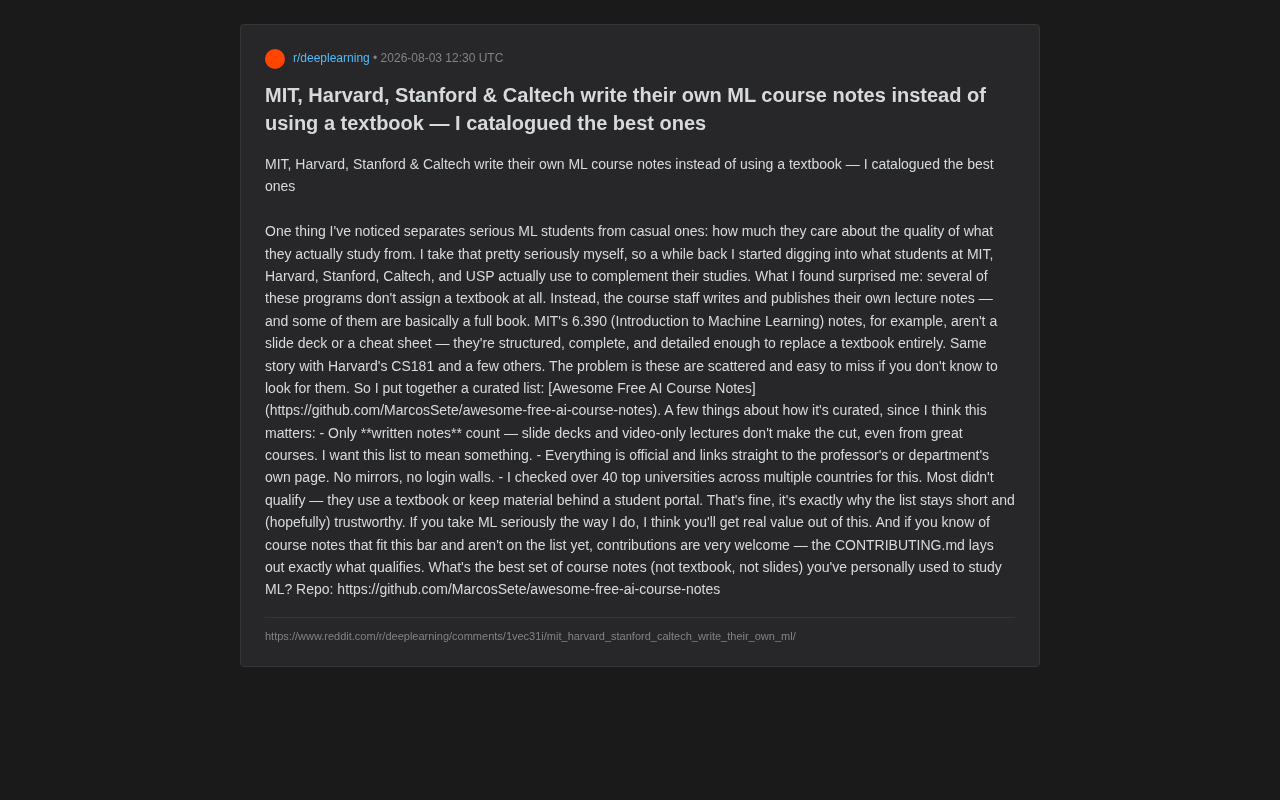
Recently, a Reddit user conducted in-depth research into ML courses at MIT, Harvard, Stanford, Caltech, and other prestigious institutions, and discovered an interesting fact: many courses in these top programs don't assign a textbook at all. Instead, the teaching teams write and publicly release complete lecture notes—and some of these are so thorough they essentially constitute a full textbook.
This phenomenon actually reflects a deep characteristic of the machine learning field: it evolves far faster than traditional textbook publishing cycles allow. A textbook typically takes 2-3 years from writing to publication, while frontier ML methods (such as Transformer architectures, diffusion models, etc.) can reshape entire subfields within months. Consequently, professors writing their own notes has become an "agile publishing" model—maintaining academic rigor while incorporating the latest research findings with each semester's iteration.
To make these scattered high-quality resources more visible, the user compiled a curated list called Awesome Free AI Course Notes, with strict inclusion criteria.
Why Top University ML Course Notes Deserve Serious Attention
Notes ≠ Slides
The author specifically emphasized a distinction that's easily confused: what's truly valuable are systematic written notes, not slide decks or cheat sheets.
Take MIT's 6.390 "Introduction to Machine Learning" as an example. Its notes aren't scattered PowerPoint pages, but structurally complete, content-rich, logically coherent documents—thorough enough to fully replace a textbook. MIT 6.390 (formerly 6.036) is a core course in MIT's Department of Electrical Engineering and Computer Science (EECS) for upper-level undergraduates and graduate students, taught by renowned professors such as Leslie Kaelbling and Tomás Lozano-Pérez. The course covers the complete pipeline of supervised learning, unsupervised learning, and reinforcement learning, and its notes are known for their rigorous mathematical notation system and clear algorithmic derivations. MIT's OpenCourseWare (OCW) tradition enables such materials to be openly accessible worldwide—an open education philosophy that traces back to MIT's pioneering OCW initiative launched in 2001.
Harvard's CS181 follows the same pattern. CS181 "Machine Learning" is the flagship ML course at Harvard's School of Engineering and Applied Sciences (SEAS), emphasizing machine learning theory from a probabilistic perspective. The course notes are particularly notable for connecting concepts like Bayesian inference, kernel methods, and graphical models within a unified probabilistic framework, reflecting Harvard's deep tradition in statistics. The course typically also releases detailed mathematical prerequisites documents to help students from different backgrounds establish a common mathematical language.
The advantages of these types of course notes include:
- Aligned with course logic: Written for teaching purposes, the pacing and concept progression have been refined through teaching practice;
- Balancing depth and readability: Mathematically rigorous yet more accessible than pure academic papers;
- Continuously updated: Maintained by active professors, often reflecting the latest advances in machine learning.
Scattered, Hidden, and Easy to Miss
The biggest problem with these free learning resources isn't quality—it's discoverability. They're scattered across various university course pages, and if you don't know where to look or what keywords to search for, you'll likely miss them entirely. This is precisely where the value of this curated list lies.
Strict Inclusion Criteria: The Soul of the List
The author established several deliberately restrained principles when compiling this ML resource list, and it's precisely these principles that make the list more credible:
- Only written notes are included: Even well-known quality courses won't be included if they only provide slides or videos. The author wants this list to be "meaningful" rather than a simple pile of links.
- Must be from official sources: All links point directly to the professor's own page or the department's official page—no mirror sites, no login-required paywalls.
- Quality over quantity: The author researched over 40 top universities across multiple countries, but most ultimately didn't make the cut—either because they use assigned textbooks or lock materials behind student-only access portals.
This "panning for gold" approach keeps the list short, but actually improves its signal-to-noise ratio. For ML self-learners, a list of 5 carefully selected items is often more useful than 50 links of mixed quality.
Practical Implications for ML Learners
High-Quality Learning Materials Are Worth Deliberately Seeking Out
The author shared an observation: one difference between serious ML students and casual learners is how much they care about "what materials they're actually learning from." This statement highlights an often-overlooked truth—learning effectiveness depends not only on how much time you spend, but on what kind of content you spend it on.
From a cognitive science perspective, this observation has a solid theoretical foundation. John Sweller's Cognitive Load Theory states that how learning materials are organized directly affects working memory burden. Through years of teaching iterations, top university professors have typically optimized the order of concept introduction, difficulty gradients of examples, and the balance between abstraction and concreteness—all key design decisions for reducing extraneous cognitive load. The most common problem with low-quality tutorials is precisely the lack of design in these areas: overly large conceptual jumps, inconsistent notation, and missing transitional explanations, all of which needlessly consume learners' precious cognitive resources.
Top university notes are precious because they crystallize leading researchers' thinking about "how to explain complex concepts clearly." Compared to the uneven quality of tutorials available elsewhere, they provide a teaching-tested, reliable learning path.
How to Efficiently Use These Course Notes
For readers who want to systematically study machine learning, here are a few suggestions:
- Use notes as the main thread, videos as supplements: Notes provide the knowledge skeleton; paired with course recordings, they help you better understand explanatory details;
- Combine with assignments and projects: Many course pages also provide problem sets—hands-on practice is essential to truly mastering algorithmic principles;
- Cross-read similar notes from multiple schools: Different professors emphasize different aspects of the same topic (e.g., probabilistic graphical models, optimization methods), and comparative reading deepens understanding.
Community Collaboration: Keeping the List Growing
This list adopts an open-source collaborative model. The author clearly lists inclusion criteria in CONTRIBUTING.md and welcomes community contributions that meet the threshold. GitHub repositories prefixed with "Awesome" have formed a unique open-source knowledge curation culture—a tradition that began with Sindre Sorhus creating the awesome list in 2014, which has since spawned thousands of domain-specific curated lists. Excellent Awesome lists typically feature clear inclusion criteria, active community maintenance, and rigorous Pull Request review processes. The essence of this model is "manual curation against information overload"—in long-tail content areas where search engines struggle to distinguish quality, manual filtering by domain experts is often more effective than algorithmic recommendations.
This "high standards + open contributions" model ensures a quality floor while allowing the list to continuously improve as more people participate.
For every learner who takes machine learning seriously, a community-maintained, officially-sourced free resource list like this is undoubtedly a bookmark-worthy starting point. As the author's closing question implies—the best learning often begins with finding the best materials.
Project link: https://github.com/MarcosSete/awesome-free-ai-course-notes
Related articles

AI-Powered SRC Vulnerability Hunting: A Hands-On Guide to Building the Hermes Agent Workbench
Based on a hands-on Bilibili video: how to build an AI-powered SRC vulnerability hunting workbench—three-step method, four report elements, Agent mode vs web chat, and tool selection.

CLI-Anything Complete Beginner's Guide: How AI Operates Software — Principles and Practice
A complete beginner's guide to CLI-Anything: how AI Agents operate professional software via the command line, covering the three-layer architecture, CLI Hub installation, DrawIO practice, generator principles, and limits.

Carbon-X: A 14.8B Open-Source Model That Handles DNA and Text Simultaneously
Carbon-X is a 14.8B open-source multimodal model on Hugging Face where DNA and text share a token stream. 6-mer tokenization, 302B token mid-training, deployable on a single 80GB GPU, 66.7% average on five DNA benchmarks, Apache 2.0 license.