Training RL on Real Data for Options Hedging: Tail Risk Cut by 3.1%, But Bull Markets Become a Drag
RL hedging agents trained on real data beat delta hedging on tail risk, but at the cost of bull market performance.
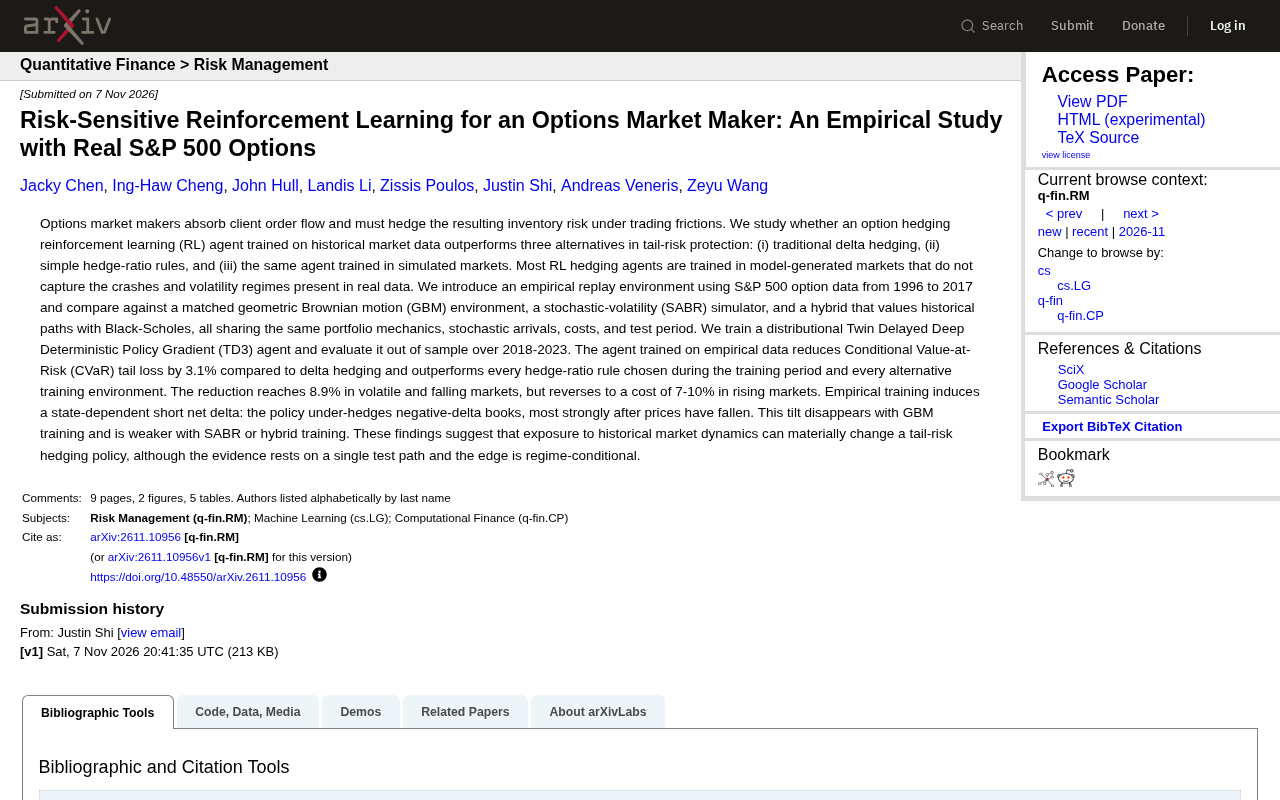
Based on S&P 500 options data from 1996-2017, this study builds an empirical replay environment compared against GBM, SABR, and hybrid environments, training hedging agents with distributed TD3 and evaluating out-of-sample from 2018-2023. Agents trained on empirical data reduced CVaR tail losses by 3.1% vs delta hedging, amplifying to 8.9% in volatile declining markets but reversing to a 7-10% cost in rising markets. The strategy induces regime-dependent net delta short behavior, under-hedging negative-delta books most strongly after price declines—a tendency absent under GBM training.
Article Content
After absorbing customer order flow, options market makers must manage the resulting inventory risk under hedging frictions. A natural question arises: can reinforcement learning (RL) hedging agents trained on real historical market data outperform traditional methods in tail risk protection? An empirical study targeting the S&P 500 options market gives a conditional yes—while also revealing an easily overlooked cost.

Research Design and Experimental Environment
According to the paper, the researchers built an "empirical replay" environment based on S&P 500 options data from 1996 to 2017, and compared it with three simulated environments: a matched geometric Brownian motion (GBM) environment, a stochastic volatility (SABR) simulator, and a hybrid environment that prices historical paths with Black-Scholes. All four environments share the same portfolio mechanics, random arrivals, costs, and test period, ensuring a fair comparison.
The agent was trained using the distributed TD3 (Twin Delayed Deep Deterministic Policy Gradient) algorithm and evaluated out-of-sample from 2018 to 2023. The researchers explicitly note that most RL hedging agents are trained in model-generated markets and cannot capture the crashes and volatility regime switches present in real data—this is precisely their motivation for introducing the empirical replay environment.
Distributed TD3 is a distributed extension of the TD3 algorithm. TD3 itself is an actor-critic algorithm for continuous action spaces that mitigates Q-value overestimation through three techniques: clipped double Q-learning, delayed policy updates, and target policy smoothing. The distributed version builds on this by extending the value function's output from a single expected value to modeling the return distribution (e.g., quantiles or categorical distributions), enabling the agent to perceive the full distribution of returns rather than just the mean when making decisions. For tail-risk-sensitive tasks like hedging, a distributional value function is particularly critical: it allows the agent to directly weight downside risk measures such as CVaR during optimization, rather than merely maximizing expected returns. This is the core reason the study chose distributed TD3 over standard TD3 or DDPG.
Empirical replay environment is not the same concept as the experience replay buffer commonly used in reinforcement learning. The latter refers to the mechanism by which an agent stores and resamples its own interaction experience during training; the empirical replay environment in this paper refers to a simulator based on real historical market paths: the researchers fixed the historical prices, volatilities, and path data of S&P 500 options from 1996 to 2017 into an interactive environment, where the agent's state transitions are driven by historical data rather than generated by an analytical model. The benefit is that it preserves the fat-tail characteristics of real markets—crashes, volatility clustering, and regime switches—exposing the agent to extreme scenarios that simulators struggle to reproduce; the cost is that the environment can only evolve along fixed historical paths, cannot generate new unseen scenarios, and is limited by the coverage of historical samples.
Benefits and Costs of Tail Risk Protection
The core results present a clear two-sided picture. According to the paper's data, the agent trained on empirical data reduced conditional value-at-risk (CVaR) tail losses by 3.1% compared to traditional delta hedging, and outperformed every hedging ratio rule selected during the training period, as well as all alternative training environments.
This advantage amplifies to 8.9% in volatile and declining markets. But in rising markets, the advantage reverses into a cost of 7% to 10%. The researchers' qualitative judgment is that the evidence is based on a single test path, and the advantage is regime-conditional.
In other words, the agent trained on real data is not universally superior—it trades higher opportunity costs for tail protection under specific market regimes.
Strategy Behavior: Regime-Dependent Net Delta Short
The study reveals an interesting behavioral characteristic: empirical training induces a regime-dependent net delta short. Specifically, the strategy under-hedges negative-delta books, and this tendency is strongest after prices have already fallen.
This tilt completely disappears under GBM training and is weaker under SABR or hybrid training. The researchers conclude that exposure to real market dynamics can substantially alter tail risk hedging strategies—the memory of crashes in historical data is encoded into strategy behavior rather than being smoothed away by the simulator's assumptions.
Net delta is the core risk metric for an options market maker's hedging book, defined as the weighted algebraic sum of the deltas of all positions in the portfolio, measuring the approximate change in portfolio value for a one-unit change in the underlying price. After absorbing customer orders, market makers typically hold non-zero net delta and need to buy or sell the underlying or options to bring exposure back to the target range. A "net delta short" refers to a directional exposure where the portfolio benefits when the underlying price falls and suffers when it rises. The strategy "under-hedging" negative-delta books means that when prices have already fallen and the book is in a net short state, the agent chooses to retain rather than reduce this exposure, thereby gaining additional protection if the decline continues but bearing larger losses on a rebound. This asymmetric behavior is the micro-level source of the 7% to 10% opportunity cost in rising markets.
Multi-Source Perspectives and Limitations
This study comes from a single paper source; the experimental design is rigorous but the boundaries of its conclusions are clear. The researchers themselves acknowledge that the evidence is built on a single test path with limited statistical robustness; the strategy's advantage is highly dependent on market regime and incurs considerable costs in trending bull markets. For live deployment, this means additional regime identification or switching mechanisms are needed rather than directly applying the trained strategy.
From a methodological perspective, the value of this work lies not only in the 3.1% figure but also in the question it raises: to what extent can the distribution gap between simulated environments and real markets distort the learning outcomes of risk-sensitive RL strategies? The empirical replay environment provides a reproducible testing path.
Implications for Market Making and Risk Management
For options market makers, the practical implications of this research are twofold. On one hand, training on real data can indeed improve tail protection in extreme market conditions; on the other hand, this improvement comes at the expense of performance in rising markets, and strategy behavior exhibits systematic tilts along price paths, requiring additional risk-control monitoring of the regime dependence of net delta exposure.
For RL researchers, the conclusion suggests that simulator fidelity may be more critical than algorithm choice—the same TD3 agent learns significantly different hedging behaviors across training environments, and GBM's smoothing assumptions systematically erase the strategy's sensitivity to crashes.
One-line Summary
RL hedging agents trained on real data outperform delta hedging on tail risk, but at the cost of bull market performance.
Paragraph Summary
This study builds an empirical replay environment based on S&P 500 options data from 1996 to 2017, compares it with GBM, SABR, and hybrid environments, trains hedging agents with distributed TD3, and evaluates out-of-sample from 2018 to 2023. Results show that agents trained on empirical data reduce CVaR tail losses by 3.1% compared to traditional delta hedging, amplifying to 8.9% in volatile declining markets, but reversing into a 7% to 10% cost in rising markets. Behavioral analysis reveals that the strategy induces a regime-dependent net delta short, under-hedging negative-delta books, with this tendency strongest after price declines and completely disappearing under GBM training. The researchers acknowledge that the evidence is based on a single test path with limited statistical robustness, that the advantage is regime-dependent, and that live deployment requires additional regime identification mechanisms.
Related articles

Gemini 4 Neon Review: Benchmark Scores Rival Carbon, API Pricing and Quota Breakdown
Google Gemini 4 Neon is now live, benchmark scores closely tracking Carbon, API pricing 3/15 at twice Hydrogen's rate. This article compiles Bilibili creator testing: Neon can replace 90% of Carbon scenarios, AntiGravity quota consumption is only one-third of Carbon, plus subscription channel restrictions and 2API ban risks.

Gemini 4 Helium Coming Soon? Signals of Google Loosening Subscription Restrictions
Google team member hints releases will continue; community speculates Gemini 4 Helium (Flash Lite) may be next. Subscription ban controversy gets a response as product lead says "Soon," suggesting restrictions may be lifted. This article covers Gemini developments, OpenAI Coding Agent and risk management, Doubao real-time audio-video API, and compute business dynamics.

AI-Assisted React Development in Practice: Optimizing a Video App and Handling Errors
A 14-year veteran developer demonstrates AI-assisted React video app optimization: compressing video from 80MB to 5MB (~94%) via ImageKit, plus reliable error handling and retry mechanisms. Includes planning, code understanding, and verification methods for working with AI.