Transitioning to AI Agent Development: A Complete Learning Path for the LangChain Tech Stack
A structured learning path for programmers to transition into AI Agent development using the LangChain ecosystem.
This guide breaks down the LangChain ecosystem into three layers—Deep Agents for rapid prototyping, LangChain for balanced customization, and LangGraph for full process control. It explains when to use each, how RAG fits in via LlamaIndex, and why mastering LangChain first, then drilling into LangGraph, is the optimal learning sequence for building production-grade AI Agents.
For programmers looking to transition from traditional development to the AI Agent field, choosing the right tech stack is often more important than learning blindly. Recently, a technical YouTuber on Bilibili shared a practical tutorial on AI Agent development, systematically outlining the complete learning path from RAG to the LangChain Agent framework. This article combines their core insights to provide an in-depth analysis of the positioning and selection logic of the LangChain technology ecosystem.
From RAG to Agent: The Complete Pipeline for Agent Development
Before diving into Agent framework learning, it's essential to understand the technological evolution of Agent applications. According to the tutorial, the theory and implementation of RAG (Retrieval-Augmented Generation) can be completed through LlamaIndex, while the RAG evaluation phase is often explained in combination with actual projects. Once the RAG component is established, the learning focus should shift to genuine Agent frameworks.
RAG (Retrieval-Augmented Generation) is a technical paradigm proposed by Meta AI in 2020, designed to address the inherent deficiencies of large language models in knowledge timeliness and hallucination issues. Its core approach is to retrieve document fragments related to the user's question from an external knowledge base before generating an answer, then inject these fragments as context into the Prompt, allowing the large model to generate responses based on real information. The entire process typically includes six steps: document chunking, vectorization (Embedding), storage in a vector database, semantic retrieval, context concatenation, and LLM generation. RAG has become the infrastructure for enterprise-level AI applications because it can inject domain knowledge without fine-tuning the model, significantly reducing the cost and barrier to large model deployment.
Here's a key distinction: LlamaIndex excels at RAG and data retrieval, while LangChain is more specialized in orchestrating Agent workflows. LlamaIndex (formerly GPT Index) is an open-source framework focused on data connection and retrieval, created by Jerry Liu in 2022. Its core value lies in providing a highly abstracted data interface layer that can uniformly transform various unstructured data sources (PDFs, web pages, databases, APIs, etc.) into indexable structures for large model retrieval. LlamaIndex has built-in multiple index types (vector indexes, list indexes, tree indexes, keyword indexes, etc.) and supports complex query engines and routing mechanisms. Compared to LangChain, LlamaIndex offers more advantages in fine-grained control of data processing pipelines, making it particularly suitable for building Q&A systems and document analysis applications centered on knowledge retrieval.
Although both can connect to various large model providers—by simply providing an OpenAI-like API, API Key, URL address, and model name to interact with large models—in arranging the entire Agent workflow, LangChain's abstract design is clearly more suitable. The OpenAI-like API mentioned here refers to major model providers (such as Baidu Wenxin, Alibaba Tongyi, Moonshot, DeepSeek, etc.) actively maintaining compatibility with OpenAI's Chat Completions API interface format when deploying model services—including request paths, message structures, and response formats. The formation of this de facto standard means developers only need to change three parameters—Base URL, API Key, and model name—to seamlessly switch between different models, which is also the technical foundation enabling frameworks like LangChain to easily connect to dozens of model providers.
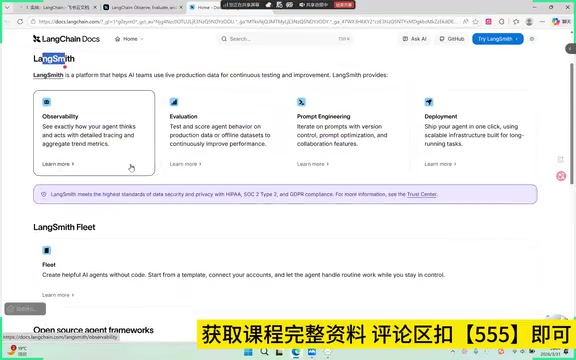
Worth mentioning is that the LangChain ecosystem also includes LangSmith, a component that serves as the monitoring system for the entire Agent, responsible for observing various metrics and operational chains of the Agent. LangSmith is a commercial observability platform launched by the LangChain team, similar to how traditional software development tools like Datadog and New Relic extend APM tools to the LLM application domain. It can track the complete chain of each Agent invocation—including rendered Prompt templates, model inputs and outputs, tool invocation sequences, token consumption, latency distribution, and error stacks. In production environments, since Agents involve multi-turn decision-making and tool invocations, their execution paths are inherently non-deterministic, making traditional logging systems ineffective for troubleshooting. The value of such observability tools is often underestimated, but they are precisely the key to diagnosing abnormal Agent behavior and are nearly indispensable in production environments.
The LangChain Ecosystem Trinity: Layered Architecture Selection Logic
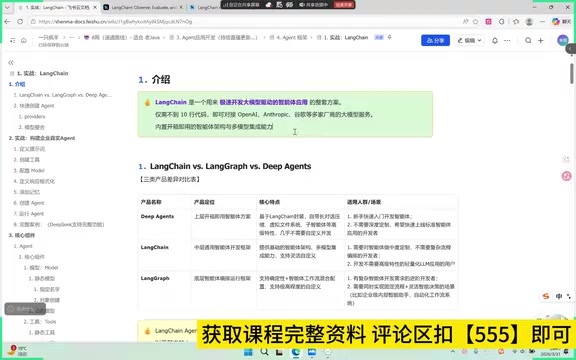
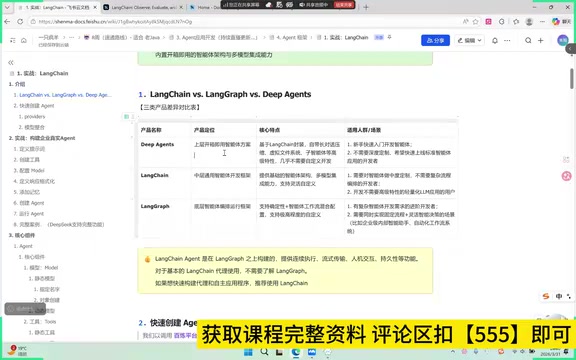
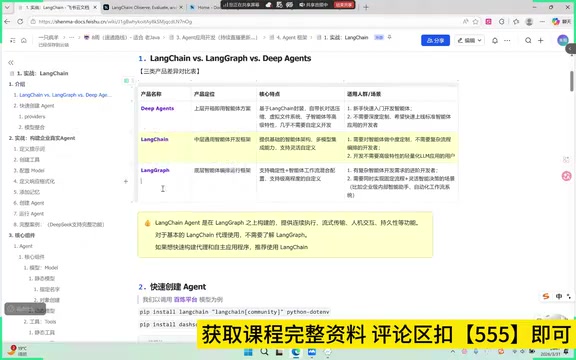
Understanding the official LangChain ecosystem is most importantly about clarifying the relationship between three core frameworks: Deep Agents, LangChain, and LangGraph. The tutorial captured their hierarchical relationship in one sentence—Deep Agents encapsulates the LangChain framework, while LangChain encapsulates the LangGraph framework. In other words, each serves as the underlying framework for the layer above, forming a clear three-tier structure.
This layered design corresponds to different use cases:
Application Scenarios for Three Frameworks
- Deep Agents (Top Layer): If you want to quickly build an Agent with almost no coding and no need for deep customization, you can get an entire Agent application running with just a few words.
- LangChain (Middle Layer): If you need some orchestration and customization of the Agent process, along with architectural-level adjustments, LangChain is the best choice. This is also the most widely used layer in practical applications.
- LangGraph (Bottom Layer): If you need complete customization of the Agent's operational flow and precise control over every stage, you must dive deep into LangGraph.
LangGraph is a low-level process orchestration framework launched by the LangChain team in 2024, with design inspiration from the computational models of Finite State Machines and Directed Graphs. In LangGraph, each processing stage of the Agent is abstracted as a "node" in the graph, while the transition logic between stages is defined through "edges," including conditional edges (dynamically deciding the next step based on runtime state) and fixed edges. This graph structure naturally supports complex flow patterns such as loops, branches, parallelism, and human intervention, far exceeding the linear expression capability of traditional Chains. LangGraph also has built-in state persistence mechanisms, supporting Checkpoints and resumption, enabling long-running Agent tasks to be safely paused and resumed. This architectural design makes it particularly suitable for building production-grade Agent systems that require precise process control.
The tutorial makes an interesting observation: LangChain, as the middle layer, is used most frequently, both encapsulating the underlying LangGraph and being depended upon by the upper Deep Agents. This "middle ground" choice, to some extent, aligns with the universal need to balance flexibility and development efficiency—neither having to orchestrate low-level processes from scratch nor sacrificing sufficient customization space.
Enterprise Deployment Perspective: Prototype Validation vs. Product Customization
From an engineering practice perspective, framework selection is often deeply tied to project phases. The tutorial provides a pragmatic judgment criterion:
If a company is only doing rapid prototype validation or developing experimental products, using high-level encapsulations like Deep Agents directly is sufficient, prioritizing speed. But if you need to create standardized product customization—such as an Agent platform-level product comparable to Coze—then you need to use LangGraph at the underlying layer to gain complete control over the process.
Coze is an AI Agent development platform launched by ByteDance, competing with OpenAI's GPTs and Microsoft's Copilot Studio. It provides a visual Agent building interface, supporting plugin marketplaces, workflow orchestration, knowledge base management, and multi-channel publishing (Feishu, WeChat, web, etc.). Such platform products require highly flexible process engines at the underlying layer—users can freely define the Agent's reasoning chains, tool invocation sequences, and conditional branches. To build this level of platform capability, the mid-level abstraction of LangChain alone is insufficient; you must dive into low-level graph orchestration engines like LangGraph to support arbitrarily complex workflows.
This perspective is particularly important for transitioning programmers. What should be reflected in resumes is not just "proficiency with a certain framework," but the ability to make reasonable technical selection decisions based on business scenarios (prototype validation vs. production customization). This architectural decision-making capability is precisely the watershed that distinguishes junior from senior Agent developers.
In the emerging field of AI Agent development, the industry is forming a capability assessment system distinct from traditional backend or frontend development. Junior Agent developers typically only need to master Prompt Engineering and basic framework API calls; intermediate developers need to understand RAG optimization strategies (such as hybrid retrieval, Reranking, query rewriting) and tool definition and Function Calling mechanisms; while senior Agent developers need to possess system architecture design capabilities, including multi-Agent collaboration patterns, state management and persistence strategies, fault tolerance and degradation mechanisms, cost control (token budget management), and evaluation system construction. The "architectural decision-making capability" emphasized in the tutorial is precisely the core manifestation of the high-level part of this capability spectrum.
Recommended Learning Path: A Progressive Order from Surface to Depth
For the entire LangChain tech stack, the tutorial provides a clear learning roadmap:
- Prioritize learning LangChain: As the middle layer, it has more content but fewer difficult points. Almost every function can be implemented "with a single line of code," with the key being extensive hands-on practice.
- Dive deep into LangGraph: After getting comfortable with LangChain, go back to learn its underlying LangGraph, and you'll truly understand how Agent process orchestration works.
- Master Deep Agents in one sentence: Once the underlying principles are clear, Deep Agents as a high-level encapsulation naturally "can be learned in one sentence."
The wisdom of this path lies in—first mastering the most widely used middle layer to establish overall cognition, then drilling down into underlying principles, and finally understanding encapsulation abstractions upward. This allows for rapid production of usable results while gradually building deep understanding of the entire tech stack.
Additionally, the tutorial repeatedly emphasizes a learning methodology: all technical learning should be based on official documentation. All feature evolution of LangChain can be tracked on the official website. Mastering the meta-skill of "how to consult the official website" enables you to keep up with the framework's continuous updates. This is especially important in the LangChain ecosystem—as an open-source project that iterates extremely rapidly (with Breaking Changes almost weekly at peak times), community tutorials and third-party blogs often quickly become outdated, and only official documentation remains a reliable information source synchronized with the latest version.
Conclusion
For programmers transitioning to AI Agent development, the LangChain tech stack provides a relatively gentle progression curve. Understanding the encapsulation relationship and applicable scenarios of the three-layer framework of Deep Agents, LangChain, and LangGraph is the first step in building practical Agent applications. True competitiveness, however, comes from the architectural judgment to match framework selection with business stages, and the learning habit of continuous hands-on practice centered on official documentation.
Related articles
GPT-6 Astra Completes All 48 Levels of 'I'm Not A Robot' Game
GPT-6 Astra successfully completes all 48 levels of the 'I'm Not A Robot' game, demonstrating remarkable visual understanding, logical reasoning, and task adaptation. This article analyzes the technical capabilities behind this breakthrough and its implications for CAPTCHA verification and AI safety.
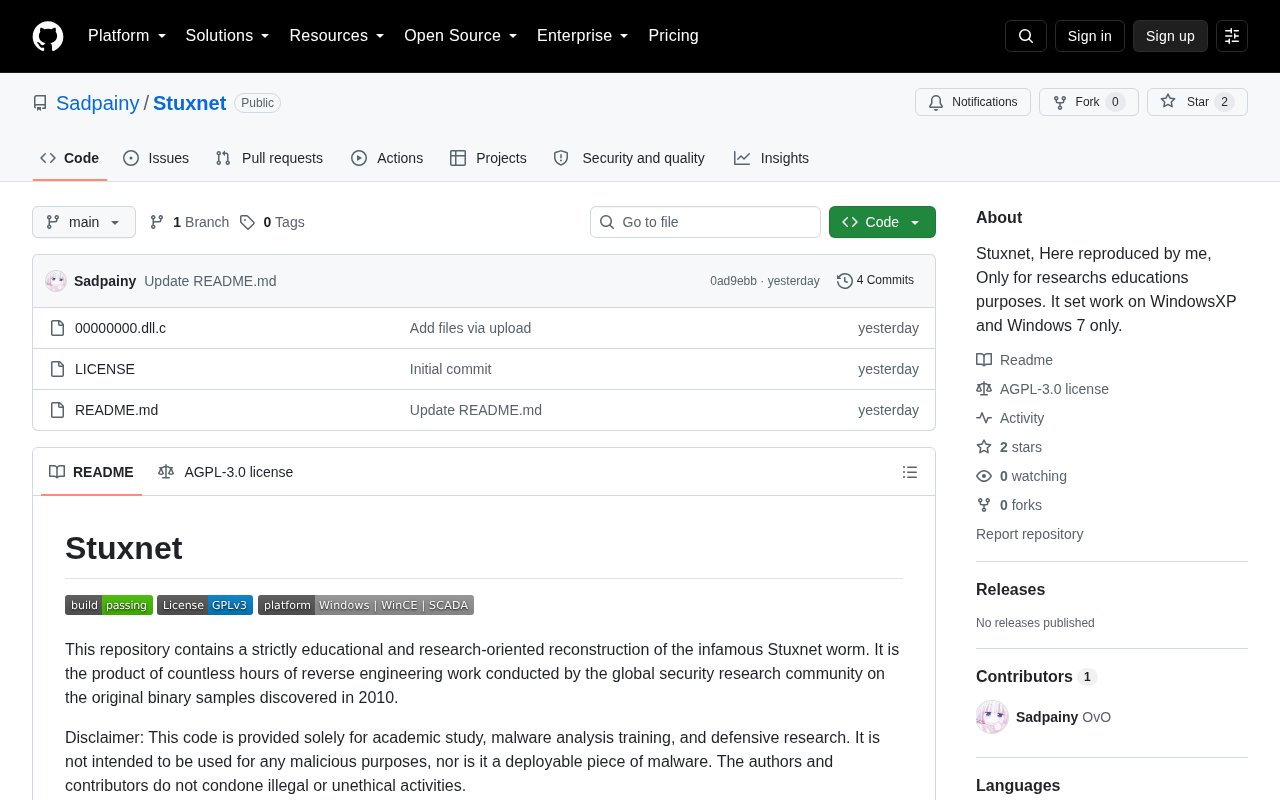
Stuxnet Source Code Reconstruction: Dissecting the Attack Chain of History's Most Complex Cyber Weapon
In-depth analysis of the Stuxnet source code reconstruction open-source project, examining how this cyber weapon targeting Iranian nuclear facilities exploited four zero-day vulnerabilities, stole digital certificates, covertly manipulated PLC centrifuges, and exploring industrial security lessons and ethical controversies of open-source reconstruction.
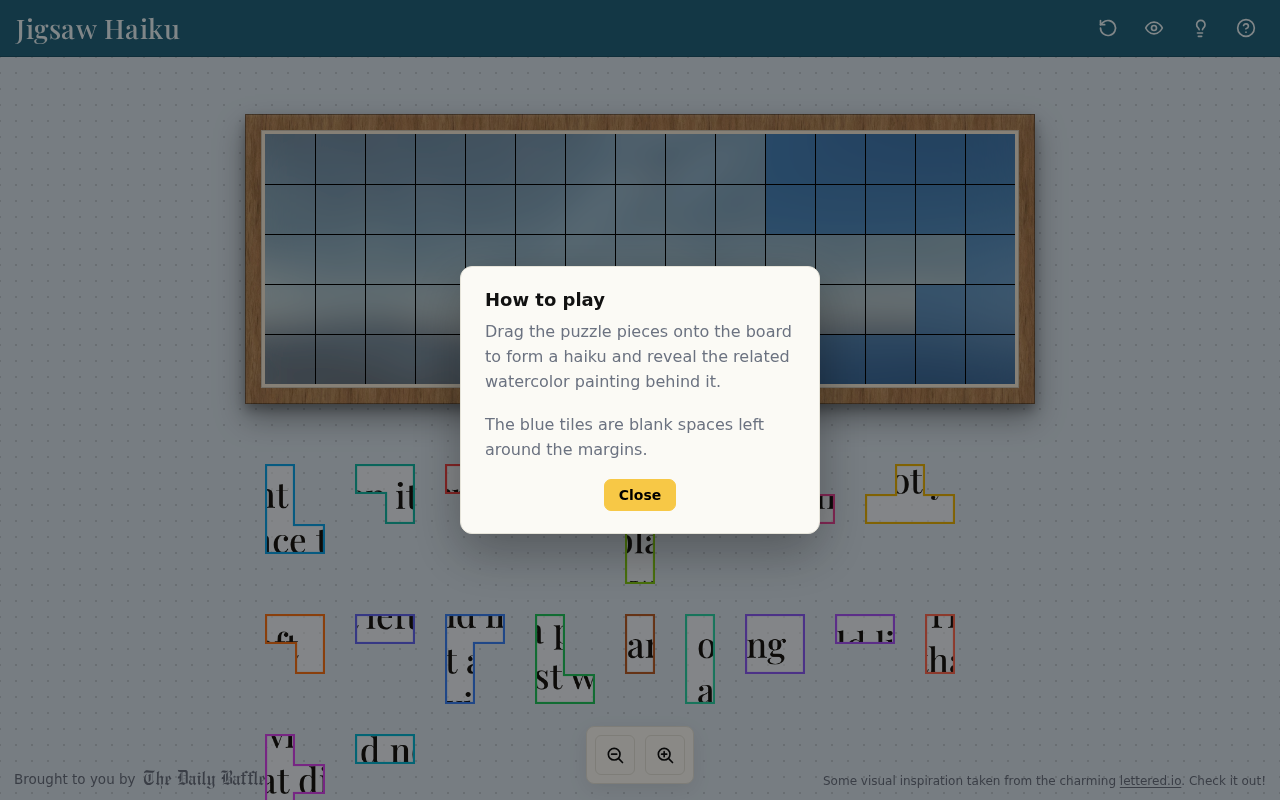
Minimalist Aesthetic Puzzle Game Development: Insights from Independent Creation
An in-depth analysis of an independent developer's aesthetic puzzle project shared on Hacker News, exploring minimalist design philosophy, Show HN community culture, and aesthetics-first product thinking in independent development.