Trump Administration Backs OpenAI: Political Turning Point in New York Times Copyright Lawsuit
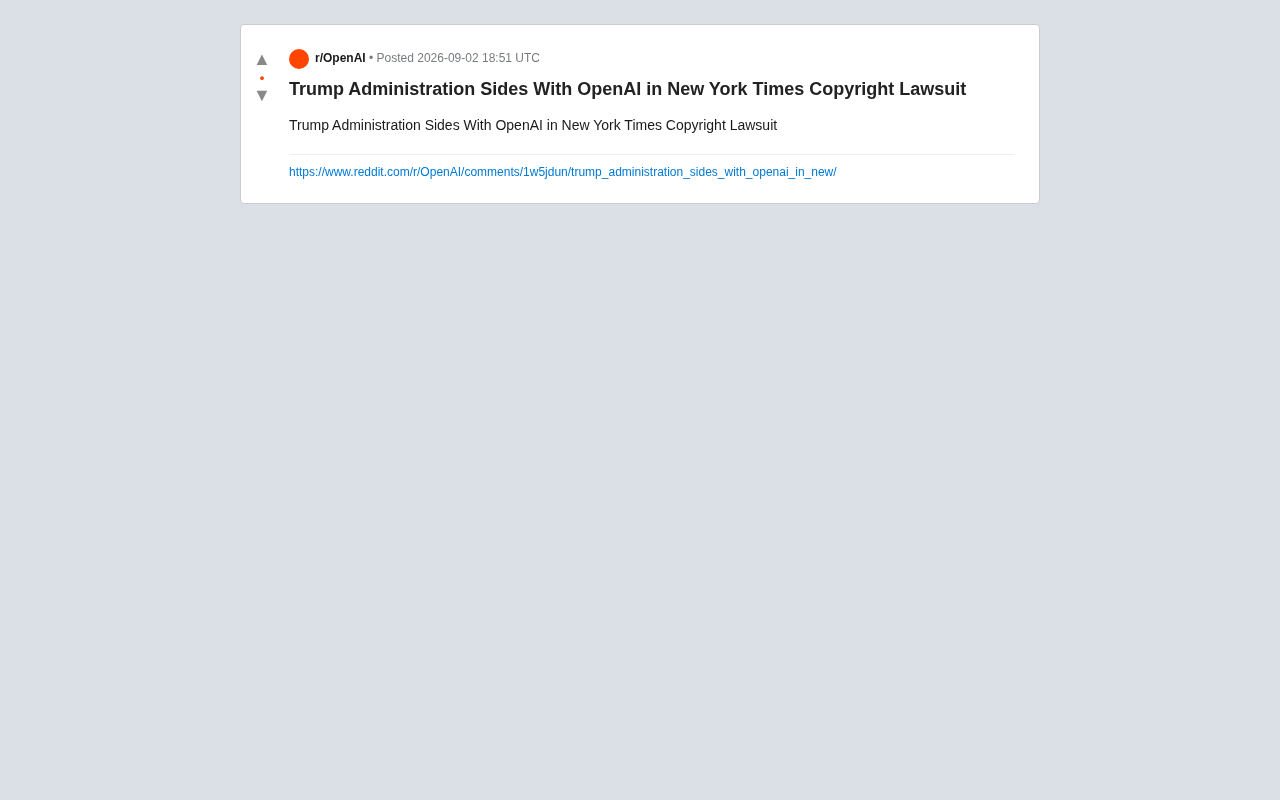
Trump administration backs OpenAI in NYT copyright suit, signaling pro-AI industry stance on training data fair use.
The Trump administration has sided with OpenAI in the landmark New York Times copyright lawsuit, supporting the fair use argument for AI training data. This political intervention reflects the U.S. push to maintain AI competitiveness amid global rivalry, particularly with China, while raising concerns about content creators losing compensation as AI companies freely use their work.
Overview
According to recent reports circulating on Reddit, the Trump administration has chosen to side with OpenAI in the New York Times copyright lawsuit against the company. This development injects a new political variable into what was already a high-profile AI copyright legal battle, and signals a clearer stance from the executive branch on the legitimacy of generative AI training data.
The copyright lawsuit between the New York Times and OpenAI is one of the most emblematic legal conflicts in the AI industry today. At the heart of the dispute is whether OpenAI used vast amounts of the New York Times' copyrighted content without authorization to train its GPT series of large language models, and whether such use constitutes "fair use" under U.S. copyright law. The executive branch's intervention will undoubtedly have a profound impact on the case's trajectory.
Case Background: Where Did the AI Training Data Copyright Dispute Originate?
The New York Times officially sued OpenAI and its major investor Microsoft in late 2023, alleging that they scraped and used millions of newspaper articles to train products like ChatGPT without permission. The plaintiff argues that this behavior not only infringes on copyright but could directly undermine the business model of news organizations — when users can obtain news content summaries or near-verbatim reproductions through AI, media subscription and advertising revenue will suffer.
OpenAI has consistently maintained that its model training falls within the scope of "fair use." The company argues that learning language patterns from publicly available internet data is not fundamentally different from a human reading books and newspapers before creating their own work, constituting "transformative use."
Understanding the Legal Framework of "Fair Use"
To deeply understand the legal foundation of this lawsuit, we need to return to the "fair use" doctrine established in Section 107 of the U.S. Copyright Act. This is one of the most important exception clauses in the copyright system. When determining whether something constitutes fair use, courts must weigh four factors: first, the purpose and character of the use, including whether it is commercial or nonprofit educational; second, the nature of the copyrighted work; third, the amount and substantiality of the portion used in relation to the copyrighted work as a whole; fourth, the effect of the use upon the potential market for or value of the copyrighted work. Among these, the concept of "transformative use" has become increasingly important in recent case law — if a new work adds new meaning, information, or expression to the original rather than simply substituting for it, it is more likely to be deemed fair use. Notably, in 2023, the U.S. Supreme Court tightened the standard for transformative use in Andy Warhol Foundation v. Goldsmith, a precedent that has directly impacted the fair use debate around AI training data, creating greater legal uncertainty for OpenAI's defense.
The Technical Reality of LLM Training Data
From a technical perspective, training large language models requires massive amounts of text data. Taking the GPT series as an example, its training corpus encompasses sources ranging from public web pages, books, and academic papers to news articles, typically amounting to trillions of tokens (the smallest units of text processing). Training datasets used by OpenAI include Common Crawl (a dataset from a nonprofit project that periodically crawls publicly accessible internet pages), WebText2, Books1, Books2, and others. During training, the model does not "store" raw text but rather extracts language patterns and knowledge representations through statistical learning, encoding information into billions of parameter weights. However, research has demonstrated that large language models can, under certain conditions, nearly verbatim "recall" content from their training data — a phenomenon known as "memorization." This is one of the plaintiff's key arguments in the copyright lawsuit — the New York Times included examples in its complaint showing that ChatGPT could output lengthy passages of text highly similar to its original reporting.
This lawsuit is therefore seen as a watershed case that will define the future relationship between the AI industry and content creators.
Why the Executive Branch's Stance Matters
Although copyright lawsuits are ultimately decided by courts, the U.S. government can express its position through mechanisms such as filing amicus curiae briefs ("friend of the court" briefs), influencing how judges interpret legal provisions. Amicus briefs are a unique feature of the American judicial system: non-parties to a lawsuit — including government agencies, industry associations, nonprofit organizations, academic institutions, and even individuals — can submit written opinions to the court, providing additional perspectives and expert analysis on the legal issues involved. While amicus briefs are not legally binding, in practice, especially when submitted by the federal government (through the Solicitor General's office in the Department of Justice), their influence is often quite significant. Research shows that the Supreme Court's adoption rate of amicus briefs submitted by the federal government is far higher than those from other parties. Through this mechanism, the executive branch is essentially leveraging its policy authority to guide the judiciary's interpretation of legal provisions.
The Trump administration's choice to support OpenAI may signal a preference for prioritizing the competitiveness and innovation speed of America's AI industry.
The Intersection of Political Maneuvering and Industrial Competition
The Trump administration's stance must be understood within the broader context of U.S. AI policy competition. In recent years, regardless of which administration is in power, AI has been viewed as central to national technological competitiveness. In the AI race with other countries, relaxing legal restrictions on training data helps domestic companies iterate on models faster and seize the technological high ground.
The Geopolitical Dimension of U.S.-China AI Competition
The U.S. government's protective stance toward the AI industry is inextricably linked to the intense competition with China in the field of artificial intelligence. China continues to close the gap on metrics such as AI R&D investment, patent counts, and academic publications, while facing relatively fewer legal restrictions on data access. The release of several notable Chinese large language models in 2024 (such as DeepSeekAd and Qwen), which performed impressively in international benchmarks, has further intensified the sense of urgency among U.S. policymakers. In this context, imposing overly strict copyright restrictions on AI training data within the United States could be seen as a self-handicapping move. Meanwhile, the European Union, through its AI Act and the Digital Single Market Copyright Directive, has provided conditional text and data mining exceptions for AI training while attaching an "opt-out" mechanism for content owners, offering a middle path between full openness and strict restriction that serves as a reference point for legislative exploration worldwide.
From this perspective, supporting OpenAI's position is not entirely about favoring one particular company but more likely reflects an industrial protection logic: if the copyright lawsuit establishes strict limitations on AI training data, the development costs for American AI companies would rise dramatically, potentially forcing them to pay hefty licensing fees to content owners, putting them at a competitive disadvantage globally.
Potential Impact on Content Creators
However, this stance has also raised concerns within the media industry and the creator community. If both the executive and judicial branches ultimately lean toward a broad interpretation of "fair use," news organizations, writers, artists, and other content producers will find it difficult to receive fair compensation for AI companies' use of their work. This could further exacerbate the already challenging survival environment for traditional media, creating an imbalanced landscape where "AI companies get content for free while content creators have no recourse."
What This Lawsuit Means for the AI Industry
Regardless of the outcome, the New York Times v. OpenAI case will become a landmark precedent in AI copyright law. The principles it establishes will directly affect virtually all generative AI products that rely on large-scale data training, spanning text generation, image generation, code generation, music generation, and other sub-fields.
For AI companies, a favorable ruling means they can continue to acquire training data at relatively low cost; an unfavorable ruling could give rise to an entirely new data licensing market, forcing the industry to establish paid licensing mechanisms similar to those in the music copyright ecosystem.
Industry Precedents and the Future Landscape of Data Licensing Markets
The music industry's copyright battles during the digital revolution provide an important reference for the AI training data dispute. From the late 20th to early 21st century, the rise of P2P file-sharing platforms like Napster severely impacted record industry revenues. After years of legal battles and industry restructuring, the result was the emergence of the streaming paid-licensing model represented by Spotify and Apple Music, as well as the modernized operations of collective rights management organizations like ASCAP and BMI. In the AI space, some content owners have already begun exploring similar paths: media groups such as the Associated Press and Axel Springer have reached content licensing agreements with OpenAI; platforms like Reddit and Shutterstock have also begun treating data licensing as a new business model. If the court ultimately rules that AI training does not constitute fair use, it could accelerate the scaling of this data licensing market, establishing an entirely new value distribution mechanism within the AI industry chain.
Future Developments Worth Watching
As a note, this story originated from Reddit community discussions, and the specific details of official documents and legal proceedings still need to be confirmed through authoritative channels. Readers should follow official reports from the U.S. court system and mainstream media for more accurate information.
Looking ahead, the final ruling in this lawsuit may take several years, with multiple rounds of appeals potentially along the way. The executive branch's stance, judicial precedent, industry self-regulation, and possible new legislation will collectively shape the new order of content copyright in the generative AI era. For practitioners and observers following the AI industry, this is undoubtedly a contest worth tracking closely.
Summary
The Trump administration's decision to side with OpenAI in the New York Times v. OpenAI case reflects the difficult balance the United States faces between AI industrial competition and content copyright protection. This is both a legal battle and a policy decision with implications for national technology strategy. Finding a balance between innovation-driven development and copyright protection that serves both AI advancement and creators' rights will be a long-term challenge for the entire industry and society.
Key Takeaways
Related articles

Workbuddy for Absolute Beginners: How a Desktop AI Agent Fits Into Real Workflows
A beginner's guide to the Workbuddy desktop AI agent: installation, claiming credits, file management, and building automated workflows—compared with CodeX for fit and cost, helping professionals shift from AI question-askers to AI managers.

OpenAI's New Agent Stack: Computer Use, Decisions API, and Ultra-Fast Workflows
OpenAI Dev Day unveiled a new agent stack: Computer Use outperforms humans, Decisions API delivers ultra-low-latency classification via Luna, Agents API opens the same Computer Use capabilities, and GPT-6.1 Sol costs only one-seventh of Astra. Core updates, benchmark data, and developer insights.

Liang Wenfeng Open-Sources DeepInfo Inference Framework, Takes On U.S. Ban
DeepSeek open-sources its DeepInfo inference framework after its models, featuring GPU/CPU cross-pipelining, small-model prediction with large-model verification, and full Huawei Ascend and NVIDIA chip support—facing the U.S. federal ban head-on. This article analyzes its significance for AI deployment and open-source strategy.