Trump Proposes 'AI Force': Plans to Appoint an 'AI Czar' Spark Regulatory Debate

Trump proposes an 'AI czar' and 'AI force,' signaling a clear pro-acceleration stance on AI policy.
President Trump posted on Truth Social expressing his intention to appoint an "AI czar" to lead a new "AI force," pledging his administration would "never hinder" AI development in any way. The announcement lands as voices across the political spectrum and within the AI industry call for a slowdown, placing the White House firmly on the accelerationist side. While an "AI czar" typically denotes a senior official with cross-agency coordination powers, the specific functions, structure, and budget of the proposed "AI force" remain unclear. If realized, the plan could weaken current regulatory momentum and affect international AI governance coordination — but for now it remains a social media declaration with no formal executive order or legislation behind it.
Trump Proposes Forming an 'AI Force'
U.S. President Trump reportedly posted on his social media platform Truth Social expressing his desire to appoint an "AI czar" to lead a new "AI force." The announcement has drawn significant attention, arriving at a time when calls for AI regulation are growing louder.
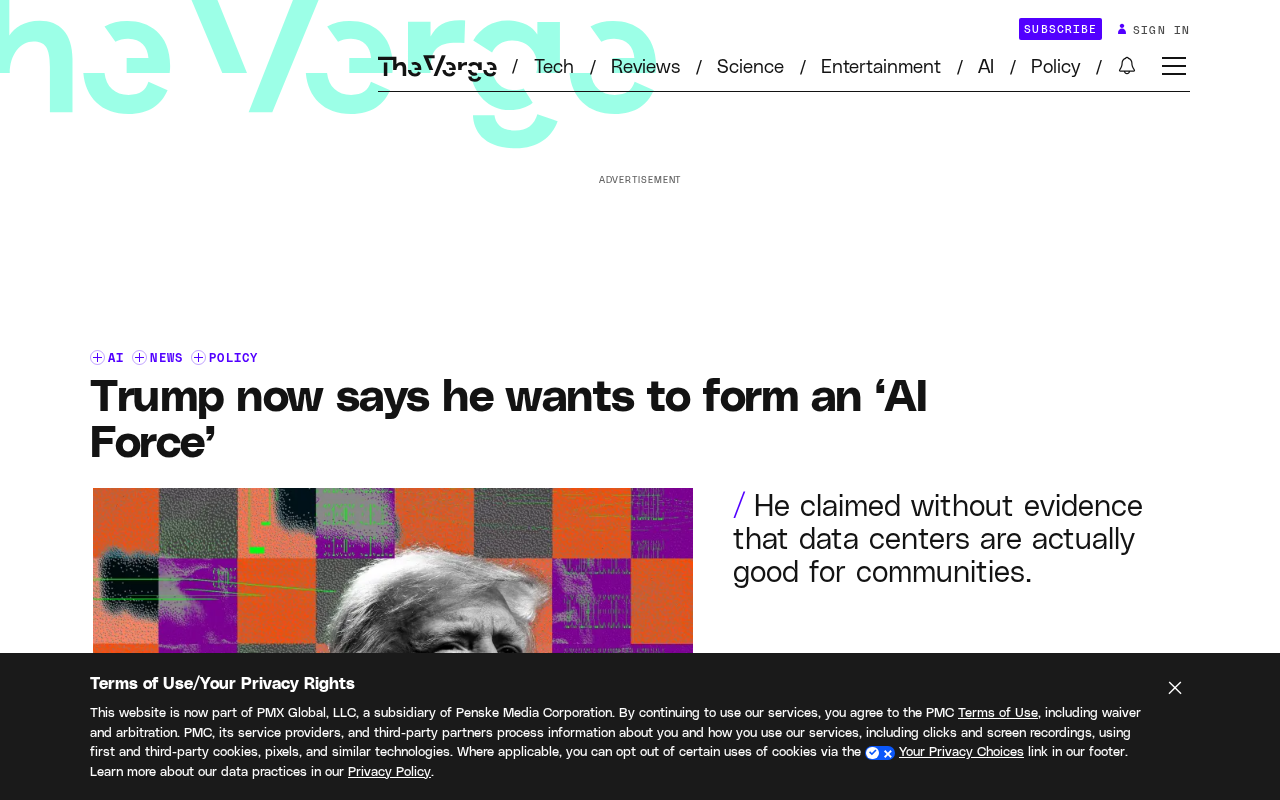
In the post, Trump emphasized that his administration would "never hinder" AI development "in any way." This stance signals that the White House favors a posture of acceleration rather than restriction in its approach to this rapidly evolving technology.
The Battle Between Accelerationists and Cautious Voices
Notably, Trump's announcement comes at a particularly significant moment — voices calling for the brakes to be applied are growing stronger from across the political spectrum and even from within the AI industry itself. A growing number of stakeholders are urging a slowdown in AI development, citing concerns around safety, employment, ethics, and the far-reaching impact on social structures.
Against this backdrop, the Trump administration's decision to establish a dedicated position and build a dedicated force to accelerate AI deployment effectively places the White House firmly in the "accelerationist" camp. This top-down push stands in sharp contrast to the more cautious approach advocated by some in the industry.
What Would an 'AI Czar' and an 'AI Force' Actually Mean?
In U.S. political parlance, a "czar" typically refers to a senior official granted cross-agency coordination authority to oversee policy in a specific domain. Appointing an "AI czar" would suggest the White House is looking to establish a centralized decision-making and coordination mechanism to unify federal AI strategy.
The concept of an "AI force," however, remains vague. Whether it would function as a policy coordination body, a technical research and development unit, or an organization with a national security mandate cannot be determined from the information currently available. Trump's post did not disclose specific organizational structures, budget figures, or functional boundaries.
Potential Policy Implications
If this proposal is realized, it could have profound implications for the direction of AI regulation in the United States. A top-level framework explicitly oriented around "not hindering development" could blunt the momentum behind current efforts to tighten oversight, providing tech companies with a more permissive environment for innovation.
At the same time, this could intensify debates over AI safety and governance. Globally, countries are sharply divided in their attitudes toward AI regulation. If the United States adopts an aggressively accelerationist strategy, it could disrupt the pace of international coordination on AI governance.
For now, this announcement remains a social media declaration and has not yet taken the form of a formal executive order or legislation. Its final shape, enforcement capacity, and whether it will be implemented at all remain to be seen.
From an international competition standpoint, the Trump administration's framing of AI as a strategic asset is closely tied to the broader context of U.S.-China tech rivalry. In recent years, the U.S. government has moved to restrict China's access to advanced AI chips and technology through export controls and the CHIPS Act. Within this framework, the "AI force" concept likely carries a dual character — accelerating civilian innovation while serving national security defense functions — rather than functioning purely as an industrial policy body. Meanwhile, the EU's AI Act formally took effect in 2024, representing a fundamentally different regulatory approach centered on risk tiering and compliance obligations. A U.S. move in the opposite direction could have significant implications for the compliance costs facing multinational AI companies and for America's influence in shaping international AI governance norms.
Background
Historically, the U.S. federal government has repeatedly turned to the "czar" model to address major policy challenges. The Bush administration created a "counterterrorism czar," the Obama administration appointed an "auto industry czar" and an "Ebola czar," and the Biden administration named a "vaccine czar" during the COVID-19 pandemic. These positions typically report directly to the president and are granted coordination authority that bypasses normal bureaucratic layers — though their actual power depends heavily on the president's political will and the willingness of other agencies to cooperate.
Past cases show that the effectiveness of "czar" positions has been highly uneven. Blurry authority boundaries and overlap with existing departmental responsibilities have frequently been practical obstacles to their effectiveness. In the AI domain, the White House Office of Science and Technology Policy (OSTP) already performs some related coordination functions. For a new "AI czar" to avoid duplicating those efforts, a clearly defined scope of authority will be essential.
Related articles

Andrew Ng Teams Up with Anthropic: A Complete Walkthrough of the Claude Code Hands-On Tutorial
Andrew Ng and Anthropic launch a Claude Code short course covering clear context, parallel sessions, MCP servers, and three hands-on projects: a RAG chatbot, Jupyter data analysis, and Figma-to-frontend.

Only Three Agent Recommendations for Beginners: ZeroStack, Claude Code, and DeepSeek Harness
Bilibili creator recommends three beginner Agents: ZeroStack for lightweight devices, Claude Code with a mature ecosystem, and DeepSeek Harness for easy plugin integration. This article outlines use cases and practical tips for each tool.

How Does an AI Agent Control Your Computer? A Full Breakdown of Hermes' Three-Layer Toolchain
Bilibili creator Xiaoyou breaks down Hermes' three-layer toolchain for operating a computer: the built-in Terminal, file modification, and code execution foundation; optional web search, vision analysis, speech synthesis, and browser/desktop control; and an external ecosystem freely extended via CLI and MCP—plus why SSH connects but still can't operate.