Trump Rally Remarks Spark Controversy: Claims He Made Google 'Kiss His Ass'

Trump claimed at a rally that his second term is stronger and that Google "kisses his ass," sparking heated tech-world debate.
The article reports that Trump, at a Kentucky rally, reviewed his second-term "achievements," citing the renaming of the Gulf of Mexico and Lake Ontario as displays of influence and claiming Google and other tech giants now treat him with deference. It traces the Trump-Google history: first-term criticism of search bias and regulatory threats, with current remarks likely political rhetoric. Analysts note tech companies avoid open confrontation with politicians, yet antitrust and content moderation pressures persist. Such remarks aim to consolidate core voters and signal he has "tamed Silicon Valley," with limited policy impact. Google has not responded, and tech policy is expected to become a midterm election focus.
At a rally in Highland Heights, Kentucky, Donald Trump reviewed the "achievements" of his second term and claimed he holds more power than during his first. He specifically cited his decision to rename the Gulf of Mexico and Lake Ontario as evidence of his influence. More notably, he declared that tech giant Google "kisses his ass." The remarks quickly ignited discussion across social media and the tech world, once again spotlighting the delicate and complex relationship between political figures and technology platforms.
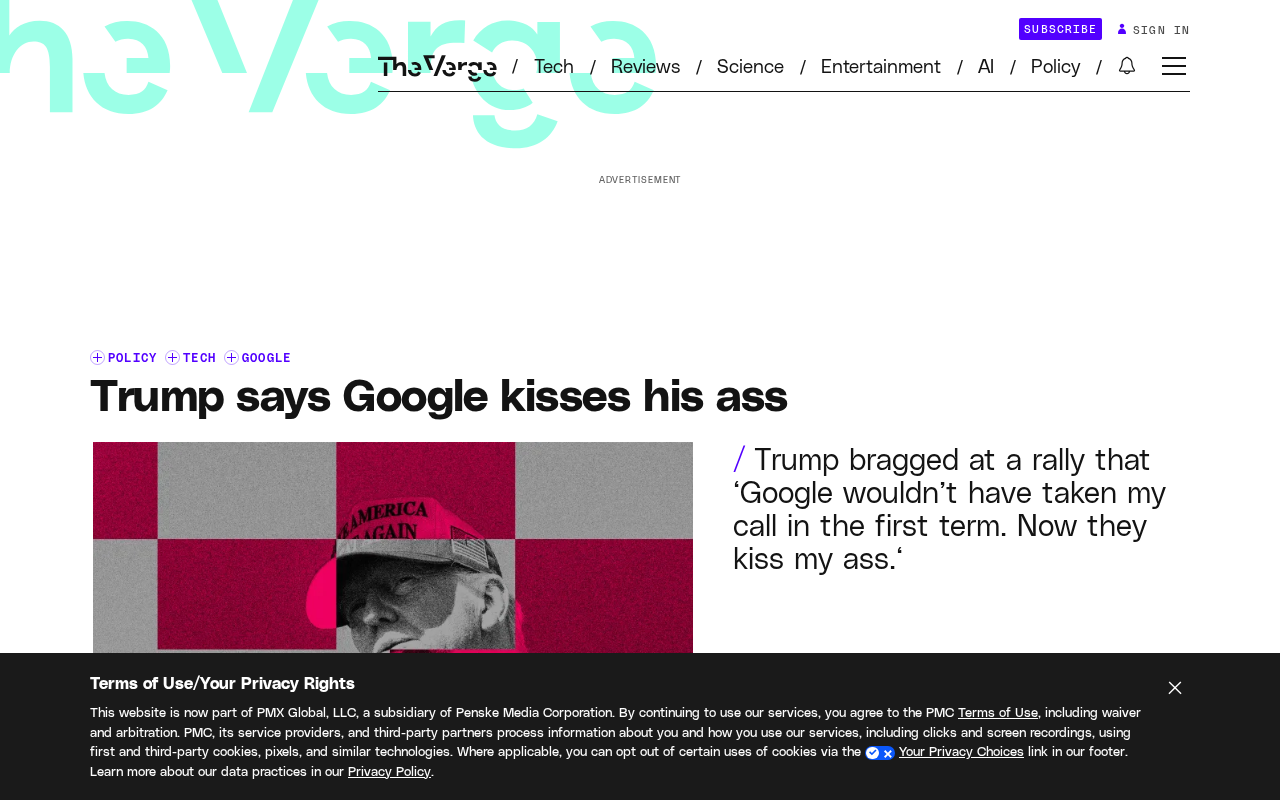
Trump's "Influence" Narrative: From Geographic Renaming to Tech Giants
At the rally, Trump listed a series of actions to prove the "strength" of his second term. Beyond familiar topics like withdrawing from international agreements and adjusting trade policy, he made a point of mentioning his decision to rename the Gulf of Mexico and Lake Ontario. Although the practical details and impact of these naming changes remain unclear, Trump framed them as symbols of his personal authority.
He then shifted to the tech industry, claiming that companies like Google now treat him with deference. While he offered no specific examples, the statement continued his signature narrative style: casting himself as a strong leader capable of "taming" Silicon Valley. Analysts note that such rhetoric is designed to shore up his base while applying pressure on the tech industry.
The Gulf of Mexico is an Atlantic gulf in southern North America, bordered by the United States, Mexico, and Cuba; its name has long been used by bodies such as the International Hydrographic Organization. A U.S. president's unilateral "renaming" of international waters has no legal effect—actual name changes typically require congressional legislation or a procedure through the U.S. Board on Geographic Names (BGN). Lake Ontario is one of North America's Great Lakes, situated on the U.S.-Canada border; its name derives from Iroquois and any renaming would involve Canadian sovereignty and bilateral agreements. Trump's treatment of such naming as a symbol of authority is more of a symbolic political gesture than an enforceable policy change.
The Political Predicament of Tech Giants: The History Between Google and Trump
Trump's relationship with Google has not always been this "harmonious." During and after his first term, he repeatedly criticized Google Search for allegedly favoring negative news coverage and even threatened regulatory action. Google has denied any political bias. Trump's claim that Google "kisses his ass" may suggest a thaw in relations—or may simply be one-sided propaganda.
Interestingly, tech companies typically avoid open confrontation with political figures, especially amid increasingly strict antitrust scrutiny and content regulation. Executives from Google's parent company Alphabet have met with Trump, though the specifics of those conversations were not made public. This ambiguous stance may have given Trump room to "show off."
"Kiss his ass" is a vulgar English slang expression meaning to submit obsequiously or flatter excessively, carrying strong connotations of disparagement and provocation. Using such coarse language at a political rally is a hallmark rhetorical strategy Trump employs to mobilize supporters: breaking conventional decorum to reinforce an "anti-establishment" image. The phrase is not a literal accusation that Google has taken specific actions, but rather conveys a narrative of power relations—that tech giants yield under pressure. Media outlets typically retain the original phrase in quotation marks when reporting it, to highlight its inflammatory nature.
The Political Calculation Behind the Remarks
By emphasizing at the rally that his "second term is stronger" and naming Google, Trump clearly intended to send a signal: he can not only exert influence in the political arena but also make tech giants submit. This narrative appeals to his core voters because it caters to "anti-elite" and "America First" sentiments.
Yet from a practical policy standpoint, the relationship between the Trump administration and the tech industry remains tense. Despite his claims that Google has softened, antitrust investigations and content moderation controversies targeting Big Tech have not ceased. His remarks are therefore more political rhetoric than factual statement.
An antitrust investigation is a legal proceeding initiated by regulators against suspected monopolistic conduct (such as abuse of market dominance or exclusive agreements). The U.S. Department of Justice and the Federal Trade Commission have brought multiple antitrust lawsuits against major tech companies including Google and Meta, with the Google Search case drawing particular attention. Such investigations, together with content moderation controversies (i.e., whether platforms' editing, removal, or throttling of user content is fair), constitute the core regulatory pressure facing tech giants. Understanding this context helps clarify that there is no direct causal link between Trump's claim that "Google has caved" and the ongoing legal proceedings—it is largely political packaging.
Industry Reaction and Future Outlook
As of publication, Google had not responded to Trump's remarks. Tech industry observers believe such statements may heighten public speculation about tech companies' political leanings but are unlikely to change the actual regulatory environment. With the 2026 midterm elections approaching, tech policy is expected to become one of the focal points of partisan debate.
For tech companies, maintaining neutrality under political pressure while preserving user trust will remain an ongoing challenge. Trump's rally remarks may be just an interlude, but they reflect the awkward position of tech giants caught in the political whirlwind.
One-line Summary
Trump claimed at a rally that his second term is stronger and that Google "kisses his ass," sparking heated discussion in the tech world.
Paragraph Summary
The article reports that Trump, at a Kentucky rally, reviewed his second-term "achievements," citing the renaming of the Gulf of Mexico and Lake Ontario as displays of influence and claiming that tech giants like Google now treat him with deference. It traces the history between Trump and Google: during his first term he criticized search bias and threatened regulation, and his current remarks may be political rhetoric. Analysts note that tech companies typically avoid openly confronting political figures, yet antitrust and content moderation pressures persist. Such remarks aim to consolidate his core voters and signal that he has "tamed Silicon Valley," with limited impact on actual policy. Google has not yet responded, and tech policy is expected to become a focus of the midterm elections.
Related articles

Big Tech AI Engineering Interview: Full-Chain Observability from Frontend Monitoring to Agents
From PerformanceObserver metrics collection and onerror/unhandledrejection exception capture, to RAG pipeline reranking and context compression for token cost control, to designing a full-site AI full-chain observability system benchmarked against LangSmith and Sentry—breaking down the three progressive layers of big tech AI engineering interviews.

WorkBuddy Step-by-Step Guide: Build Your Own AI Agent Work Assistant
WorkBuddy step-by-step guide: starting from the limits of chat models like Doubao, learn to build your own AI Agent work assistant for batch local file processing and automation—no programming required.

Building a Local Knowledge Base with LangChain-Chatchat + DeepSeek on Windows
This article, based on a Bilibili tutorial, details the full workflow of building a local knowledge base on Windows using LangChain-Chatchat and DeepSeek, including Anaconda environment setup, Ollama model management, mirror acceleration, and common error solutions, helping you quickly implement RAG Q&A.