Trump Suggests Tim Cook Take Over Nvidia as Jensen Huang's Resignation Sparks CEO Speculation

Huang resigns amid scandal, Nvidia led temporarily by CFO, Trump suggests Tim Cook as successor.
Nvidia CEO Jensen Huang suddenly resigned amid reports of multiple extramarital affairs, one involving an individual alleged to be a Chinese spy, and the company is temporarily led by its CFO. President Trump publicly suggested former Apple CEO Tim Cook take over, though analysts question the fit given Nvidia's deep technical needs. The successor faces AI chip leadership, export controls, and team stability challenges.
Nvidia CEO Jensen Huang abruptly announced his resignation this morning, following reports that he was involved in multiple extramarital affairs, one of which involved an individual alleged to be a Chinese spy. The company is currently being temporarily led by the CFO, and US President Trump has already publicly weighed in on a successor—he strongly recommended former Apple CEO Tim Cook to head the chip giant.
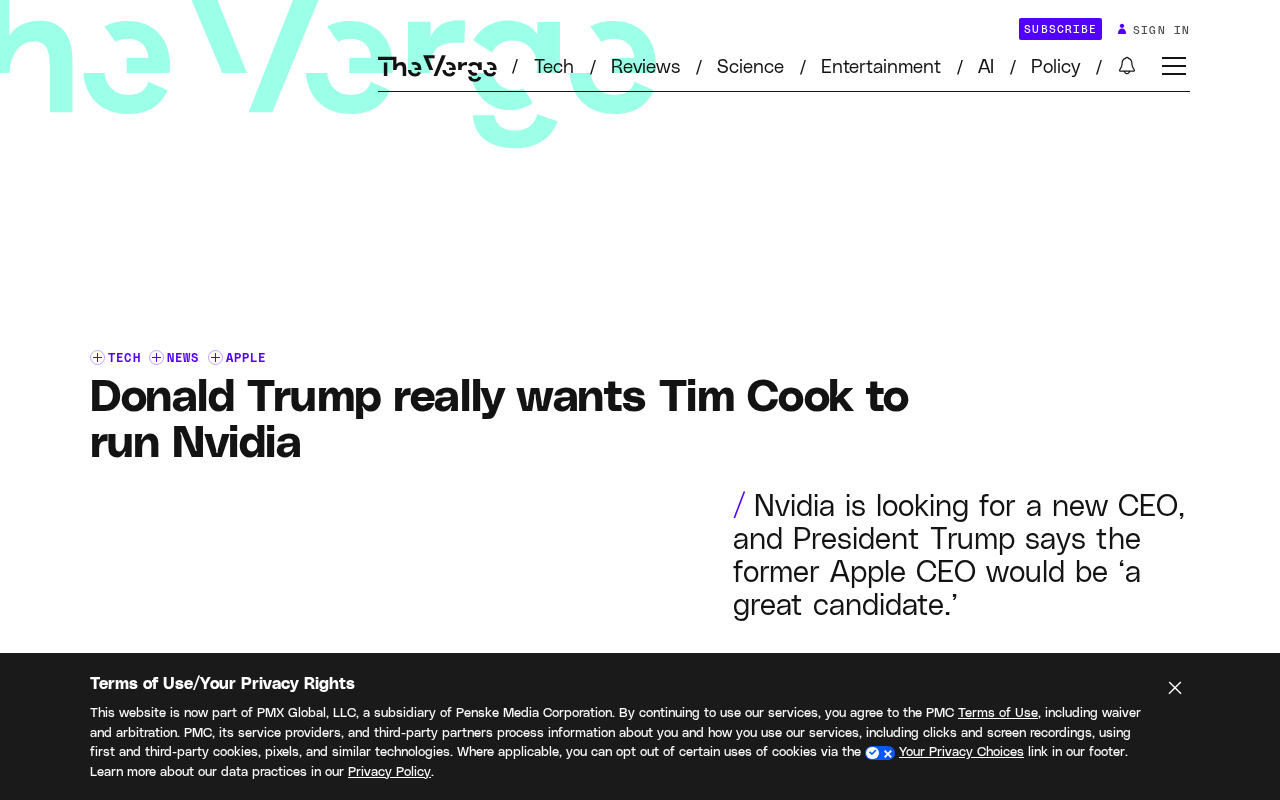
Jensen Huang's Resignation and Nvidia's Interim Arrangement
According to the original report, Huang's resignation is directly related to personal life scandals. The report mentions involvement in multiple extramarital affairs, with one of the individuals alleged to be a "Chinese spy." This allegation has not been independently confirmed, but it has been enough to trigger a corporate governance earthquake. Nvidia is currently led on an interim basis by the CFO, meaning the company has not yet determined a formal successor, and the transition period could last weeks or longer.
For a semiconductor company with an extremely high market valuation, the sudden departure of its CEO amid security-sensitive allegations will undoubtedly draw attention from both investors and regulators. Having the CFO take over temporarily is a common contingency arrangement, but CFOs typically lack decision-making experience in technology strategy and product roadmaps, so it is not an ideal long-term solution.
CFO interim takeover is a common contingency mechanism for public companies when a CEO suddenly departs. Chief financial officers are usually familiar with a company's financial condition, internal controls, and investor relations, and can ensure short-term operational compliance and continuity in information disclosure. However, the CFO's focus is on finance and risk management rather than technology roadmaps or product strategy, so this arrangement is generally positioned as a transitional solution, and boards typically begin the formal successor selection process within weeks to months. The US Securities and Exchange Commission (SEC) has disclosure requirements for executive changes, and public companies must promptly report CEO departures and transition arrangements on Form 8-K, which is one reason such events often become public quickly.
Why Trump Named Tim Cook
US President Trump said publicly that he believes former Apple CEO Tim Cook is a suitable choice to lead Nvidia. This statement carries an obvious personal preference—Trump had multiple interactions with Tim Cook during Cook's tenure at Apple, including policy lobbying and manufacturing reshoring issues. Trump may value Cook's experience in supply chain management, global operations, and brand building.
However, Tim Cook has already left the Apple CEO role, and whether he is willing to return to the front lines of a tech company—especially in the highly technology-driven semiconductor field—remains unknown. Nvidia's core business revolves around GPU architecture, AI computing platforms, and software ecosystems such as CUDA, fields that place extremely high demands on a leader's technological judgment. Cook's strengths lie in operations and commercialization, not chip design.
CUDA (Compute Unified Device Architecture) is a parallel computing platform and programming model launched by Nvidia in 2006 that allows developers to use GPUs for general-purpose computing. After nearly two decades of accumulation, CUDA has formed a vast developer ecosystem and software libraries such as cuDNN and TensorRT, becoming one of the de facto standards for AI training and inference. Its moat lies not only in the technology itself but also in migration costs—many deep learning frameworks and research codebases are optimized for CUDA. Therefore, part of the reason Nvidia's leader's technological judgment is so critical is the need to maintain the long-term evolution direction of this hardware-software collaborative ecosystem.
Challenges Facing the Successor
Whoever the final choice is, Nvidia's new CEO will need to address several key issues: maintaining leadership in the AI chip market, handling export control pressure brought by geopolitics, and stabilizing team confidence shaken by the founder's sudden departure. As a long-standing symbol of Nvidia, Jensen Huang's personal image is deeply tied to the company's brand, and a successor will need time to establish internal authority and external trust.
Trump's proposal is more of a political statement than a corporate governance decision. When selecting a CEO, Nvidia's board will most likely prioritize executives with deep semiconductor industry backgrounds rather than cross-industry outside hires. The mention of Tim Cook's name reflects heightened outside attention to Nvidia's future direction, but the actual likelihood of it happening should be questioned.
Export controls refer to a government restricting the export of specific goods, technologies, or software to specific countries or entities through regulations. In recent years, the US Department of Commerce's Bureau of Industry and Security (BIA) has repeatedly adjusted export rules for advanced semiconductors and AI chips, directly affecting some of Nvidia's high-end GPU products, which have had to launch compliant "downgraded" versions to maintain parts of the market. Geopolitical factors have therefore become a variable that cannot be ignored in Nvidia's strategic planning, and a successor will need to strike a balance between complying with regulations and maintaining global customer relationships.
Signals Behind the Event
This incident reflects two trends: first, the personal conduct risks of tech company CEOs are being scrutinized more strictly, especially when national security-sensitive areas are involved; second, political figures are increasingly willing to publicly intervene in personnel arrangements at tech giants. For Nvidia's customers and partners, short-term business continuity is ensured by the CFO, but uncertainty over long-term strategic direction requires continued observation.
(This article is based on a single-source report, and the relevant allegations and personnel change details have not yet been cross-verified by Nvidia officially or by independent sources.)
One-line Summary
Jensen Huang resigns amid scandal, Nvidia temporarily taken over by CFO, Trump suggests Tim Cook succeed him.
Paragraph Summary
The article reports that Nvidia CEO Jensen Huang suddenly resigned due to involvement in multiple extramarital affairs, one of which involved an individual alleged to be a Chinese spy, and the company is temporarily led by the CFO. US President Trump publicly suggested that former Apple CEO Tim Cook lead Nvidia, but the article argues that Cook's strengths in operations and commercialization are mismatched with the technological judgment Nvidia requires, and that the actual likelihood of this happening is doubtful. The successor will face challenges including maintaining leadership in AI chips, responding to export controls, and stabilizing team confidence. The article also notes that the incident reflects two trends: stricter scrutiny of tech CEOs' personal risks and growing willingness among political figures to intervene in personnel matters at tech giants, while emphasizing that the information is based on a single source and has not been cross-verified.
Related articles

Build Your Own Personal Assistant Agent or Buy Off-the-Shelf? A Developer's Practical Decision Guide
Starting from a real Reddit developer question, this analyzes the trade-offs between building a personal assistant agent and using off-the-shelf products: data sovereignty, model swappability, confirmation for high-risk operations, LangGraph selection and hosting options, with a phased decision framework.

Former OpenAI Researcher Finds Hidden Blackwell Signature in Open-Source Model
A former OpenAI researcher discovered a Blackwell signature in an open-weight model, sparking discussion on transparency, hardware binding, and portability of open-source models. This article analyzes possible sources, impact on the open-source ecosystem, and key points to watch.
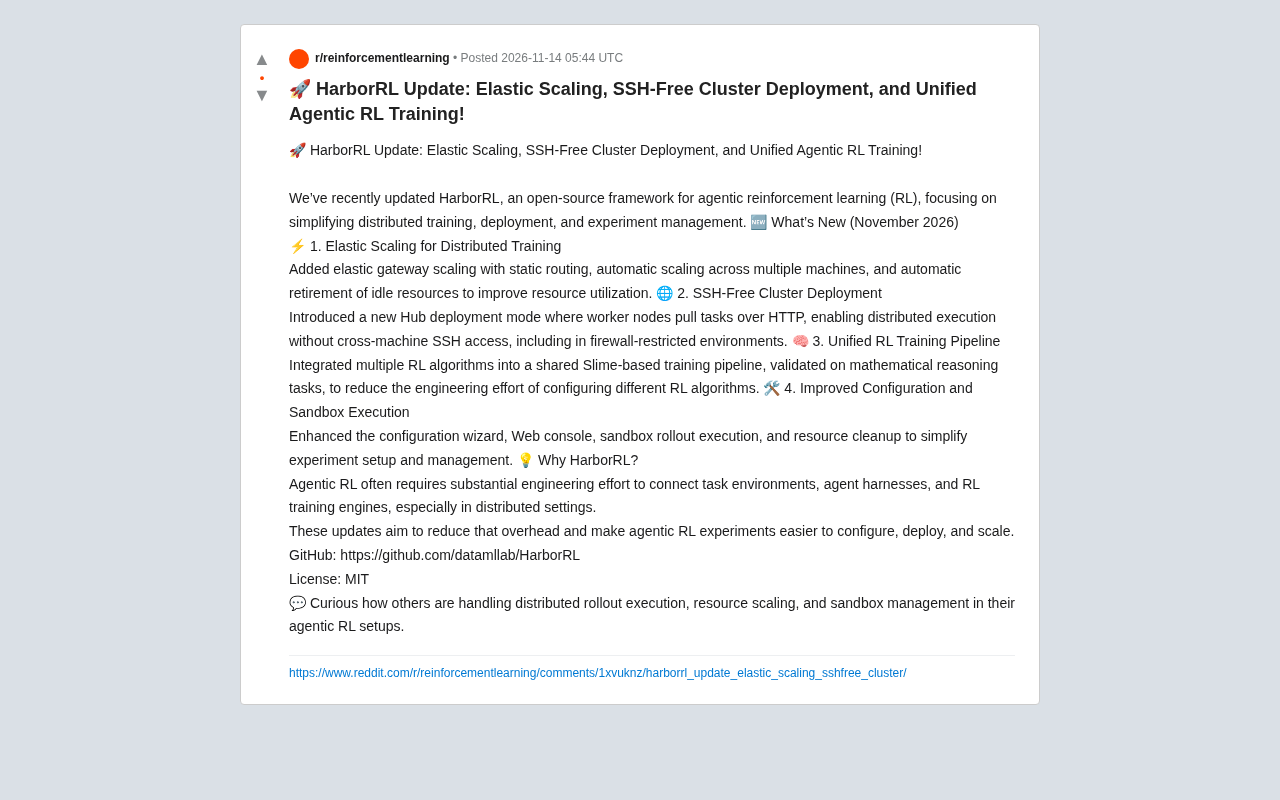
HarborRL Update: Elastic Scaling and SSH-Free Cluster Deployment
HarborRL, an open-source Agentic RL framework, releases an update: elastic gateway scaling with automatic idle resource reclamation, SSH-free cluster deployment via HTTP task pulling, a unified RL training pipeline based on Slime, and improvements to the configuration wizard and sandbox execution—lowering the engineering barrier for distributed agent reinforcement learning.