Trying Meta's AI Assistant: Cute, But Surprisingly Good at Spending Your Money

Meta's AI agent is charming and capable, but its seamless purchasing features raise real questions about convenience vs. manipulation.
Meta's AI assistant presents itself as a warm, capable helper for everyday tasks, using natural language to autonomously handle searches, bookings, and purchases. But this seamless "task completion" capability raises a core question: is it saving users effort, or nudging them toward spending? The personable, emotionally engaging design lowers psychological defenses and boosts retention — but for Meta, which depends on advertising and e-commerce, an agent that smoothly drives purchases has enormous commercial value. The article urges users to stay clear-headed and think critically about where "saving time" ends and "spending money" begins.
First Impressions of Meta's AI Agent
Meta's AI assistant presents itself with a warm, personable image — designed to become a helpful companion in users' everyday lives. The author of the original piece describes it with a touch of humor as a "cute little thing," only to quickly discover that what it does best, under the guise of "helping out," is spending your money.
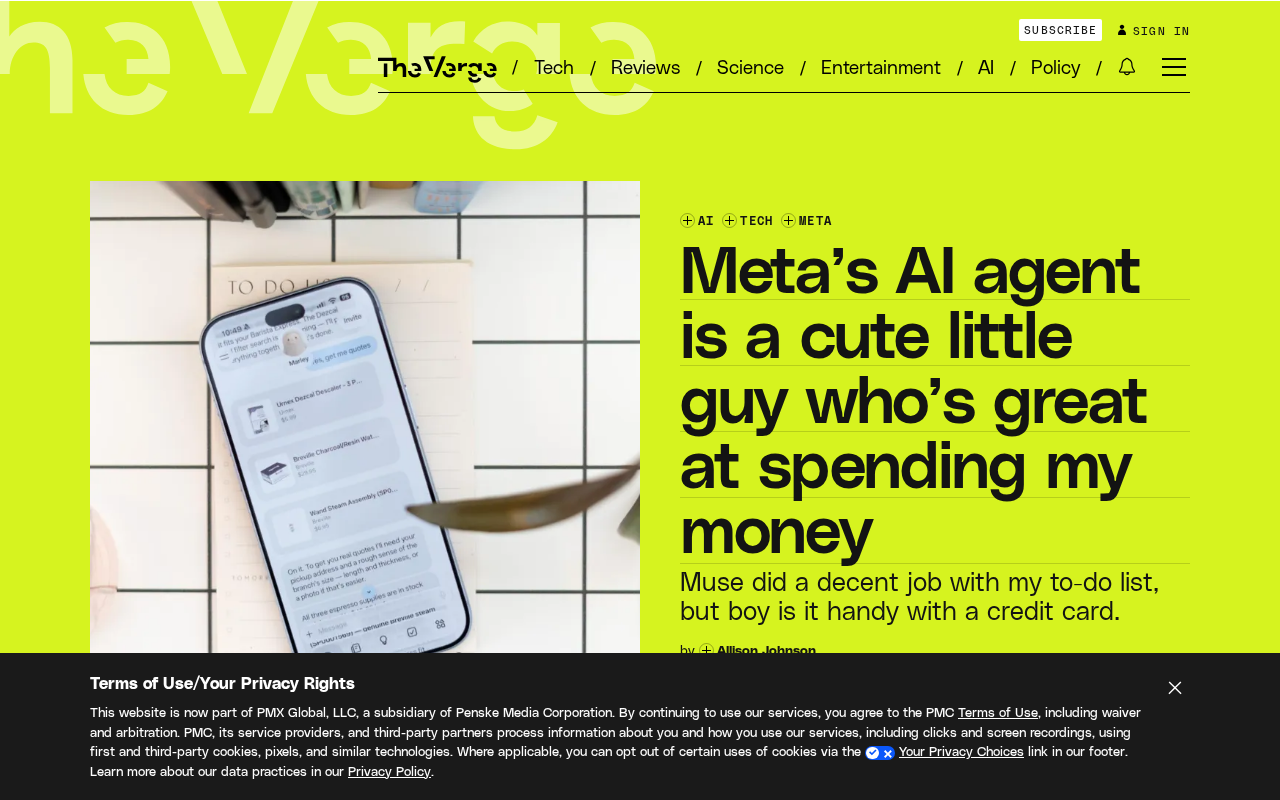
In modern life, to-do lists seem to generate themselves endlessly. The author sets the scene with a vivid example: you're minding your own business, doing absolutely nothing, when a branch falls in your backyard — and suddenly you have to figure out what to do about it. These kinds of trivial, unexpected, action-required moments are exactly the pain points AI agents claim to solve.
The Real Value — and Real Concerns — of AI Agents
From the core observations in the piece, Meta's AI assistant is clearly designed around the high-frequency need to "get things done." It understands natural language instructions and can proactively help with searches, bookings, and placing orders. But the title already signals the tension: when an AI assistant is "good at spending money," is it actually saving you effort — or quietly nudging you toward consumption?
This touches on a widespread debate in today's AI agent landscape. The more proactively and seamlessly an agent converts "intent" into "purchase behavior," the blurrier the line becomes between genuine convenience and subtle consumer manipulation. When dealing with a minor task — like clearing a fallen branch — becomes a few taps to book an on-demand service and pay for it, users get convenience, but also find themselves spending money almost without noticing.
The fundamental difference between an AI agent and an ordinary chatbot lies in autonomous action capability. A regular AI assistant answers questions or generates content. An agent, by contrast, can call external tools, access third-party services, and execute multi-step tasks on the user's behalf — including searching for price comparisons, filling out forms, and completing purchases. This closed-loop of "perceive → decide → act" transforms the agent from an advisor into an operator. Meta, Google, OpenAI, and others are all investing heavily in this direction, and the key competitive advantage is how many real-world service integrations an agent can access. When an agent is connected to e-commerce platforms, local service providers, and payment systems, every transaction it facilitates can generate platform revenue. The user's "convenient experience" and the platform's "commercial conversion" are by design highly aligned — and that structural overlap is the root of the controversy.
The Product Logic Behind the Cute, Personable Design
Wrapping an AI assistant in the image of a "cute little thing" is a deliberate product experience choice on Meta's part. A personable, approachable persona lowers the barrier to use and disarms users psychologically, making them more willing to trust and rely on it. This design strategy is becoming increasingly common in consumer AI products — emotionally engaging interactions significantly boost user retention.
But from a critical perspective, the more likable an AI assistant is, the easier it is for users to let their guard down. When "cute" and "good at spending money" come together, it's worth maintaining a degree of awareness about the product's commercial intentions. For a company that depends on advertising and e-commerce ecosystems, an agent that smoothly guides users toward purchases carries enormous business value in its own right.
In psychology, this kind of design is known as the Anthropomorphism Effect — humans are innately inclined to trust and form emotional bonds with things that exhibit human-like characteristics. Extensive user research shows that AI assistants with names, personalized tones, and even virtual avatars make users feel more "understood" than purely functional interfaces, which in turn reduces critical scrutiny of the assistant's suggestions. This effect is especially pronounced in consumer decision-making scenarios: when users perceive an AI as a "friend who has their best interests at heart" rather than a "sales tool," resistance to its recommendations drops dramatically. Meta (formerly Facebook) has accumulated vast data on emotional design and user behavior through its social products. Applying that methodology to AI agent products is a differentiating advantage over purely technical companies — and also one of the reasons outside observers remain cautious about its motives.
Something for Users to Reflect On
This hands-on review is relatively brief, yet it raises a question worth every AI agent user's consideration: how do you strike the right balance between convenience and spending? AI assistants can genuinely free us from the tedium of everyday tasks — but before handing over decision-making authority and payment capabilities, it's worth understanding where the boundaries of their "help" actually lie.
When choosing and using products like this, it's worth asking one extra question: is it saving me effort, or spending my money? The answer is rarely one or the other — it's usually both. Taking a clear-eyed view of what agents can and can't do is the only way to truly put technology in service of your life, rather than letting it lead you around by the nose.
Related articles

FlyEnv Plugin Review: Visually Running llama.cpp and Managing GGUF Models
FlyEnv launches the official llama.cpp plugin with side-by-side Metal runtime management, public GGUF repository indexing with file type labels, and visual configuration of context, threads, and GPU layers—saving templates and speculative decoding with each model for one-click local LLM inference.

How Can Frontend Developers Advance into AI Agent Development? Deconstructing System-Level Agent Architecture from OpenClaw
Starting from the OpenClaw demo in a Bilibili open class, this article breaks down the three-layer architecture and universal formula of system-level AI agents, and analyzes the path for frontend developers to enter agent development based on TypeScript, including plugin-based design and security/memory layer challenges, with an interview answer framework.

WorkBuddy in Action: How AI Agents Automate Batch File Conversion and Archiving
Bilibili creator Teacher Shanyao tests WorkBuddy vs. Doubao on batch file conversion, showing how AI Agents move from "giving solutions" to "direct execution," with a full workflow and credit cost reference.