Turkish Stuttering Stigma Detection: The StutterStigma-TR Dataset and a Target-Aware BERT Framework
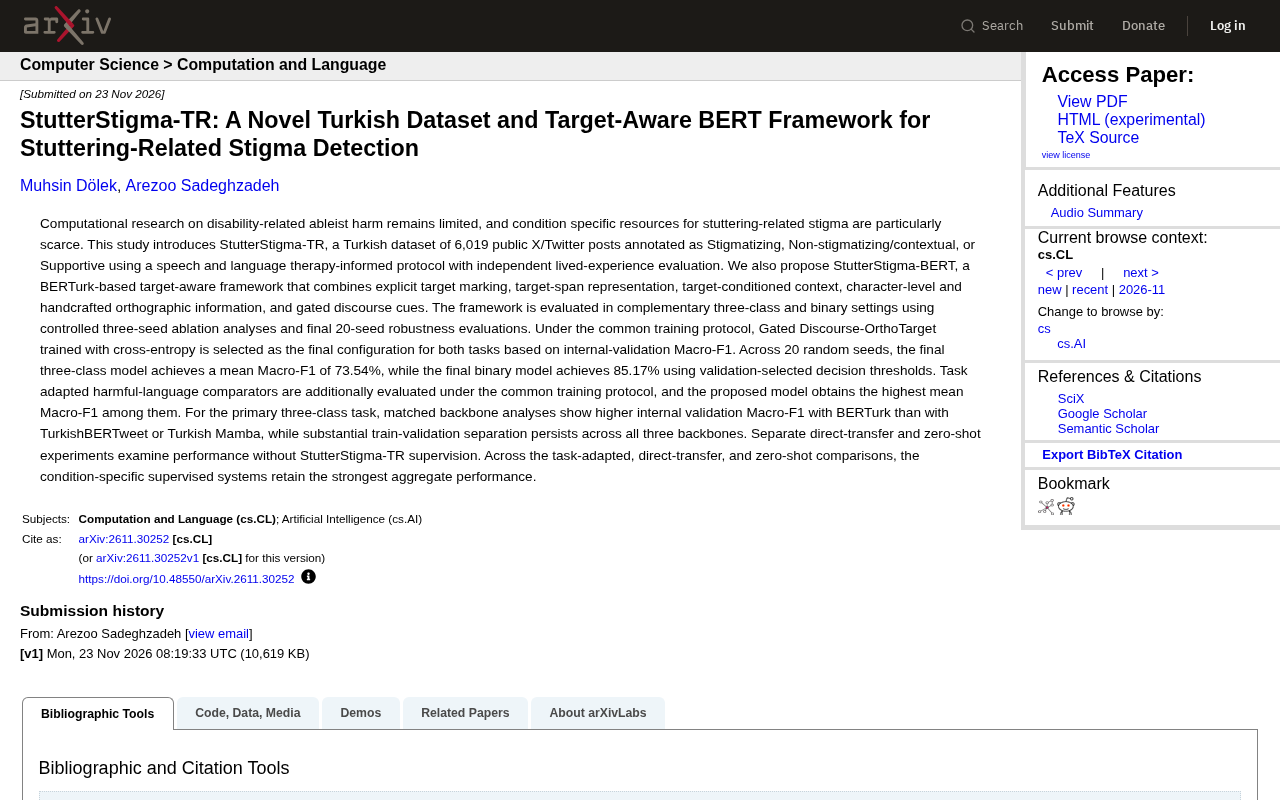
New study releases the Turkish stuttering stigma dataset StutterStigma-TR and the target-aware model StutterStigma-BERT.
Addressing the lack of disability-related discriminatory language research and dedicated stuttering stigma corpora, a new study releases StutterStigma-TR—6,019 Turkish X/Twitter posts annotated via a speech-therapy-informed protocol and lived-experience assessment into three classes. The BERTurk-based StutterStigma-BERT fuses target marking, span representations, conditioned context, character-level and orthogonal features, and gated discourse cues, reaching 73.54% (three-class) and 85.17% (binary) average Macro-F1 across 20 seeds.
Computational research on discriminatory language against disabilities has long been marginalized, and stigma related to stuttering in particular lacks dedicated corpus resources. A new study releases StutterStigma-TR—a dataset of 6,019 public Turkish X/Twitter posts—alongside the StutterStigma-BERT target-aware framework, which attempts to identify stuttering-related stigma through condition-specific supervised learning.
Why stuttering stigma detection deserves separate modeling
Ableist harm related to disabilities has seen limited study in computational linguistics, and as a specific condition, stuttering's expressions of stigma do not fully overlap with general hate speech. Posts may appear in the form of "support" or "contextualized mention," or may carry implicit derogatory meaning; the three-class setup is designed precisely to distinguish these subtle differences.
Data annotation employed a speech-therapy-informed protocol and incorporated independent lived-experience assessment, meaning labels rely not only on linguistic judgment but also on the actual perceptions of people who stutter. This approach is uncommon in disability-related NLP resources and enhances the dataset's ecological validity.
Macro-F1 is a commonly used aggregate metric in classification tasks: first compute the F1 score for each class (the harmonic mean of precision and recall), then take an unweighted average across classes. Unlike micro-F1, Macro-F1 gives each class equal weight, so poor performance on minority classes significantly lowers the overall score. In an imbalanced three-class task like stuttering stigma detection, Macro-F1 reveals whether a model has truly learned to distinguish the three categories—"stigmatizing," "non-stigmatizing or contextualized," and "supportive"—rather than boosting accuracy by merely predicting the majority class. The reported average Macro-F1 of 73.54% (three-class) and 85.17% (binary) is based on this metric for measuring fine-grained discrimination ability.
Architecture design of StutterStigma-BERT
StutterStigma-BERT is built on BERTurk, with a core idea of being "target-aware": when processing text it explicitly marks target words, preserves target span representations, and introduces target-conditioned context, while also fusing character-level information, handcrafted orthogonal features, and gated discourse cues.
The motivation for this multi-signal fusion is that stigma expression often depends on the combination of specific words and context, which a single word vector struggles to capture. The gating mechanism regulates the contribution of discourse-level cues to prevent irrelevant context from diluting the target signal.
Complementary evaluation with three-class and binary classification
The framework is evaluated under two settings: three-class (stigmatizing / non-stigmatizing or contextualized / supportive) and binary. The final configuration is Gated Discourse-OrthoTarget with cross-entropy training, selected based on internal validation Macro-F1.
In a robustness evaluation across 20 random seeds, the three-class model achieved an average Macro-F1 of 73.54%, and the binary model reached 85.17% when using the validation set to select the decision threshold. The higher binary score is expected—merging the middle category lowers task difficulty—but it also suggests that the three-class setting is the true test of a model's fine-grained discrimination ability.
BERTurk is a BERT variant pretrained for Turkish, trained by the Turkish NLP community on large-scale Turkish corpora, and is often used as the default backbone for downstream Turkish tasks. Turkish is an agglutinative language with rich morphology, where a single root can derive a large number of morphological variants, making subword tokenization and character-level information especially important. This paper chooses BERTurk over TurkishBERTweet (pretrained on tweet corpora) or Turkish Mamba (a state-space model architecture) and compares the three in controlled experiments with matched backbones. It should be noted that although TurkishBERTweet is closer to the tweet domain, its internal validation Macro-F1 did not exceed BERTurk's, suggesting that domain matching does not necessarily confer a generalization advantage and that the train-validation separation more likely stems from data scale or annotation noise.
Comparison with general harmful language models
The study evaluated task-adapted harmful language comparison models under a unified training protocol, and the proposed model achieved the highest average Macro-F1 among them. This result shows that even when general models are task-adapted, condition-specific supervision signals still provide gains.
Analysis with matched backbones showed that BERTurk's internal validation Macro-F1 was higher than that of TurkishBERTweet and Turkish Mamba, but all three backbones consistently exhibited a clear separation between training and validation sets. This phenomenon deserves attention: it suggests that data scale or annotation noise may limit model generalization, rather than merely being a matter of backbone choice.
Limitations of unsupervised transfer
Direct transfer and zero-shot experiments examined performance without relying on StutterStigma-TR supervision, and the results showed that the condition-specific supervision system remained strongest in aggregate performance. The three comparisons—cross-task adaptation, direct transfer, and zero-shot—jointly point to one conclusion: stuttering stigma detection cannot easily "free-ride" on general resources, and dedicated annotated data remains the performance bottleneck.
Zero-shot means the model is applied directly to the target domain without training on any labeled samples from the target task; direct transfer means training on a related but different source task and then applying the model directly to the target task—neither uses StutterStigma-TR's supervision signals. These two types of experiments are set up to test whether general harmful language models can "for free" cover stuttering stigma detection. The results show that the condition-specific supervision system remains strongest in aggregate performance, indicating that the linguistic patterns of stuttering stigma differ systematically from general hate speech and that cross-task transfer cannot fully bridge the gap. This conclusion has general significance for disability-related NLP: general resources can serve as a starting point but cannot replace dedicated annotated data.
Implications for disability-related NLP
The value of StutterStigma-TR lies not only in a Turkish dataset. It demonstrates a path: annotation with lived-experience participation, target-aware modeling for fine-grained stigma, and multi-seed evaluation to ensure robustness. For resource-scarce disability conditions, this pipeline is replicable.
The limitations are equally clear. The train-validation separation persists across all backbones, suggesting the model may overfit to annotation style; the three-class Macro-F1 is still far from practical use; and the single-language Turkish scope limits cross-lingual extrapolation of the conclusions. Future work needs to continue advancing data augmentation, cross-lingual transfer, and annotation consistency.
One-line Summary
A new study releases the Turkish stuttering stigma dataset StutterStigma-TR and the target-aware model StutterStigma-BERT.
Paragraph Summary
Addressing the lack of research on disability-related discriminatory language and the absence of dedicated corpora for stuttering stigma, a new study releases StutterStigma-TR—a dataset of 6,019 Turkish X/Twitter posts, annotated with a speech-therapy-informed protocol and lived-experience assessment under a three-class scheme of stigmatizing / non-stigmatizing or contextualized / supportive. The accompanying StutterStigma-BERT, built on BERTurk, fuses explicit target marking, target span representations, target-conditioned context, character-level and handcrafted orthogonal features, and gated discourse cues. Across 20 seeds, the three-class average Macro-F1 is 73.54% and the binary reaches 85.17%, achieving the highest average Macro-F1 among task-adapted harmful language models. Direct transfer and zero-shot experiments show that general resources cannot replace dedicated annotated data.
Related articles

Pure-Code Video Generation Tested: Which AI Model Actually Follows Instructions?
A Bilibili creator tested three AI models' pure-code video generation with unified prompts and three revisions each: Xiaonaomao has a high ceiling but lacks stability, GPT 6.2 Extra models well but only follows half the instructions, and OPAS 5.5 remains the benchmark.

GPT-6 Six-Tier Hands-On Test: Astra Ultra Dominates but Bills Double
GPT-6 six-tier test: Astra Ultra sweeps 3:0 in 3D tasks thanks to sub-agents and runs 14% faster, but hidden backend bills make its real cost 2.6x single-threaded.

GPT-6.2 Astra vs Fable 5.2: Huge Cost-Efficiency Gap Across 12 Real-World Tests
Bilibili creator tests GPT-6.2 Astra vs Fable 5.2 across 12 real tasks: Fable wins 7-5 but costs 7.2x more and takes nearly 5x longer. Token efficiency emerges as the key selection metric.