Turnstone: A Free Grok Bot Alternative That Brings Your Own AI
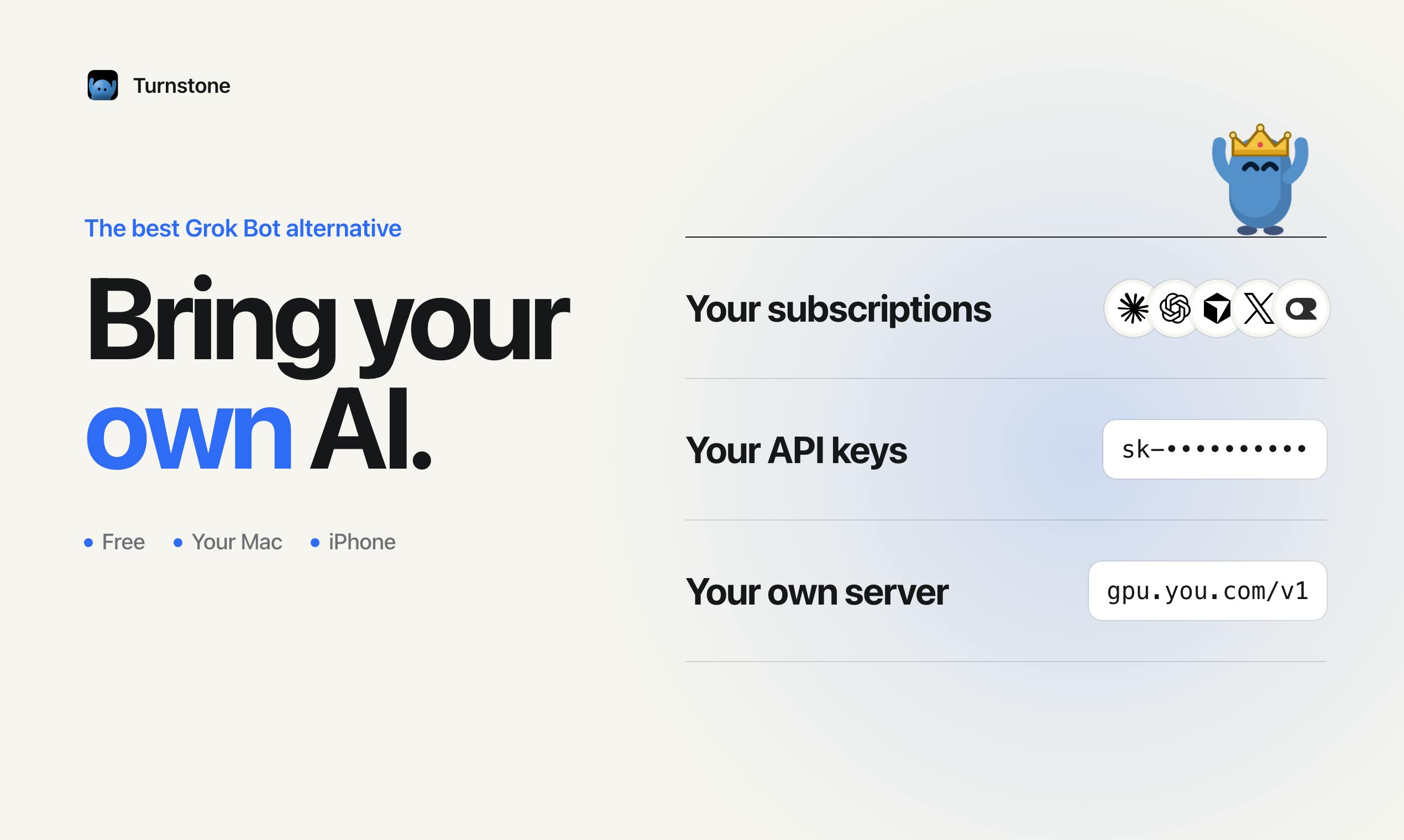
Turnstone lets users drive a cross-platform Agent with their own AI subscriptions or self-hosted models, switching sources automatically.
Turnstone is the second-ranked AI Agent product on Product Hunt, built on the idea of "not providing AI, but orchestrating the AI you already have." Users can connect their own subscriptions, API keys, or self-hosted models, and when one source hits its usage limit, the Agent automatically switches to the next to keep executing tasks—solving the problem of a single subscription's quota interrupting workflows. The product covers Mac and iPhone and is completely free. The article analyzes three values of the bring-your-own-AI model: a shift in cost structure, availability redundancy, and the privacy headroom of self-hosting. It also cautions that, as an early-stage product, details on supported providers, switch criteria, and task capabilities are not yet public, and the real-world experience remains to be verified.
In an era where AI assistant tools keep proliferating, most products try to lock you into their own models and subscription systems. Turnstone, ranked second on Product Hunt, takes the opposite path: it doesn't provide AI—it lets you drive a cross-platform agent with the AI you already have.
What Is Turnstone
Turnstone's positioning is clear—a Grok Bot alternative, but running on "the AI you already have." According to the official description, you can connect your own AI subscription, API keys, or self-hosted models. When one AI hits its usage limit, your Agent automatically switches to another and keeps working.
This solves a very practical pain point: the quota limits of a single AI subscription. Whether it's the message cap on a chatbot or the rate limit on an API, dense usage tends to interrupt workflows. Turnstone's approach is to orchestrate multiple AI sources into a rotating resource pool, letting the Agent handle switching in the background with no manual intervention from the user.
The product currently supports Mac and iPhone, and the team emphasizes that it is "completely free." On Product Hunt it received 97 upvotes, placing second for the day, filed under the Mac, Productivity, and Artificial Intelligence tags.
Failover is a core concept in distributed systems and high-availability architecture, referring to the mechanism by which a system automatically redirects requests to a backup node when the primary node or service becomes unavailable due to failure, overload, or hitting a quota limit. In AI Agent scenarios, failover triggers typically include API rate limits (such as HTTP 429 responses), exhausted subscription message quotas, excessive service latency, or model errors. Unlike traditional load balancing, Agent failover must preserve task context consistency—after switching models, the new model must be able to pick up the prior state and continue reasoning, which places additional demands on passing along conversation history and tool-call results. Turnstone's claimed "automatic switching" is essentially this mechanism implemented in a consumer-grade product, and its reliability depends on the accuracy of switch decisions and the completeness of context migration.
Why the Bring-Your-Own-AI Model Is Worth Watching
The "Bring Your Own AI" idea is nothing new in developer tools, but applied to a consumer-grade Agent product, Turnstone's design has several points worth unpacking.
First is the shift in cost structure. The product itself is free, meaning the team doesn't make money from model calls; users' spending depends on the AI source they choose—an existing subscription incurs no extra cost, APIs are billed by usage, and a self-hosted model is a fixed capital investment. For users already paying for multiple AI services, this model avoids paying twice for the same capability.
Second is the redundancy design for availability. The automatic switching mechanism is essentially failover. When a model hits its limit or the service fluctuates, the Agent doesn't stop—it moves to the next source. For Agent scenarios that need to continuously execute multi-step tasks, this continuity matters more than single-model performance.
Third is the privacy headroom offered by the self-hosted option. The team explicitly supports connecting self-hosted models, which means privacy-sensitive users can run the Agent entirely on their own infrastructure without sending content to third-party APIs.
Bring Your Own AI (BYO-AI) is a product design paradigm similar in logic to Bring Your Own Device (BYOD) common in SaaS: the product vendor doesn't bear the cost of model calls; instead, users supply the underlying AI capability source. This model has precedents in developer tools—some code assistants, for example, let users plug in their own OpenAI or Anthropic API keys. Its commercial implication is that the vendor shifts from "model reseller" to "orchestration and experience provider," with revenue no longer tied to token consumption. For users, BYO-AI means reusing existing subscriptions and avoiding duplicate payments, but it also shifts part of the responsibility for model availability, billing fluctuations, and security compliance to the user side. Turnstone goes a step further by introducing multi-source rotation, evolving BYO-AI from "single-key access" to "resource pool management."
Cross-Device Support Meets Agent Continuity
Turnstone covers both Mac and iPhone, a combination that hints at the product's focus on "picking up where you left off." The desktop is suited to long-running, multi-step Agent tasks, while mobile handles instructions and check-ins during fragmented moments. Although the team hasn't disclosed details of the sync mechanism, cross-device support itself is a necessary step for Agent products moving from demo to daily use.
One detail: the official description repeatedly uses the phrase "your Agent," which shows the product's core is not a chat interface but an entity that can continuously execute tasks. Switching AI sources and running across devices both serve the goal of "keeping the Agent from stopping."
Self-hosted Model refers to deploying open-source large models (such as Llama, Mistral, Qwen, etc.) on the user's own servers or local hardware and exposing API endpoints through a local inference framework. Compared with calling cloud APIs, the core advantages of self-hosting are that data never leaves the local environment, there is no usage-based billing, and deep customization is possible—but the cost is bearing GPU hardware costs, model update maintenance, and inference performance tuning yourself. In Agent products, the self-hosted option is often seen as a fallback for privacy-sensitive scenarios—when tasks involve internal enterprise documents or personal information, users can route the Agent entirely through a local model to prevent content from flowing to third parties. Turnstone explicitly supports this option, meaning its architecture must be compatible with different API protocols and authentication methods, which is also one of the key indicators for judging the maturity of its orchestration layer.
Who It's For, and What to Watch Out For
Based on the available information, Turnstone is better suited to users who already have multiple AI subscriptions or API quotas, as well as technical users willing to tinker with self-hosted models. If you only have one AI service and don't use it heavily, automatic switching offers limited benefit; if you have strict requirements about where your data flows, the self-hosted option is a key selling point.
One caveat: the information disclosed so far centers on functional positioning. Public materials have yet to detail which specific AI providers are supported, how switch triggers are determined, or what types of tasks the Agent can perform. As an early-stage Product Hunt product, its real-world experience and stability still need hands-on verification.
At a time when AI tools are broadly trending toward subscription lock-in, Turnstone chooses to be a lightweight orchestration layer that hands model choice back to the user. Whether the market accepts this direction depends on whether it can make "automatic switching" seamless and reliable enough.
One-line Summary
Turnstone lets users drive a cross-platform Agent with their own AI subscriptions or self-hosted models, switching sources automatically.
Paragraph Summary
Turnstone is the second-ranked AI Agent product on Product Hunt, built on the idea of "not providing AI, but orchestrating the AI you already have." Users can connect their own subscriptions, API keys, or self-hosted models, and when one source hits its usage limit, the Agent automatically switches to the next to keep executing tasks—solving the problem of a single subscription's quota interrupting workflows. The product covers Mac and iPhone, and the team emphasizes it is completely free. The article analyzes three values of the bring-your-own-AI model: a shift in cost structure, availability redundancy, and the privacy headroom of self-hosting, and notes that cross-device support serves Agent continuity. It also cautions that, as an early-stage product, details on supported providers, switch criteria, and task capabilities have not yet been made public, and the real-world experience remains to be verified.
Related articles
 Tech Frontiers
Stylome Bot Slammed as Useless Junk: Why Do AI Detection Tools Keep Failing?
Reddit users test the Stylome AI detection bot: Gemini-rewritten text judged human-written, consistently low confidence. An analysis of AI text detection's technical dilemmas, privacy concerns, and credibility crisis in community governance.
 Tech Frontiers
When AI Becomes a Productivity Divide: Clarity or "AI Psychosis"?
A civil engineer's deep use of agentic AI boosted efficiency but bred contempt for peers who refuse to learn. Is this clarity or AI psychosis? An analysis of the cognitive and psychological challenges behind the AI productivity divide.
 Tech Frontiers
Opus 5.5 Benchmark Scores Climb, Community Says Its "Weights Are Blessed"
Reddit community discusses Opus 5.5's rising scores on the Benchmaxxing Bench, with users describing its performance as "weights are blessed." This article interprets the community reaction and cautions against conflating benchmark scores with real capability.