Two MIT Professors Win Pritzker Award: A Milestone in AI-Discovered Antibiotics

Two MIT professors win the Pritzker Award for co-discovering the first AI antibiotic, marking mainstream recognition of AI scientific discovery.
MIT professors Regina Barzilay and Jim Collins jointly received the Pritzker Award for their pioneering collaboration in AI-driven drug discovery, honoring their identification of the first antibiotic discovered by AI. Barzilay is an expert in natural language processing and machine learning, while Collins has deep expertise in synthetic biology and antibiotic resistance research. Their interdisciplinary collaboration enabled AI candidate molecules to move from computational results to experimental validation. The achievement is regarded as a milestone in AI drug discovery, proving that machine learning can efficiently pinpoint molecular structures with antibacterial potential from vast chemical spaces. The Pritzker Award's honor for AI-centered scientific research sends a signal that AI's role in basic science is being accepted by the mainstream academic evaluation system, and provides key endorsement for the AI pharma track to shift from cost reduction and efficiency gains to opening up new drug sources.
Two MIT Professors Win Pritzker Award: A Milestone in AI-Discovered Antibiotics
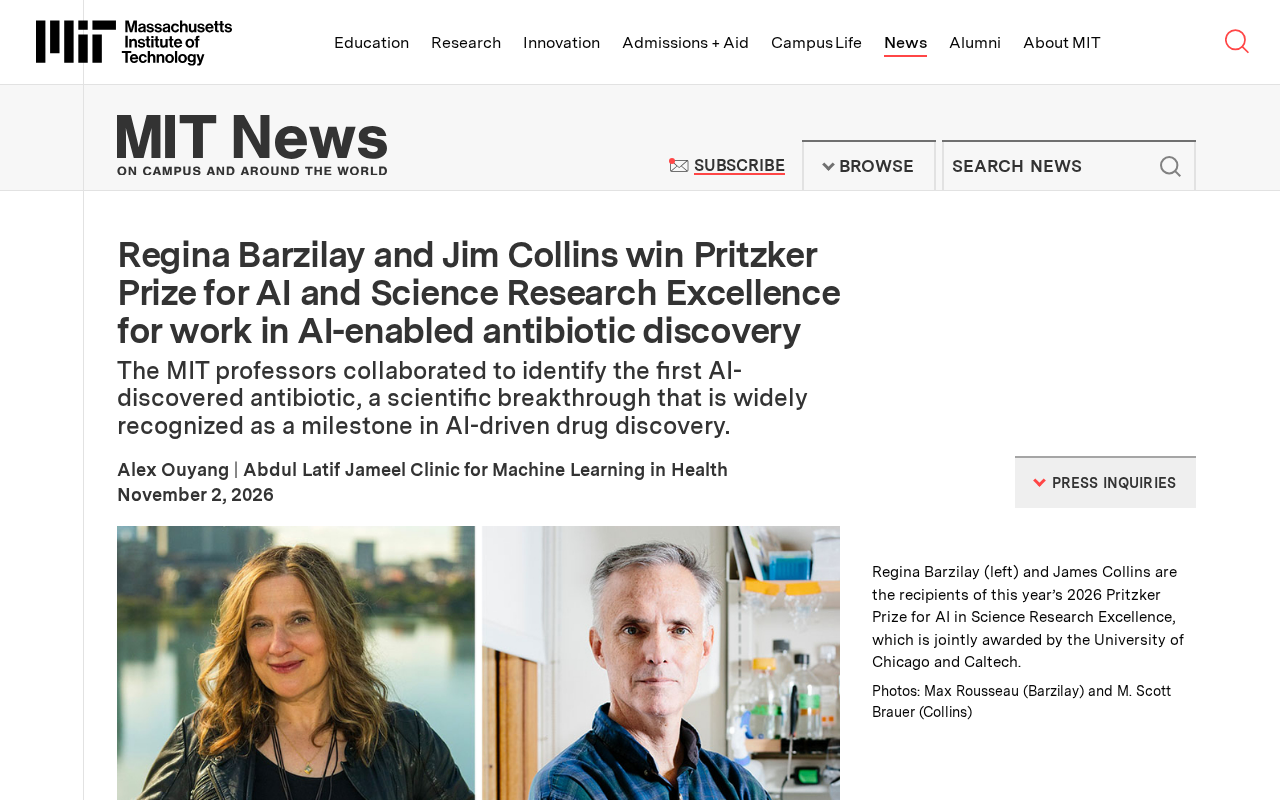
When AI moves from playing chess and writing poetry to discovering new antibiotics, it is no longer just a cool tool in the lab—it becomes a scientific engine directly tied to human health. MIT's Regina Barzilay and Jim Collins have jointly received the Pritzker Award for their pioneering collaboration in AI-driven drug discovery, honoring their contributions to the exceptional integration of AI and scientific research.
From Zero to One: The First AI-Discovered Antibiotic
The two professors' collaboration points to a concrete scientific breakthrough: identifying the first antibiotic discovered by AI. This achievement is widely regarded as a milestone in the field of AI-driven drug discovery. Previously, antibiotic discovery often relied on large-scale screening and serendipity, with long cycles and high costs. AI's intervention has changed this paradigm—efficiently searching vast chemical spaces through algorithms to pinpoint molecular structures with antibacterial potential.
The significance of this breakthrough goes beyond "discovering a new drug." It proves that machine learning models can learn chemical rules from massive data and generate verifiable candidate molecules. According to the original report, this achievement has been widely recognized by the scientific community as a landmark event in AI for drug discovery, providing a replicable path for subsequent research.
Chemical space refers to the set of all theoretically possible drug-like small-molecule compounds. Estimates put its scale at around 10^60, far exceeding what can actually be synthesized and screened. Traditional high-throughput screening typically covers only libraries of millions to tens of millions of compounds, making it like random sampling within chemical space. The advantage of AI methods (such as generative models and graph neural networks) is that they can learn distribution patterns from known chemical structures and biological activity data, directly generating or prioritizing candidate molecules in a vast virtual space—bypassing exhaustive screening and focusing experimental validation on the few most promising molecules.
An Interdisciplinary Combination: Where Computing Meets Biomedicine
Regina Barzilay is a professor in MIT's Department of Electrical Engineering and Computer Science, long engaged in natural language processing and machine learning research; Jim Collins is a leading figure in bioengineering and medical engineering, with deep expertise in synthetic biology and antibiotic resistance research. Their collaboration is symbolic in itself: on one side, an AI expert skilled at extracting patterns from complex data; on the other, a biologist deeply versed in pathogens and drug mechanisms of action.
This combination is not a simple "technology + application." AI models need high-quality biological experimental data for training, while biologists need AI to accelerate hypothesis generation and candidate screening. According to the original report, it is precisely this deep collaboration that enabled the AI-discovered antibiotic to move from computational results to experimental validation, ultimately gaining recognition from the scientific community.
The core idea of synthetic biology is to introduce engineering design principles into living systems, modifying microorganisms or constructing new biological functions through standardized biological parts and genetic circuits. In antibiotic research, synthetic biology can be used on one hand to analyze and modify antibiotic biosynthetic gene clusters, and on the other to build screening models and validate targets. Its intersection with AI lies in: AI proposes candidate molecules or target hypotheses from data, while synthetic biology provides controllable, measurable experimental platforms to rapidly validate these hypotheses, forming a closed-loop iteration between computation and experiment.
Why This Award Matters
The Pritzker Award has this time honored the intersection of AI and scientific research, sending a clear signal: AI's role in basic science is being accepted by the mainstream academic evaluation system. In the past, AI research was often seen as "instrumental" work, difficult to compare with experimental science; this award demonstrates that AI-driven scientific discovery itself has independent value.
For the global health challenge of antibiotic resistance, this work is especially significant. The development of new antibiotics has long faced insufficient investment and scientific bottlenecks, and AI offers a scalable new path. According to the original report, this breakthrough is widely regarded as a milestone in AI-driven drug discovery, meaning more researchers and capital will flow into this direction.
Implications for the AI Pharma Track
The birth of the first AI-discovered antibiotic provides a key validation point for the AI pharma industry. It shows that AI can not only accelerate drug optimization for known targets but also explore entirely new structures in unknown chemical space. For startups and large pharmaceutical companies, this means adjusting R&D strategy: from "using AI to cut costs and improve efficiency" to "using AI to open up new drug sources."
Of course, there is still a long road from discovery to clinical application. But the recognition of the award itself is an endorsement of the long-term value of this direction. The two professors' collaboration model also suggests that deep integration of AI and science requires interdisciplinary teams, not single-point technological breakthroughs.
(This article is based on the original reporting from the RSS source and introduces no additional data.)
Antimicrobial resistance (AMR) refers to pathogens surviving and reproducing after exposure to antimicrobial drugs, rendering previously effective drugs ineffective. Its causes include drug misuse, non-standard treatment courses, and bacteria's own genetic mutations and horizontal gene transfer. AMR makes common infections difficult to treat and has been listed by the World Health Organization as one of the top ten threats to global public health. Developing new antibiotics faces both economic and scientific dilemmas: new drug R&D cycles are long with high failure rates, and new antibiotics are often restricted in use to slow resistance, resulting in insufficient commercial returns. The reason AI-discovered antibiotics with new structures attract attention is precisely that they may bypass known resistance mechanisms and provide entirely new chemical scaffolds.
One-line Summary
Two MIT professors win the Pritzker Award for co-discovering the first AI antibiotic, marking mainstream recognition of AI scientific discovery.
Paragraph Summary
MIT professors Regina Barzilay and Jim Collins jointly received the Pritzker Award for their pioneering collaboration in AI-driven drug discovery, honoring their identification of the first antibiotic discovered by AI. Barzilay is an expert in natural language processing and machine learning, while Collins has deep expertise in synthetic biology and antibiotic resistance research. Their interdisciplinary collaboration enabled AI candidate molecules to move from computational results to experimental validation. The achievement is regarded as a milestone in AI drug discovery, proving that machine learning can efficiently pinpoint molecular structures with antibacterial potential from vast chemical spaces. The Pritzker Award's honor for AI-centered scientific research sends a signal that AI's role in basic science is being accepted by the mainstream academic evaluation system, and provides key endorsement for the AI pharma track to shift from cost reduction and efficiency gains to opening up new drug sources.
Related articles

Prompt Engineering for Beginners: From Writing Instructions to Systematic Design
A beginner's guide to prompt engineering: the difference between prompts and prompt engineering, the four roles of prompts, the six-step process and four goals, plus key limitations around capability ceilings, stability, hallucinations, context length, and cost.

GPT-6.2 Astra Leaked: Low-End Config Beats Previous Top-Tier, SVG Generation Stuns
Leaked GPT-6.2 Astra benchmarks and SVG demos surface: lowest inference tier beats previous top-tier; same batch includes Tencent HY4, Anthropic FlashProve model verification, DeepSeek V5 Ascend roadmap, and Binance security incident.

PolicyIK: Reinforcement Learning for High-Precision Robotic Arm Inverse Kinematics
PolicyIK uses goal-conditioned reinforcement learning to achieve high-precision robotic arm inverse kinematics, with 93.5% of simulated tasks within 1mm and 0.2° error, a deployment protocol raising success to 98.9%, and the ability to execute VLA policy commands.