Two Months of Self-Study to Land a 36K LLM Offer: A Four-Stage AI Agent Learning Roadmap

Breaking down a Bilibili PhD creator's four-stage AI application development roadmap, examining its validity and salary inflation.
The article examines a Bilibili PhD creator's roadmap of "two months of self-study to switch into AI application development and land a 36K offer," noting that 90% of career switchers fail due to unsystematic knowledge rather than inability to learn. It breaks down four stages: Python-based fundamentals covering RAG, vector databases, LangChain/LangGraph, Agent orchestration, and prompt engineering (15K); real project implementation emphasizing AI service orchestration, API design, deployment, and monitoring over LangChain demos (30K); deep optimization covering KV cache, prefix caching, hybrid retrieval, and fine-tuning evaluation (30K+); and Agent clusters covering routing, cross-agent memory, and full-pipeline monitoring. The author concludes that two months to 36K is an extreme outlier, but the four-stage progression corresponds to junior, mid-level, senior, and lead competency tiers and is worth using as a learning planning reference.
LLM application development is fast becoming the hottest track right now. A PhD creator on Bilibili shared a "two months of self-study to switch into AI application development" roadmap that has drawn a lot of attention—according to their account, two months of purely interest-driven self-study was enough to land a 36K AI application development offer. Whether that number is broadly applicable is another question, but the four-stage competency model broken down in the video does clearly articulate the engineering skills companies actually need today.
Why 90% of People Switching to AI Are Studying the Wrong Way
The video opens with a sobering fact: of the people who want to switch into AI, 90% don't fail because they can't learn—they fail because they're learning the wrong things. Massive amounts of time get spent memorizing concepts, grinding through theory, and piling up demos, yet when it comes to interviews and real project implementation, they get stuck.
The core problem is that "knowledge isn't systematic." Scattered learning of a bunch of small LangChain examples and reading a few RAG explainers still leaves you clueless about where to start when building a real project. Companies aren't hiring based on how many knowledge points you've studied—they're hiring based on whether you can independently walk through an end-to-end development pipeline from zero to one.
According to this Bilibili creator's observations, major tech companies are aggressively expanding AI application agent roles in the 2026 fall recruitment cycle, and AI-related salaries are significantly higher than traditional development roles. For people who missed the internet boom, this window of LLM implementation is worth taking seriously.
Stage 1: Build Foundations, Target 15K
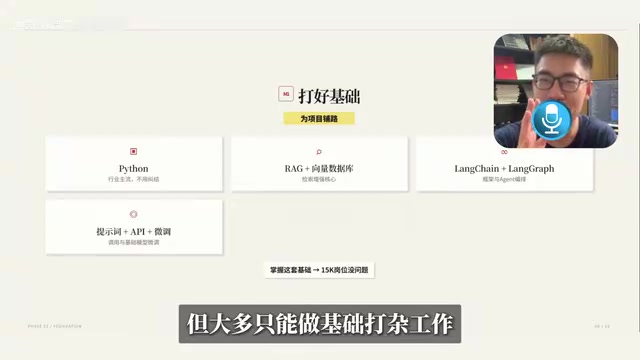
There isn't much to agonize over when it comes to tech stack choices at the foundation stage—Python is the first choice. It's the industry's mainstream language, so there's no need to spread your energy across Java or Node.
The core content you need to master includes: RAG (Retrieval-Augmented Generation), vector databases, LangChain and LangGraph, Agent orchestration, prompt engineering, LLM API calls, and basic model fine-tuning. This combination basically covers the foundation of LLM application development.
The creator's assessment: with this foundation, landing a 15K role is entirely doable. But you need to be clear-eyed that most capabilities at this stage only qualify you for basic support work—you're still a ways off from core development.
RAG (Retrieval-Augmented Generation) is a technical paradigm in which, before answering, the LLM first retrieves relevant document fragments from an external knowledge base and then stitches them into the prompt sent to the model to generate an answer. It solves three major pain points of LLMs: training data going stale, inability to access private data, and the tendency to fabricate information (hallucination). It's the standard solution for enterprise knowledge base Q&A, customer service assistants, document analysis, and similar scenarios. A complete RAG pipeline typically includes document parsing and chunking, vector embedding, storage in a vector database, similarity retrieval, re-ranking, prompt stitching, and answer generation—where recall quality and context organization directly determine the final result.
Vector databases specialize in storing and retrieving dense vectors generated by embedding models, using approximate nearest neighbor algorithms to quickly find the most semantically similar fragments among millions of records. Common choices include Milvus, Qdrant, Weaviate, Chroma, and cloud provider managed services. Selection requires weighing data scale, latency, filtering capabilities, and operational costs.
Stage 2: Build Real Projects, Aim for 30K
This is the part of the roadmap most prone to pitfalls. The video specifically warns: do not pile up a bunch of LangChain demos. Many people crank out seven or eight small LangChain examples in one go, only to discover in interviews that companies use native Python development—and they crash and burn.
What really matters at the project stage is business and engineering implementation capability. Focus on mastering the entire zero-to-one development pipeline: AI service orchestration, API design, deployment, and project monitoring. Once you've walked through this pipeline, you've transformed from "someone who can call APIs" into "someone who can build projects"—and that's what gives you the confidence to aim for 30K.
AI service orchestration refers to organizing LLM calls, retrieval, tool functions, conditional branching, retries, and fallbacks into a maintainable, observable service flow—rather than piling all the logic into one script. Common engineering practices include using workflow frameworks like LangGraph or Dify to declaratively describe nodes and state transitions, or encapsulating each capability as an independent microservice dispatched through an API gateway. Its core value lies in making the pipeline testable, rollback-capable, and horizontally scalable, and in gracefully degrading when the model times out or gets rate-limited—this is precisely the key assessment point interviewers use to distinguish "can call APIs" from "can build projects."
Stage 3: Deep Optimization, Benchmark 30K+
At this stage, competitiveness comes from understanding the underlying mechanisms and performance tuning capability. You need to dive deep into LLM fundamentals, including technical details like KV cache and prefix caching; master hybrid retrieval to improve RAG recall performance.
If conditions allow, also do model fine-tuning and reinforcement learning, along with proper data cleaning and building evaluation sets to ensure stable and controllable LLM output. The creator believes that mastering this area qualifies you for a project lead role, benchmarking against 30K+ positions.

KV cache is the core mechanism for accelerating LLM inference: during autoregressive generation, the key-value tensors of previously computed historical tokens are cached and reused, avoiding recomputing the entire prefix every time a new token is generated, thereby reducing complexity from quadratic to linear. Prefix caching further precomputes and persists the KV states of identical prefixes shared across multiple requests (such as system prompts or long documents), reusing them directly on hits—significantly reducing first-token latency and compute costs.
Hybrid retrieval means using both vector semantic retrieval and keyword retrieval such as BM25 simultaneously, then merging the results via Reciprocal Rank Fusion (RRF) or weighted combination, balancing semantic generalization with exact matching. Common enhancement techniques also include query rewriting, multi-route recall, and re-ranking models, used to improve RAG recall and ranking quality.
Stage 4: Agent Clusters—The Engineering Capability Companies Need Most
The final stage tackles the Agent cluster capabilities that companies urgently need, including Agent routing, cross-agent memory, observability, and full-pipeline monitoring.
One judgment from the video is worth noting: this is currently the engineering capability companies lack most when implementing intelligent agents. Everyone can build a single-agent demo, but multi-agent collaboration, state management, monitoring, and troubleshooting—these engineering problems are where real differentiation happens.
Agent routing refers to dispatching requests to the most appropriate sub-agent or tool based on user intent—essentially a scheduling layer with semantic understanding. Common implementations include intent classification models, LLM structured-output decision-making, and rule-based fallbacks. Cross-agent memory addresses how multiple Agents share and isolate context, typically divided into short-term conversational memory, long-term vectorized memory, and shared blackboard-style state storage—requiring handling of write conflicts, expiration, and privacy boundaries. Observability requires recording complete trace links, token consumption, tool call parameters and results, and failure reasons for every invocation, along with integration into metrics monitoring and alerting, so that when a multi-agent system fails, you can quickly pinpoint which node, which retrieval, or which tool call caused the problem.
Is This Roadmap Worth Trusting?
Objectively speaking, going from zero to 36K in two months is an extreme outlier and shouldn't be treated as a general expectation. This creator has a PhD background, and their learning ability and time investment are not comparable to the average career switcher. 36K is on the higher end for AI application development roles, typically requiring matching project depth and engineering experience.
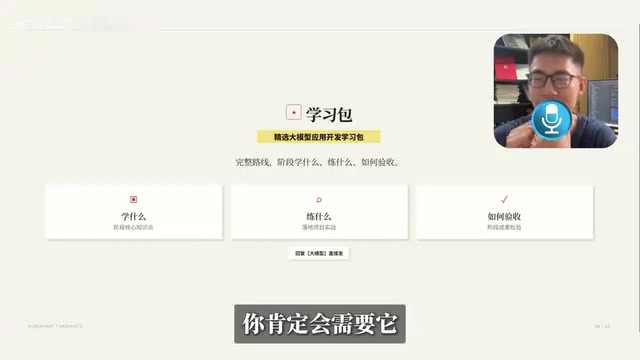
That said, setting aside the salary figure, the progressive logic of the four stages holds up: foundational toolchain → engineering implementation → performance optimization → cluster architecture. This does correspond to the competency tiers of junior, mid-level, senior, and lead. For people who want to systematically switch careers, planning your learning sequence along this path is far more efficient than blindly grinding through tutorials. The learning package and stage acceptance criteria mentioned in the video can serve as a reference framework for self-learners to check their progress.
What ultimately determines the outcome is still whether you can actually build and run the projects at each stage. The roadmap is just a map—you still have to walk the road yourself.
One-line Summary
Breaking down a Bilibili PhD creator's four-stage AI application development roadmap, examining its validity and the salary inflation.
Paragraph Summary
The article centers on a Bilibili PhD creator's roadmap of "two months of self-study to switch into AI application development and land a 36K offer," pointing out that 90% of people switching to AI have a problem of unsystematic knowledge rather than inability to learn. The author breaks down the four-stage competency model: Stage 1 uses Python as the base to master RAG, vector databases, LangChain/LangGraph, Agent orchestration, and prompt engineering, corresponding to 15K; Stage 2 emphasizes building real projects rather than piling up LangChain demos, mastering AI service orchestration, API design, deployment, and monitoring to aim for 30K; Stage 3 dives into KV cache, prefix caching, hybrid retrieval, and fine-tuning evaluation, benchmarking 30K+; Stage 4 tackles Agent routing, cross-agent memory, and full-pipeline monitoring—the cluster engineering capabilities companies need most. Finally, the author concludes that two months to 36K is an extreme outlier, but the progressive logic of the four stages corresponds to the competency tiers of junior, mid-level, senior, and lead, making it worth using as a reference for learning planning.
Related articles

Meta vs. Publishers: The AI Data Battle Over Terms of Service Changes and the Future of the Internet
Meta changed its business account terms to allow AI training on linked website data, sparking backlash from publishers and creators. Industry groups demanded negotiations, forcing Meta to remove 'training' wording and delay the effective date. The dispute reveals the deeper battle over data authorization and the future of the internet in the AI era.

When Outside Xbox Meets Blood on the Clocktower: A Legion Match in Minecraft
Outside Xbox guests Ellen and Mike play Minecraft Blood on the Clocktower in a Legion game. How can three good players fight an evil majority amid information noise? This article breaks down Legion mechanics, information-role mind games, and the endgame reversal.

Kimi K3.1 Hands-On Test: Open-Source Model Nears Opus, Video Generation Steals the Show
Kimi K3.1 completed motion graphics, 3D rendering, mini-games, and video generation in a live test. Analysis of its 2.8T MoE architecture, gap vs Opus/GPT, and hidden video generation.