Two Years of Khanmigo in Real Classrooms: What AI Tutoring Actually Achieves

Khan Academy's two-year Khanmigo experiment marks AI education's shift from demos to real-world validation.
Khan Academy's AI tutoring tool Khanmigo uses a Socratic guidance design to scale high-quality one-on-one tutoring. A two-year real-classroom experiment placed the tool in complex teaching environments, going beyond the short-term demos most AI education products rely on. Assessing its impact faces multiple challenges: learning outcomes are hard to attribute to a single tool, LLM hallucinations can mislead students, and real-world variables like network conditions and teacher training add noise. The technical community remains cautious, prioritizing statistical significance and differentiated effects across ability levels over marketing claims. This experiment reflects a broader trend: generative AI is moving from showcasing capabilities to proving real-world results.
When AI Enters Real Classrooms
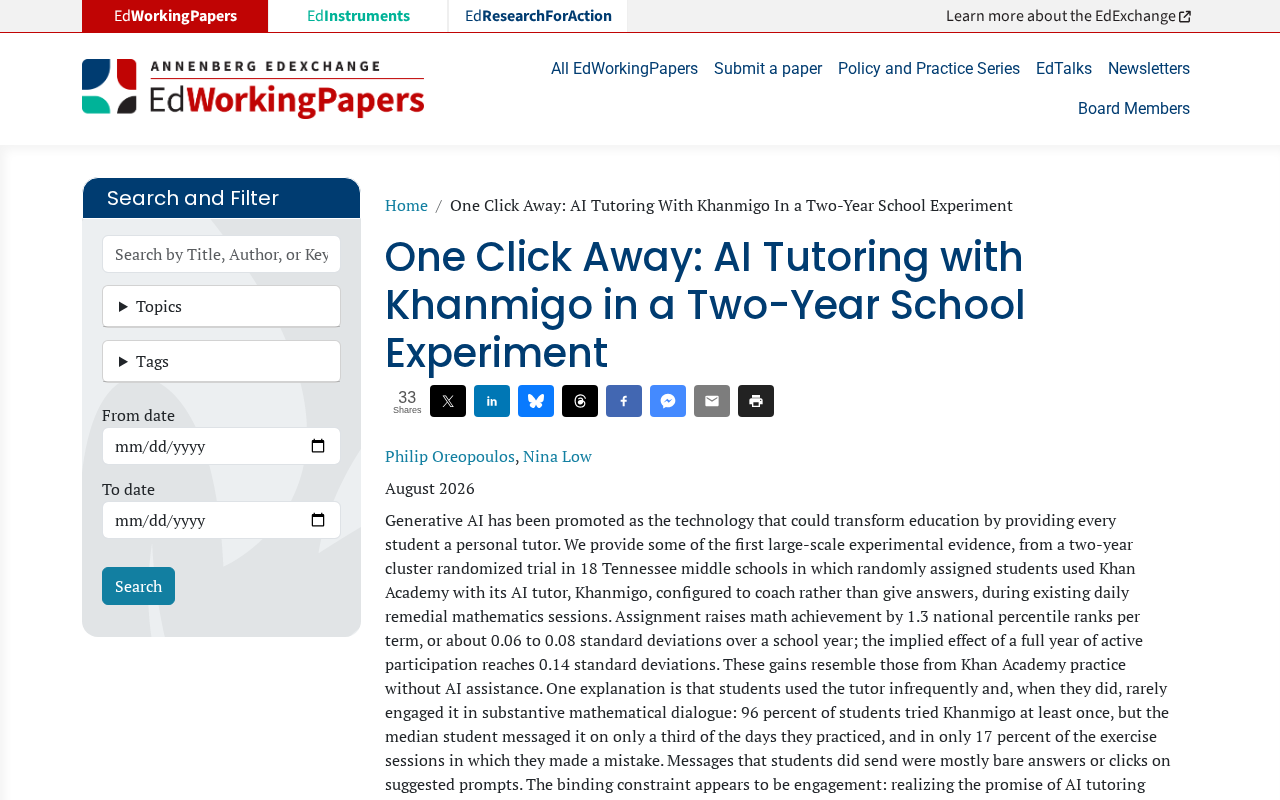
Khanmigo, the AI tutoring tool from Khan Academy, has been widely regarded as a benchmark case for generative AI in education since its launch. Unlike lab demonstrations, a two-year school-based experiment placed this tool into authentic teaching environments to answer a critical question: can AI tutoring genuinely improve student learning outcomes, or does it remain stuck at the concept-demonstration stage?
The topic sparked discussion in the technical community on Hacker News. While modest in scale (17 upvotes, 8 comments), it touched on one of the most fundamental debates in edtech — whether AI-driven personalized tutoring represents a breakthrough for educational equity, or simply another wave of overhyped technology.
Khanmigo's Product Philosophy
Built on large language models, Khanmigo's core design philosophy is to act as a Socratic tutor. Rather than providing direct answers, it guides students through questions and prompts, helping them reason their way to solutions. This design targets a key weakness of traditional AI Q&A tools: students can easily copy answers outright, bypassing any real learning.
From an educational theory standpoint, this guided tutoring approach more closely resembles how a one-on-one human tutor works. Research has long shown that high-quality one-on-one tutoring can significantly boost learning outcomes, but human tutors are expensive and difficult to scale. Khanmigo aims to fill this gap with AI, giving every student an experience that approximates one-on-one instruction.
The Socratic Method traces back to the dialogues of the ancient Greek philosopher Socrates, whose core practice was to use continuous questioning to expose contradictions and assumptions in a student's thinking — guiding them to actively construct knowledge rather than passively receive answers. In modern educational psychology, this aligns closely with Constructivism: learners must internalize knowledge through active thinking and exploration, not simple memorization. Translating this approach to an AI system poses unique challenges. A large language model must judge when to probe further, when to offer a hint, and how to dynamically adjust its guidance based on student responses — rather than mechanically refusing to give answers. This "withhold the answer at the right moment" design is technically more complex than simply generating a response, because it requires the model to continuously infer the student's cognitive state.
The Value of a Two-Year Experiment
Most AI education products rely on short-term tests or carefully staged demonstrations for their marketing claims. What makes this experiment meaningful is its duration. A two-year window is long enough to observe the tool's sustained impact across real teaching rhythms — including usage rates after the novelty wears off, teacher adoption, and differentiated effects across students of varying ability levels.
Real classroom environments introduce complex variables that lab conditions cannot replicate: network reliability, device availability, teacher training quality, student self-discipline, and how the AI's occasional errors affect learning trust. These factors collectively determine whether an AI tool moves from "looks impressive" to "actually useful."
The Difficulty of Measuring Impact
Assessing AI tutoring effectiveness is itself a challenge. Learning outcomes are influenced by too many factors, making it difficult to attribute grade changes to any single tool. Beyond that, the "hallucination" problem in educational AI contexts is particularly sensitive — if a math tutoring tool occasionally produces incorrect solution steps, it can actively mislead students. This is a risk that generative AI applications in education must confront squarely.
Hallucination in generative AI poses a special danger in educational settings. Hallucination refers to large language models generating plausible-sounding but factually incorrect content with high apparent confidence. While this may be tolerable in casual conversation, it carries serious consequences in math problem-solving or science reasoning tutoring — students may memorize and internalize incorrect solution steps as authoritative answers. What makes this more insidious is that logical errors in intermediate steps of a mathematical derivation are far harder for students lacking foundational knowledge to detect than obvious grammatical mistakes. This is precisely why AI educational tools demand far higher accuracy than general-purpose chatbots, and explains why teacher oversight remains indispensable in real classroom experiments. Teachers must serve as "hallucination filters," correcting the AI's occasional misdirection.
The Technical Community's Cautious Stance
The Hacker News discussion reveals that technically-minded practitioners hold a notably measured view of AI in education. They recognize the potential for AI to lower tutoring costs and broaden access to quality education, while remaining alert to the gap between vendor claims and real-world results. This empirically-oriented conversation is precisely what the edtech space often lacks — rigorous long-term data is far more persuasive than marketing language.
The questions that truly matter include: Is the academic improvement from AI tutoring statistically significant? Does it help struggling students and high achievers equally? Does it diminish or enhance the teacher's role? These answers carry far more practical value than sweeping declarations that "AI will revolutionize education."
Implications for AI Deployment in Education
This experiment reflects a broader trend: generative AI is moving from the technology demonstration phase into real-world effectiveness validation. Whether in education, healthcare, or enterprise applications, the standard for judging AI value is shifting from "what can it do" to "how well does it actually perform."
For practitioners tracking AI adoption, Khanmigo's classroom experiment offers an important reference point. It reminds us that the ultimate value of an AI product depends not on model parameters or demo performance, but on whether it can reliably create value in messy, unpredictable real-world environments. Education — a domain with exceptionally high demands for accuracy and reliability — turns out to be an ideal proving ground for AI maturity.
Related articles

Build an AI Super Employee System at Zero Cost: A Full Breakdown of Automated Agent Workflows
A deep breakdown of the AI super employee system demoed on Bilibili: agent orchestration, digital human voiceovers, map and enterprise lead generation, 24/7 customer service, and legal modules. We analyze the business logic and compliance risks behind zero-cost signup to help entrepreneurs judge the real ROI of this AI digital employee system.

The Essential Difference Between Chatbots and AI Agents: Crossing from Conversation to Execution
What's the difference between a chatbot and an AI agent? Based on the MCP series on the Learn Tech channel, this article uses examples like booking flights and summarizing notes to explain: a chatbot only gives answers, while an agent actually completes tasks through a think-act-observe loop. It breaks down the four core components—model, tools, memory, and goal—as well as MCP's role as a bridge, and discusses agents' applicable boundaries and permission risks.

Free GitHub Repo: 342 Hours of AI Courses, from Math to MCP Servers
A free GitHub repo offers 342 hours of AI courses: 523 lessons across 20 phases, from math fundamentals to agent building and MCP servers. Nearly 100,000 learners have started.