typesafe-ai 3.0.27 Released: Documentation Format Unification and Dependency Updates
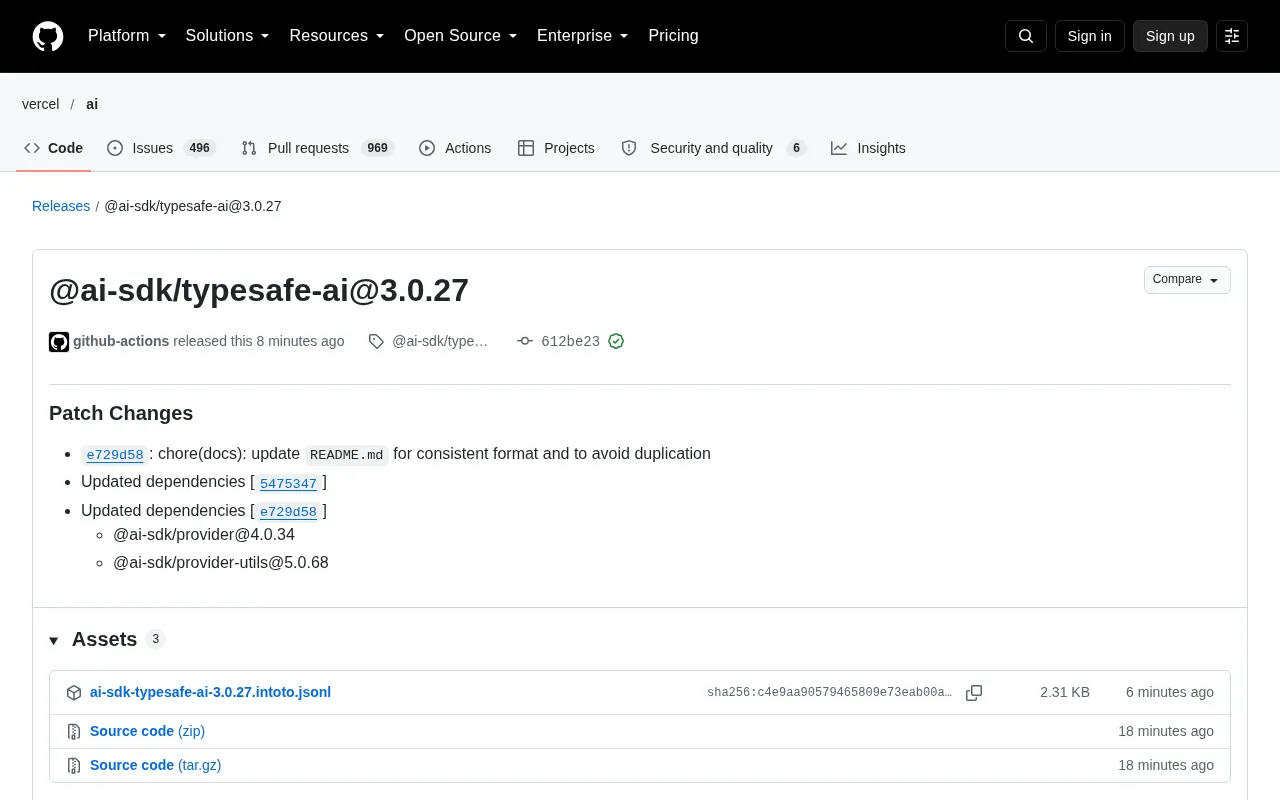
@ai-sdk/typesafe-ai releases patch 3.0.27 with only documentation cleanup and dependency sync.
`@ai-sdk/typesafe-ai` releases patch version 3.0.27 with no new features or breaking changes. The update includes two main items: unifying README format and removing duplicate content to improve documentation consistency and readability; and synchronizing underlying dependencies `@ai-sdk/provider` to 4.0.34 and `@ai-sdk/provider-utils` to 5.0.68 to maintain ecosystem version alignment. The release is automated via GitHub Actions with verified signatures, ensuring a standardized and traceable process. Since changes are concentrated at the documentation and dependency levels, upgrade risk is low, but the article still recommends running type checks and integration tests after upgrading to confirm no unexpected provider interface compatibility drift. Overall, this is a small-step iteration on the stable branch focused on maintenance.
A Small but Steady Patch Update
The @ai-sdk/typesafe-ai package in the AI SDK ecosystem has released version 3.0.27. According to the GitHub release notes, this is a typical patch (Patch Changes) release that introduces no new features or breaking changes, focusing primarily on documentation formatting cleanup and synchronized updates of underlying dependencies.
For developers using this package, this type of update typically means lower upgrade risk, but it's still worth paying attention to subtle changes that may arise in the dependency chain.
Documentation Consistency: An Underrated Maintenance Task
The most notable commit in this update is e729d58, described as "chore(docs): update README.md for consistent format and to avoid duplication." Simply put, the maintainers unified the README format and removed duplicate content.
Such changes may seem trivial, but for a widely depended-upon SDK, documentation consistency directly affects developer onboarding efficiency. When the README's examples, section order, and wording remain stable, developers face lower cognitive costs when consulting the documentation and can more easily locate changes across version iterations. Releasing this in a patch version also aligns with Semantic Versioning (SemVer) conventions—no change to external behavior, only readability improvements.
Semantic Versioning (SemVer) is currently the most widely adopted versioning convention in software package management, formatted as Major.Minor.Patch. According to the SemVer 2.0.0 specification: a major version increment means incompatible API changes; a minor version increment indicates new functionality added in a backward-compatible manner; a patch version increment contains only backward-compatible bug fixes or internal maintenance without changing external behavior. Therefore, 3.0.27 falls in the patch position, theoretically making it a completely transparent upgrade for callers. It's worth noting that SemVer only constrains a package's public interface; updates to transitive dependencies within the dependency chain may still introduce indirect risks, which is why the article recommends running tests after upgrading.
Dependency Synchronization: provider and provider-utils
The release notes list two updated dependencies: @ai-sdk/provider bumped to 4.0.34, and @ai-sdk/provider-utils bumped to 5.0.68. These two packages form the foundation layer of the AI SDK system, responsible for model provider interfaces and utility functions respectively.
Dependency updates don't necessarily bring behavioral changes, but they are a necessary step to keep the entire SDK ecosystem version-aligned. For projects using typesafe-ai, it's recommended to run existing type checks and integration tests after upgrading to confirm that provider interface compatibility hasn't drifted unexpectedly.
@ai-sdk/provider and @ai-sdk/provider-utils belong to the underlying abstraction layer in the AI SDK system. The former defines the unified interfaces that model providers must implement (such as call signatures and return structures for language models and embedding models), enabling models from different vendors to be invoked through the same set of types; the latter provides reusable utility functions and type guards for building providers, such as streaming response handling, error wrapping, and request parameter validation. Upper-layer packages like typesafe-ai depend on this abstraction layer for type-safe wrapping, so version drift in these two packages propagates upward through the dependency chain. "Version alignment" refers to multiple packages in the ecosystem referencing the same underlying interface definitions, avoiding situations where the same type is judged incompatible across different packages.
How to Understand This Version's Positioning
@ai-sdk/typesafe-ai is positioned as a type-safe wrapper around the AI SDK. Version 3.0.27 falls within the 3.x series, following the patch number increment rhythm, indicating that the project maintainers are doing continuous small-step maintenance on the stable branch rather than aggressively pushing new features.
From the release process perspective, this release was automatically completed by github-actions with a GitHub verified signature, indicating that the project's release pipeline is automated and traceable. For production projects depending on this package, this is a positive signal: the release process is standardized, and the version source is trustworthy.
GitHub Actions is a CI/CD automation platform provided by GitHub, where trigger conditions and execution steps are defined through workflow files (.github/workflows/*.yml). In the npm ecosystem, common release workflows automatically run tests, builds, and npm publish when tags are pushed or merges to the main branch occur, and can work with the provenance mechanism to generate source attestations. A release artifact bearing a "Verified" signature means the version was generated by GitHub's trusted build environment rather than manually uploaded from a local machine, which reduces the risk of supply chain poisoning and version forgery. For downstream users, an automated and traceable release pipeline is an important reference indicator when evaluating whether a package is worth adopting.
Upgrade Recommendations
If you're using @ai-sdk/typesafe-ai, you can follow the standard patch upgrade process: update the version number, install dependencies, and run tests. Since the changes are concentrated at the documentation and dependency levels, no business code modifications are expected. If your project has locked version requirements for @ai-sdk/provider, confirm whether 4.0.34 is compatible with your existing code before upgrading.
Overall, 3.0.27 is a maintenance-oriented release whose value lies not in new capabilities but in keeping the package's documentation and dependencies in a healthy state.
Related articles

New Trailer for 'Everest: The Other Side' Released: Ski Mountaineers Take On Ski Descent of the North Face
National Geographic's 'Everest: The Other Side' trailer follows pro ski mountaineers attempting Everest's Direct North Face and the first ski descent, with rare North Face footage and life-or-death avalanche moments.
Building Automotive Crash AI Surrogate Models with NVIDIA PhysicsNeMo
An analysis of the NVIDIA PhysicsNeMo crash analysis workflow: how to train a Transolver surrogate model with simulation datasets and package it as an inference API via NIM, covering the complete four-step process of geometry parameterization, data splitting, and error validation.

LangGraph in Production: The Pain of Silent API Changes
Explores the challenge of silent external API changes affecting LangGraph agents in production, analyzes monitoring and testing limits, and proposes semantic validation and regression testing defenses.