TypeSafe Launches Jev: A Millisecond-Level AI Model Built for Code Decisions

Jev is a non-generative AI model built for machine decisions — millisecond responses at 20–200x lower cost than LLMs.
TypeSafe's Jev completely inverts the logic of mainstream large models: instead of generating text, it accepts structured inputs in parallel and returns typed decisions with confidence scores (select, score, boolean). By abandoning the autoregressive loop, Jev responds in milliseconds at 20–200x lower cost than comparable models — a 6x speed improvement verified by Vercel. Named after Kahneman's dual-process theory, Jev is a pure "System 1" model designed to embed within deterministic software architectures and handle the high-frequency decision points that are too complex for if/else logic but too trivial to justify a full LLM call.
An AI Model That Doesn't Write Text
Virtually every frontier model we know — from ChatGPT to Gemini — is doing fundamentally the same thing: generating human-readable text one token at a time. Jev, the new model released by TypeSafe (also referred to as TypeSpace in the video, under parent company System 1), takes a completely different approach.
According to the video, Jev was built by a team that includes Diego Almeida, one of the original co-founders of ChatGPT. Its positioning is unambiguous: this is not a model you chat with — it's a model that produces "decisions" for code execution. It can't explain itself or write a coherent sentence, but it delivers remarkable efficiency on specific tasks.
The core problem it addresses: existing large models are trained for human preferences, which makes them poorly suited for machine-use scenarios — prone to mode collapse, overconfidence, and unreliability. The TypeSafe team spent two years redesigning the training pipeline, introducing what they call "calibrated decision RL" (calibrated decision reinforcement learning).
Speed and Cost Differences of an Entirely Different Magnitude
Jev's most striking selling point is speed and cost. The numbers cited in the video: for tasks like classification and true/false judgments, it responds in just a few milliseconds, at a cost 20 to 200 times lower than existing models suited for the same tasks.
This isn't incremental improvement — it's a difference in magnitude. Vercel (pronounced "Versil" in the video), a production-grade company, was previously using cheap models like Gemini 2.5 Flash Lite for classification work. After switching to Jev, they saw roughly a 6x speed improvement and "basically saturated the evaluation" — meaning accuracy far exceeded expectations.
For companies that need to run classification or validation at scale, this is critical. Traditional LLMs are non-deterministic, prone to going off the rails or hallucinating, and as scale increases, both cost and unreliability compound. Jev absorbs these high-frequency, low-complexity decision tasks at a dramatically lower price.
Vercel is a cloud deployment platform for frontend developers, widely known as the official hosting provider for Next.js, with a business involving large volumes of edge computing and real-time request processing. In AI feature integration, classification and routing tasks (such as determining the type of a user request or deciding which downstream service to call) are high-frequency and latency-sensitive. Gemini 2.5 Flash Lite is Google's streamlined model designed for low-cost, high-throughput scenarios — already one of the faster and cheaper options on the market. The fact that Vercel could still achieve a 6x speed improvement by replacing it with Jev highlights a structural inefficiency in autoregressive generation architectures for pure classification tasks — they carry unnecessary computational overhead to support text generation capabilities they don't need in these scenarios.
How It Actually Works
Both Jev's name and its working mechanism contain an easter egg. The parent company System 1 takes its name from Daniel Kahneman's dual-process theory in Thinking, Fast and Slow: System 1 is fast, intuitive judgment; System 2 is slow, deliberate reasoning.
The LLMs we've been using all strive to be "System 2" — writing word by word, reasoning step by step. Jev is thoroughly "System 1": it generates no tokens and has no autoregressive loop. You send it a state (a piece of text, a JSON object) and a set of typed questions, and it evaluates those questions in parallel.
Parallelism is the key to its speed — requests aren't sent in a blocking sequence but processed simultaneously. When submitting questions, you have three types to choose from:
- Select: Provide a list of options (e.g., billing, technical, sales); the model picks one based on probability and returns a confidence score
- Score: Rate something based on a scale — say, user sentiment from calm to polite to angry
- Null/Bool: Returns a probability number for whether something is true
Every response includes a confidence value, allowing downstream code to perform further deterministic processing based on that output.
Kahneman's Dual-Process Theory is a foundational framework in cognitive psychology. System 1 (fast thinking) relies on intuition and automatic processing, consuming almost no cognitive resources — handling instantaneous pattern recognition and judgment. System 2 (slow thinking) requires active attention, proceeds step by step, and is suited to complex or unfamiliar problems. The generation process of traditional autoregressive language models is structurally analogous to System 2 — each step depends on the previous output, must be completed in sequence, and cannot be truly parallelized. Jev bypasses this structure entirely: rather than producing a sequence of intermediate tokens, it performs a one-shot parallel probability evaluation on the input state. Computationally, this resembles a classifier or discriminative model rather than a generative one. This is precisely why it achieves order-of-magnitude advantages in latency and cost — but at the cost of losing any ability to generate coherent language.
The Real Value: Hybrid Architecture for AI Software
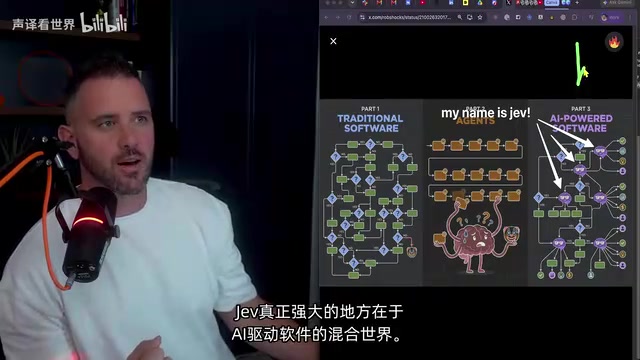
Jev's most compelling positioning is filling the gap between deterministic software and non-deterministic agents.
Traditional software is deterministic — pure if/then/else gating logic. Agents are highly flexible but non-deterministic, with no guarantee they'll always get it right or follow the plan. Jev's power lies in serving the "hybrid world of AI-driven software": embedding a model like Jev within a deterministic framework to handle those decision points that can't be managed with purely deterministic methods.

The video demonstrates several typical scenarios:
- Model router: Classify a task and determine which model to use
- Guardrail replacement: Instead of using a sub-agent for safety review, let Jev handle it at lightning speed
- Tool call decisions: Which tool should an agent use, and with what confidence — highly relevant for MCP and CLI use cases
In a helpdesk ticket-routing example, inputting a ticket like "no one has responded to my WiFi report in over a week," combined with context like user role, location, and channel, the model returns a priority judgment (medium priority), an assigned department, and a probability for control questions like "does this mention a deadline" (5% true).

"Calibrated decision RL" targets a core flaw in existing LLMs: overconfidence. After RLHF (Reinforcement Learning from Human Feedback) training, general-purpose large models tend to give answers that sound fluent and certain — even when internal uncertainty is high, confidence scores skew upward, leading to "mode collapse" where the model outputs a small set of fixed answers across diverse inputs. TypeSafe redesigned the training objective to maintain calibration between the model's output probabilities and actual accuracy rates — meaning if the model predicts 70% confidence, the real accuracy should also be close to 70%. These calibrated probabilities are meaningful for downstream deterministic code: developers can set thresholds (e.g., confidence below 60% gets routed to human review), allowing the entire system to degrade gracefully under uncertainty rather than failing silently.
Real-World Tests and Use Cases
The video showcases multiple real-world demonstrations. In a smart home demo, natural language commands like "turn off all the lights," "turn on the living room light," and "start brewing the coffee" were processed by Jev in approximately 185 milliseconds, returning structured instructions as lights and devices responded in real time.
For a more extreme example: Jev was connected to Doom and ran live for an hour with an astonishing number of invocations — total cost was around $7. System 1 (fast intuition) receives a structured description of the game state in real time, and the model responds with structured instructions. Other cases include completing missions in StarCraft, and the OpenCode team using it to test browser operations.
Community adoption is also active: YouTuber Vogel used it to classify and prioritize hundreds of emails in seconds — a task that would have taken far longer with a conventional LLM. There's also a "six degrees of separation" test where the model navigated between Wikipedia pages looking for links, with TypeSafe completing it in 1.7 seconds.
What This Means for Developers
Jev didn't position itself as a general-purpose model. Instead, it carved out an extremely narrow but extremely deep niche. It may not be the smartest model, but on the dimension of "cost per workflow," it pushes to an extreme — making large-scale deployment economically viable and unlocking entirely new categories of companies and workflows.
If you're building AI-driven software, it's worth asking yourself: which high-frequency decision flows in your system are consuming significant time and real money? Replacing those yes/no judgments with something faster, cheaper, and structured in both input and output could make a surprising difference.
Access isn't hard to get — the video's author reportedly waited only a few hours on the waitlist before getting access, after which they could use the playground, API keys, and install it directly into Claude Code. As more "ultra-fast, ultra-cheap" decision models continue to emerge, the architectural paradigm for AI software may be in the process of being fundamentally redefined.
Related articles

NVIDIA cuML Accelerates Spectral Clustering: 100x+ Speedup Over Scikit-Learn Benchmarked
NVIDIA cuML lets Scikit-Learn spectral clustering run on GPU without code changes, delivering 200x+ speedups on large datasets. Learn how it works and how to use it.

Google DeepMind Launches New Institute to Bring the AGI Debate into the Open
Google DeepMind has launched a new institute to bring AGI debate into the public sphere. We analyze what this signals about the shift from technical competition to AI governance.
How Cooley Is Reinventing IPO Legal Workflows with ChatGPT: A Look at the GO Public Tool
Cooley built GO Public on ChatGPT Work to accelerate IPO legal workflows, helping lawyers catch issues earlier and focus judgment where it matters most.