Uber and Zipline Launch Drone Delivery in Houston

Uber Eats and Zipline's drone delivery launches in the Houston suburb of Spring, with plans to expand to dozens of cities.
Uber Eats and Zipline's drone delivery service has officially launched in Spring, a suburb of Houston—the first project to go live since the partnership was announced and Uber invested in Zipline. Dallas will be the next launch city, followed by plans to expand to dozens of U.S. cities. The article notes that choosing a suburb for the launch is related to local airspace conditions and low-density delivery demand, with drones able to more efficiently cover areas that ground delivery struggles to reach quickly. At the same time, scaling still faces challenges including airspace regulation, community acceptance, weather impacts, and infrastructure investment; in the short term it is better suited to small, lightweight orders, and whether it becomes a mainstream option depends on changes in user usage frequency and operating costs.
Uber Eats and Zipline's drone delivery service has officially launched in Spring, a suburb of Houston. This is the first project to go live since the two companies announced their partnership and Uber made an investment in Zipline. Dallas will follow next, with plans to expand to dozens of U.S. cities in the future.
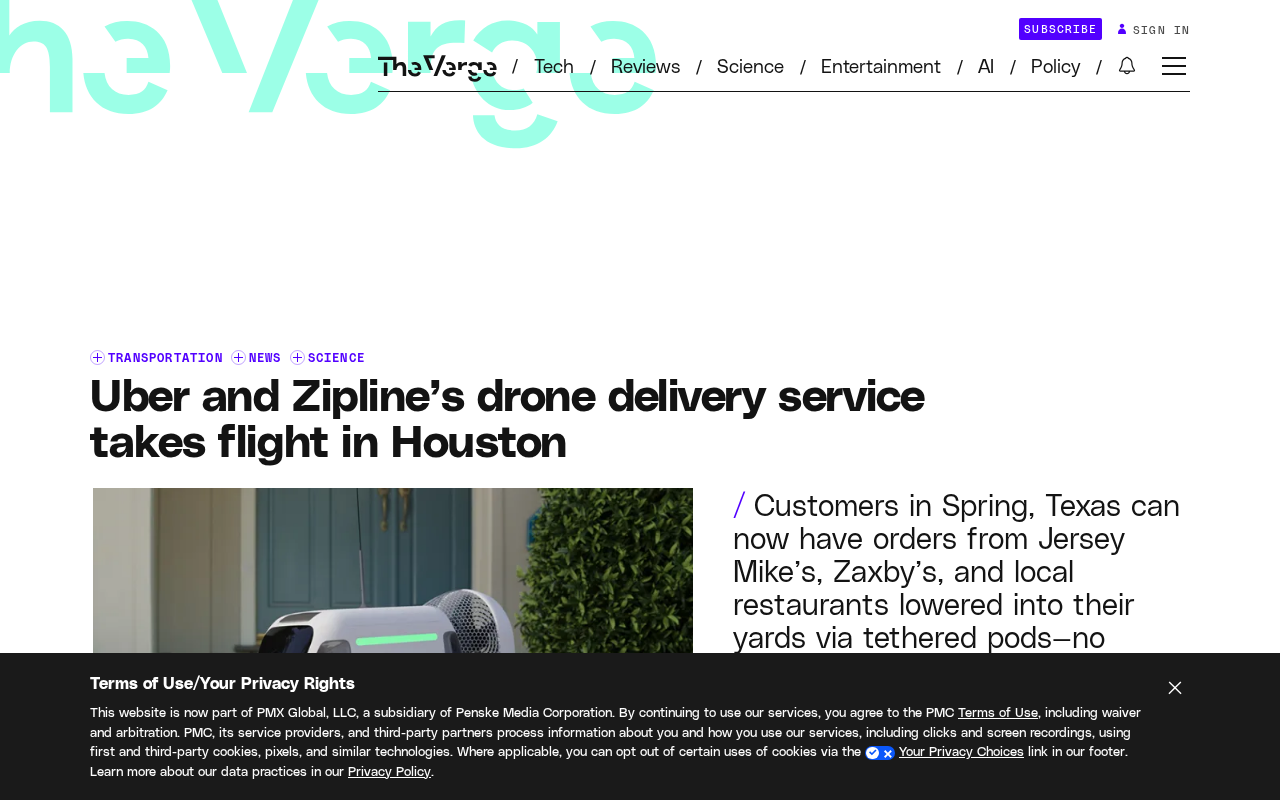
Partnership Goes Live: From Investment to Real Service
The Uber-Zipline partnership is more than a simple service integration. When the two companies announced their collaboration, Uber also invested in Zipline, signaling a long-term bet on the drone delivery space. Now that partnership has finally become a real service, first made available to users in the Houston suburb of Spring.
Choosing Spring as the launch site may be related to local airspace conditions and suburban delivery demand. Suburban areas have lower user density and relatively simpler ground traffic, allowing drone delivery to more efficiently cover areas that traditional delivery struggles to reach quickly.
Who Is Zipline
Zipline is a U.S. drone delivery company founded in 2014. It initially gained recognition for using fixed-wing drones to transport blood and vaccines in African countries such as Rwanda and Ghana, then expanded to medical supply and retail delivery in the United States. Its drones use fixed-wing aircraft with parachute drops or hover-and-rope drops, offering greater range and wind resistance than common multirotor models—this is the technical foundation that enables it to serve low-density suburban areas. Uber's investment in Zipline is essentially a bet on a drone operations system already validated through cross-border medical logistics, rather than building one from scratch.
Expansion Roadmap: Dallas and Dozens of Cities
Uber isn't stopping at Houston. According to official information, Dallas will be the next launch city, after which the service is planned to roll out to dozens of U.S. cities. This expansion pace suggests that Uber and Zipline are confident in the model's replicability.
However, scaling drone delivery still faces real challenges such as airspace regulation, community acceptance, and weather impacts. Going from a single suburb to dozens of cities across the country will require solving no small number of operational details.
The U.S. Regulatory Framework for Drone Delivery
The core constraint on scaling drone delivery in the U.S. comes from the Federal Aviation Administration (FAA) rule system. Routine operations must follow Part 107, which in principle requires drones to fly within the operator's visual line of sight and prohibits flying over people; to achieve routine beyond-visual-line-of-sight (BVLOS) delivery, operators need waivers or must obtain certification under Part 135 air carrier standards. In recent years, the FAA has been gradually establishing rules for BVLOS flight and drop operations through processes such as the Part 108 rulemaking. This is why drone delivery tends to launch first in suburbs and low-density airspace—those areas more easily meet regulators' risk-control requirements, while downtown airspace and population density create higher compliance barriers.
Industry Impact: A New Variable in On-Demand Delivery
Drone delivery is seen as a potential supplement to on-demand delivery, especially in food delivery scenarios, where it can shorten delivery times and reduce dependence on ground traffic. As a mainstream food delivery platform, Uber Eats' large-scale experiment could push more platforms to follow suit.
In the short term, however, drone delivery is better suited to small, lightweight orders, and its cost structure differs from traditional delivery. Whether it can become a mainstream option will depend on observing changes in actual user usage frequency and operating costs.
The Cost Structure of Drone Delivery
Drone delivery costs are fundamentally different from traditional courier delivery. Costs consist mainly of fixed investments (aircraft models, takeoff/landing stations or micro-fulfillment centers, charging and maintenance facilities) and variable costs (battery wear, operations labor, per-order drop consumables). Marginal costs decline as order volume rises, but only if a single site has enough order density to spread fixed costs. By contrast, labor-based delivery costs are almost linearly related to order volume. This means drone delivery is economically better suited to scenarios with concentrated orders, higher average order values, or time sensitivity, while low-density, low-frequency areas may depend on subsidies for a long time. Understanding this helps assess the feasibility boundaries as it moves from suburban pilots to dozens of cities.
Challenges and Outlook
Despite the promising outlook, widespread adoption of drone delivery still must overcome regulatory approvals, accumulated safety records, and infrastructure investment. The Uber-Zipline launch is an important step, but there is still a long way to go before realizing the vision of "dozens of cities."
For readers interested in AI and automated logistics, this partnership is worth following closely, because it concerns not only delivery efficiency but also the infrastructure and rule-making for the urban low-altitude economy.
One-line Summary
Uber Eats and Zipline's drone delivery launches in the Houston suburb of Spring, with plans to expand to dozens of cities.
Paragraph Summary
Uber Eats and Zipline's drone delivery service has officially launched in Spring, a suburb of Houston—the first project to go live since the partnership was announced and Uber invested in Zipline. Dallas will be the next launch city, followed by plans to expand to dozens of U.S. cities. The article notes that choosing a suburb for the launch is related to local airspace conditions and low-density delivery demand, with drones able to more efficiently cover areas that ground delivery struggles to reach quickly. At the same time, scaling still faces challenges including airspace regulation, community acceptance, weather impacts, and infrastructure investment; in the short term it is better suited to small, lightweight orders, and whether it becomes a mainstream option depends on changes in user usage frequency and operating costs.
Related articles

Zed Editor Releases v1.29.2: Observations on a Routine Version Iteration
Zed editor releases patch v1.29.2, version bump by @JosephTLyons, commit verified via GitHub signature. This article covers the release's basic info, what a patch version means, and practical upgrade advice for users.

Anthropic IPO Questioned: Hacker News Debates Timing of Going Public
A Hacker News post titled "Just say no to Anthropic's IPO" sparks debate on the timing of Anthropic's public listing and AI capitalization, touching on valuation bubbles and mission independence.

Hands-On with the Genie 4 World Model: Directing Worlds in Real Time Like a Puppeteer
Google DeepMind's Genie 4 world model in depth: Special Guest X's hands-on demo of real-time scene direction via prompts, custom interactive apps in Project Genie, and prompts-as-seeds reproducibility.