Ultracite v8: The Zero-Config Linter Built for AI Agent Programming

Ultracite v8 is a zero-config linter built for AI agent programming that catches low-quality code sub-second.
Ultracite v8 is a zero-config code checking and formatting tool for AI agent programming, created by Hayden Bleasel, which earned 80 upvotes and ranked 8th on Product Hunt. Built on Oxlint, Biome, and ESLint presets, it checks every agent edit against hundreds of strict rules in under half a second, ensuring code review receives well-formed, type-safe code rather than low-quality output. The article notes that agent programming is fast and high-volume, making line-by-line human review impractical, so an automated quality gate is needed; fast feedback gives agents a "generate—check—fix" loop. The official page says teams at OpenAI, Vercel, Mintlify, and thousands of open source projects use it, but no specific scale is disclosed. The author stresses that a linter can only constrain style and types, not judge business logic, so it should be seen as a quality gatekeeper rather than a universal cure.
When AI Agents Write the Code, Lint Tools Need a Redesign
AI coding assistants are changing the software development workflow. More and more code is no longer typed entirely by hand—it's generated by agents like Claude Code, Cursor, and Copilot. This raises a new question: how do you ensure the code these agents produce is consistent in style and type-safe?
Ultracite v8's answer is a zero-config code checking and formatting tool designed specifically for "agent programming." According to its Product Hunt page, it builds presets on top of Oxlint, Biome, and ESLint, and can check every edit an agent makes against hundreds of strict rules in under half a second—ensuring that what reaches code review is well-formed, type-safe code rather than "slop."
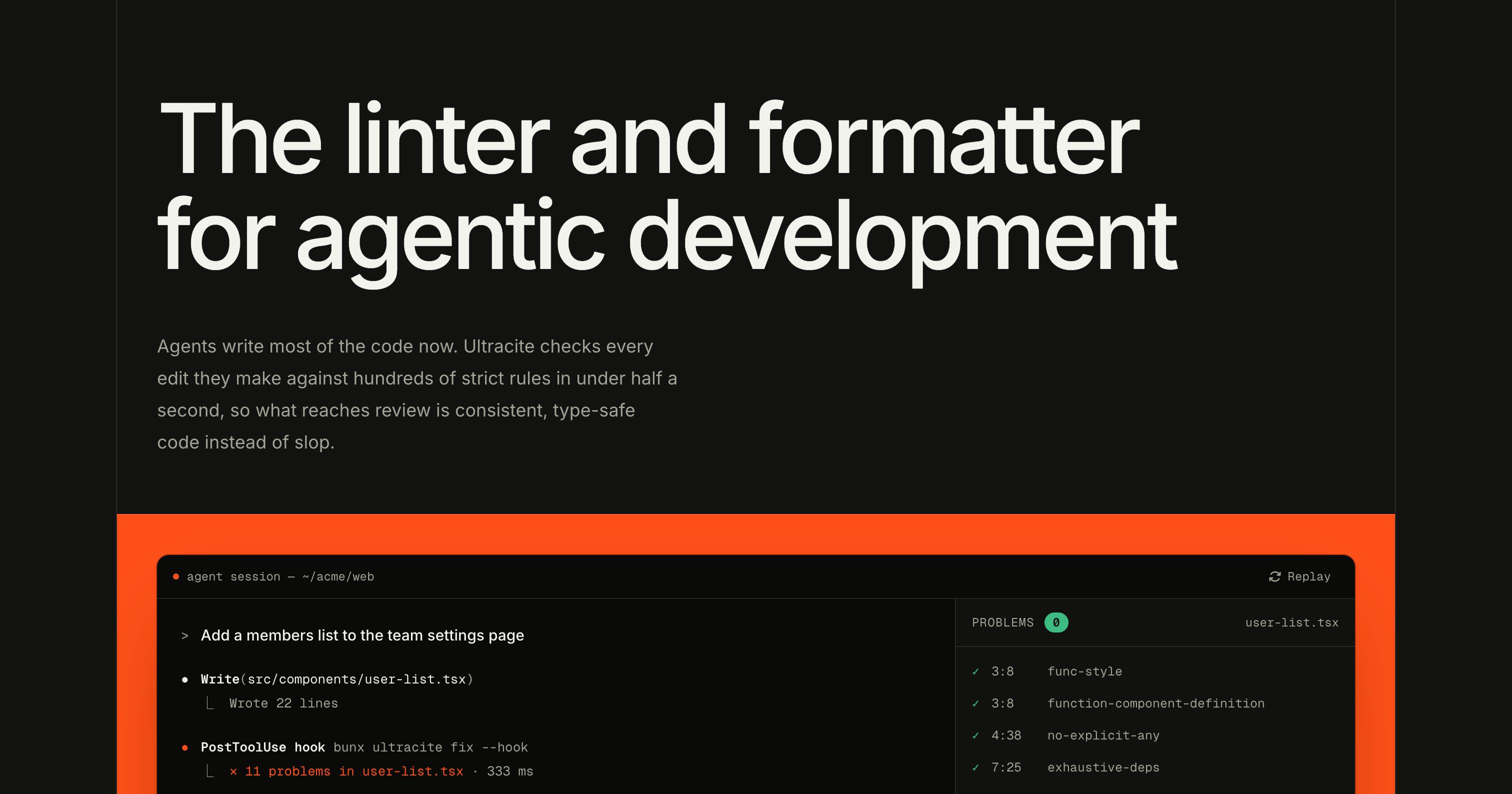
Developed by Hayden Bleasel, the product earned 80 upvotes on Product Hunt and ranked 8th for the day, categorized under open source, developer tools, and GitHub. The page also notes that engineering teams at OpenAI, Vercel, and Mintlify, along with thousands of open source projects, are using it.
Why Agent Programming Needs a Dedicated Linter
Traditional linters assume "a human is writing the code," so their rules lean toward style preferences and common mistakes. But agent programming has different pain points: an agent may generate a large amount of code in a single conversation—fast and voluminous—making line-by-line human review impractical. Without an automated quality gate, the subtle inconsistencies agents produce—missing type annotations, messy import ordering, overlooked edge cases—quickly accumulate into technical debt.
Ultracite is positioned as exactly that gate. It emphasizes "zero config": developers don't need to hand-pick rules one by one, because the presets come with a strict rule set built in and work out of the box. For agents, this means immediate feedback after every edit, forming a "generate—check—fix" loop.
The Division of Labor Between Linters and Formatters: A Linter handles static analysis, catching potential errors, bad patterns, or code that violates team conventions—such as unused variables, unsafe type assertions, or suspicious async calls. A Formatter only deals with pure layout concerns like whitespace, indentation, quotes, and line breaks. The two are often confused, but the distinction matters in agent programming: the Formatter keeps code visually consistent, while only the Linter can intercept semantic-level hazards. Ultracite provides both checking and formatting, meaning that after every edit the agent's output is both uniformly formatted and reviewed against the rule set—reducing back-and-forth manual fixes.
How Oxlint, Biome, and ESLint Relate: All three are static analysis tools in the JavaScript/TypeScript ecosystem, but with different positioning. ESLint is the oldest with the richest plugin ecosystem, but it suffers from complex configuration and slower performance on large projects. Biome, written in Rust, combines Linter and Formatter into one, emphasizing out-of-the-box usability and performance. Oxlint is also Rust-based, focused on extremely fast checking, and is often used as an acceleration replacement or complement to ESLint. As a preset layer, Ultracite interfaces with all three, letting teams choose the underlying engine that fits their existing toolchain without overturning their current configuration.
Speed Is Key: A Feedback Loop Under Half a Second
Agent programming moves far faster than manual coding. If lint checks take seconds or longer, the agent's iteration efficiency gets dragged down. Ultracite claims to complete checks in under half a second, thanks to its use of high-performance tools like Oxlint under the hood.
Fast feedback is especially important for agent workflows: an agent can perform multiple consecutive edits within a single task, each passing through checks, eliminating most low-level issues before submission. This eases the burden on human reviewers and makes the agent's output more predictable.
Why the Language of the Underlying Engine Affects Speed: Traditional ESLint runs on Node.js with rules implemented in JavaScript, and when many rules are enabled at once, the overhead of parsing and traversing the AST (abstract syntax tree) grows with project size. Oxlint and Biome rewrite the core parsing and rule execution paths in Rust and can process files in parallel across multiple threads, so they're typically an order of magnitude faster with the same number of rules. Ultracite's claimed sub-second checking relies fundamentally on this native-engine performance dividend; no matter how strict the rule set, as long as execution is fast enough, the agent's "generate—check—fix" loop won't be blocked.
Multi-Engine Support and Ecosystem Compatibility
Ultracite doesn't start from scratch—it exists as a preset layer for Oxlint, Biome, and ESLint. This design lets it integrate into existing frontend and Node.js ecosystems, so teams can get a rule set tailored for agent programming without switching toolchains. For projects already using ESLint or Biome, migration costs are low; for teams chasing performance, Oxlint offers a faster underlying engine.
Judging from the product information, Ultracite's core value isn't inventing new checking capabilities but packaging "strict rules suited to agent programming" into ready-to-use presets that lower the barrier to adoption.
What a Preset Means: In the context of lint tools, a preset is a preconfigured set of rules and options that users adopt without enabling rules or tuning parameters one by one. Its value lies in codifying decisions like "which rules to enable and how strict to make them" into reusable configuration, lowering the cost of standardizing across a team. Ultracite's presets raise strictness for agent programming scenarios—for example, enforcing explicit type annotations and standardizing import order—which differs from the orientation of general recommended configs, which tend to be more lenient for compatibility's sake.
Who Uses It, and Its Boundaries
According to the official page, engineering organizations at OpenAI, Vercel, Mintlify, and others are among its users, along with thousands of open source projects. These names add credibility, but note that the product page doesn't disclose specific usage scale or case details, so there's still a gap between "being used" and "deeply relied upon."
Another point to view rationally: a Linter can only ensure code conforms to rules—it can't judge whether business logic is correct. What Ultracite reduces is style-and-type-level "slop"; architectural flaws or misread requirements in agent-generated code still require human review and test coverage. Treating it as a quality gatekeeper on the agent programming pipeline—not a universal cure—is the more accurate framing.
What It Means for Developers
If you're using AI agents to write code, two Ultracite features are worth your attention: the low adoption cost of zero config, and the smooth experience of sub-second checks. It represents a trend—development tools are shifting from "helping humans write code" to "constraining agents writing code." As agents take on more coding work, agent-oriented code quality tools like this may become standard equipment.
Ultracite v8 is now live at ultracite.ai, and its open source nature makes it easy for teams to evaluate and customize.
Related articles

Qwen 4 First Test Leaks: Performance Rivals Opus 5.5, DeepSeek V4 Series Surfaces
Early Qwen 4 test outputs leak, with front-end generation said to rival Opus 5.5; DeepSeek V4 Mini, Flash, and Pro names appear in a code repo; Ant Group's Ling-3.1-flash surfaces too. Here's the latest on model tiering and on-device lightweight models.

OpenCode Makes DeepSeek V4.1 Flash Free, AI Daily Roundup
AI daily roundup: OpenCode makes DeepSeek V4.1 Flash free, StepFun Step5 Preview and Ling 3.1 Flash open-sourced, Grok Voice 3.0 tops speech leaderboard, Matrix Game 4.0 open-sourced, and the EU opens its first AI Act enforcement probe into OpenAI and Anthropic.

DeepSeek V4.1 Flash 1017 Released: Reasoning and Coding Upgrades, Search and Fetch API Now Available
DeepSeek releases V4.1 Flash 1017 with major gains in reasoning, coding, and agentic tasks, plus web search and fetch APIs at 5 yuan per 1,000 requests. Tencent Hunyuan open-sources High Memory 2.0, Perplexity open-sources multimodal decision models, and MOFCOM seeks comments on AI export catalog.